FALASTEEN · The complete table of contents

Contents

الفهرس

A room of the archive

The Record

السِّجل

AcreAcreBir al-SabaBir al-SabaGaza CityGaza CityHaifaHaifaHebronHebronJaffaJaffaJerusalemJerusalemNablusNablusal-MajdalBethlehemBethlehemJeninJeninJerichoJerichoKhan YounisKhan YounisLyddaLyddaNazarethNazarethRafahRafahRamallahRamallahal-Ramlaal-RamlaSafadSafadTabariyyaTabariyyaTulkarmTulkarmBeit HanounBeit HanounDeir al-BalahDeir al-BalahJabaliaJabaliaQalqilyaQalqilyaal-Birehal-Birehar-Ramar-RamBeit HaninaBeit HaninaKufr 'AqabKufr 'AqabQalandiyaQalandiyaSheikh JarrahSheikh JarrahShu'fatShu'fat

Drag the map · click a village · ⌘-scroll to zoom Or use the arrow keys to move over the country, plus and minus to zoom, and Enter to open the village at the centre.

village with a record here documented, record to come city or townBoundaries: Natural Earth (public domain) · Villages and city coordinates: Wikidata (CC0) · Place geocoding: © OpenStreetMap contributors (ODbL)

Vol. I · Est. MMXXVI · A public trust

A living archive for Palestine

أرشيف حيّ من أجل فلسطين

The documented record, the poetry, the names, and the land — searchable, citable, and free forever. Every village on the map has a sourced coordinate, and every one of them opens.

The registry

72,835

people killed in Gaza who have been named and certified — each with a national ID number, a date of birth and an age, each held on one scrollable wall so that no one becomes a number.Read the wall →

A floor, not a toll

This is the number of people who could be named — each with a national ID number, a date of birth and an age. It is not the number of people killed. The Ministry of Health counts violent deaths only, and certifies a death individually or not at all. Starvation and untreated disease are excluded by policy. The named list does not capture every missing, unrecovered or still-unidentified person; some under-rubble deaths can enter after family reporting and verification, so published estimates cannot be added without checking overlap.

Two independent peer-reviewed studies put the undercount of violent deathsalone at between34.7% and41%. Deaths from every other cause are on top of that, and no one has measured them for the whole period.The full accounting →

curated entries
779curated entrieswritten, sourced and cross-linked by hand
villages on the Atlas
425villages on the Atlaseach at a source-verified coordinate
poets and poems
53poets and poemsthe verse a century has kept against forgetting
testimonies
27testimoniessurvivors, in their own words, not summarised

Where to give

العطاء

Independent organisations working in Palestine — relief, medicine, and legal defence. This archive is not affiliated with any of them, takes nothing from them, and does not speak for them. Every link goes to the organisation’s own site. Look into any of them yourself before you give.

Every link opened and checked by hand on 5 August 2026. FALASTEEN.AI takes no commission, collects no donations, and runs no fundraising of its own —how this archive works.

IIThe ongoing record

Gaza, by name

غزة، بالاسم

Governments count in tens of thousands. We count one by one — Sidra, Khaled, Hind — and the full documented list of 72,835 names sits in the Registry, searchable.

IIIMemory

The villages of 1948

More than four hundred Palestinian villages were depopulated. Their names are kept here, and on the Atlas — each at the coordinate where it stood, each opening onto whatever the archive holds about it: who was born there, who testified, what remains.

In memoriam

“If I must die,
you must live
to tell my story.”

Refaat Alareer, Gaza. Read the poem, and remember the medics, journalists and teachers who were killed doing their work.

Enter the memorial

The village work map

425 village records, now a map you can use

The map is also a public work queue. Choose a village to open its written record, locate an Atlas-only site, or bring a source for work that remains unfinished.

Village index1948 layer · Record status
Historic Palestine with 425 village coordinate records from the Atlas's 1948 layerGold-ringed marks connect to written archive records. Hollow marks identify coordinate records whose written pages remain open research work.
Written recordMiska
Page availableResearch open

The villages of 1948

Choose a village. Follow the record.

Each mark is a mapped coordinate record. Some open a sourced village page; others show where research is still unfinished. Tap a mark to see what the archive holds.

Atlas records
425
With pages
184
Research open
241

184 coordinate records connect to written pages. 5 additional written village records are not represented in this 1948 coordinate layer.

Data and boundary notes

Marks encode Atlas coordinate records and whether a written archive page is available. The source has one record per Wikidata item; nearby or duplicate entries can represent the same place. Five marks sit beyond this approximate modern boundary and remain visible. The land’s cut-paper depth is decorative. When several records share one tap area, lifted tabs separate those real choices; neither treatment shows terrain or elevation. The boundary is a modern approximation of Mandatory Palestine derived from present-day Natural Earth boundaries, not a digitised Mandate-era survey.

Boundaries: Natural Earth (public domain) · Villages and city coordinates: Wikidata (CC0) · Place geocoding: © OpenStreetMap contributors (ODbL)

The inheritance

A dress was an address

التطريز والزيّ الفلسطيني

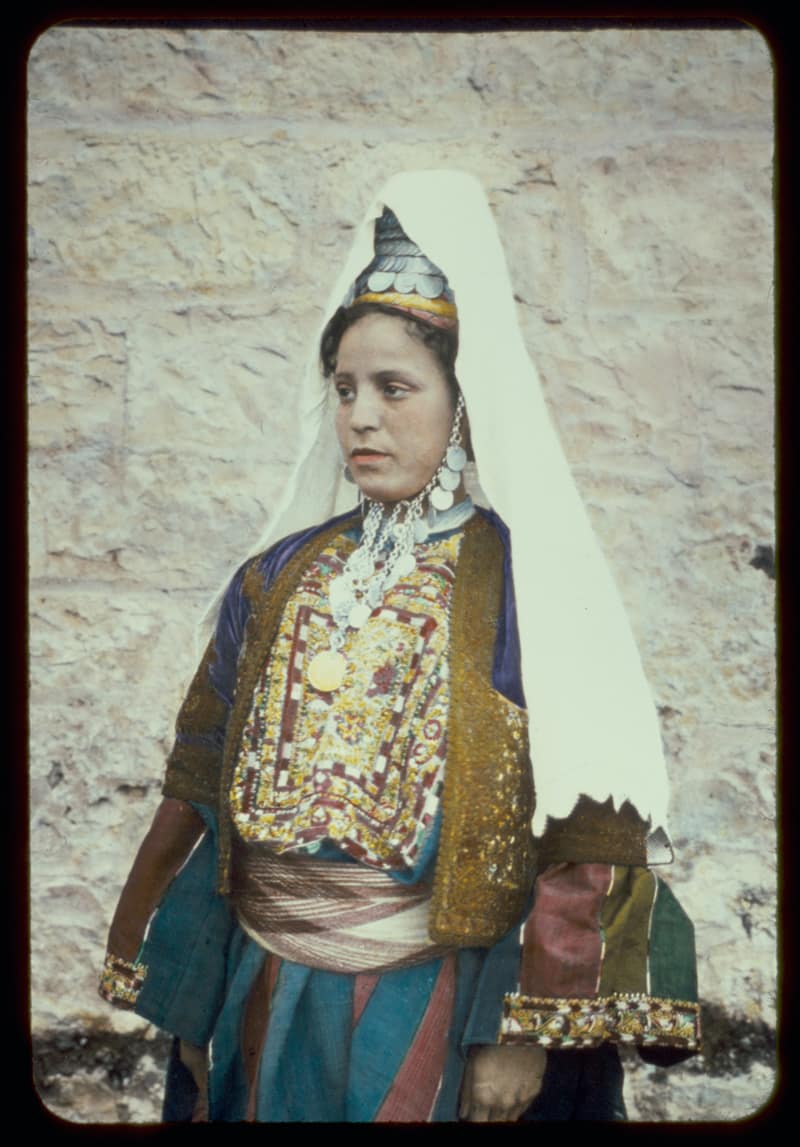
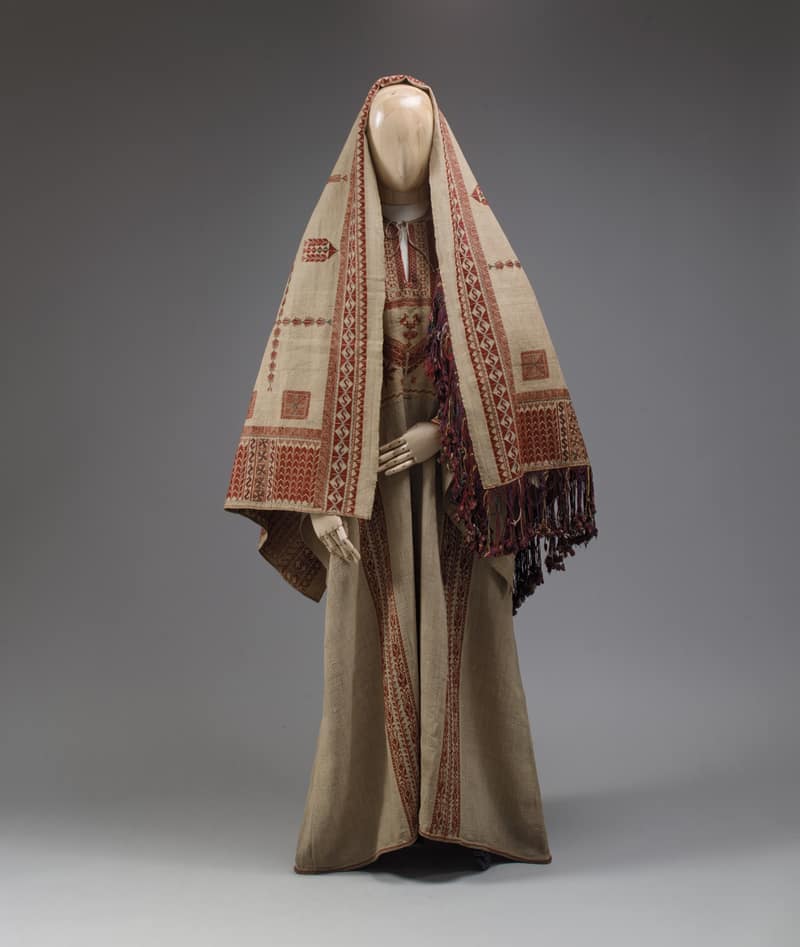
Until 1948 you could tell where a Palestinian woman came from by looking at her: the cut of her dress, the colour of her thread, the shape of the cap on her head. The chest panel was worked separately and moved from dress to dress, so a woman could wear her mother’s stitching on her own linen. This was not folklore assembled after the fact. It was a working system of regional difference, elaborate enough that a stranger could place a woman at a glance — and old enough that the photographers who arrived in the 1890s found it already long settled.

A woman in Bethlehem dress stands against a limestone wall. She wears a tall conical cap covered in silver coins under a long white veil, a chain of coins under her chin, a densely embroidered chest panel in red, gold and white, a gold-worked jacket and a striped sash.
Bethlehem. The shatweh — a stiffened conical cap sewn with the coins of the wearer's own dowry — worn under the veil, above a chest panel couched in silk and gold. Matson Photo Service colour slide; the Library of Congress dates this part of the collection between 1950 and 1977 (matpc.23087) · Source file on Wikimedia Commons for “A woman in Bethlehem dress stands against a limestone wall. She wears a tall conical cap covered in silver coins under a long white veil, a chain of coins under her chin, a densely embroidered chest panel in red, gold and white, a gold-worked jacket and a striped sash.”
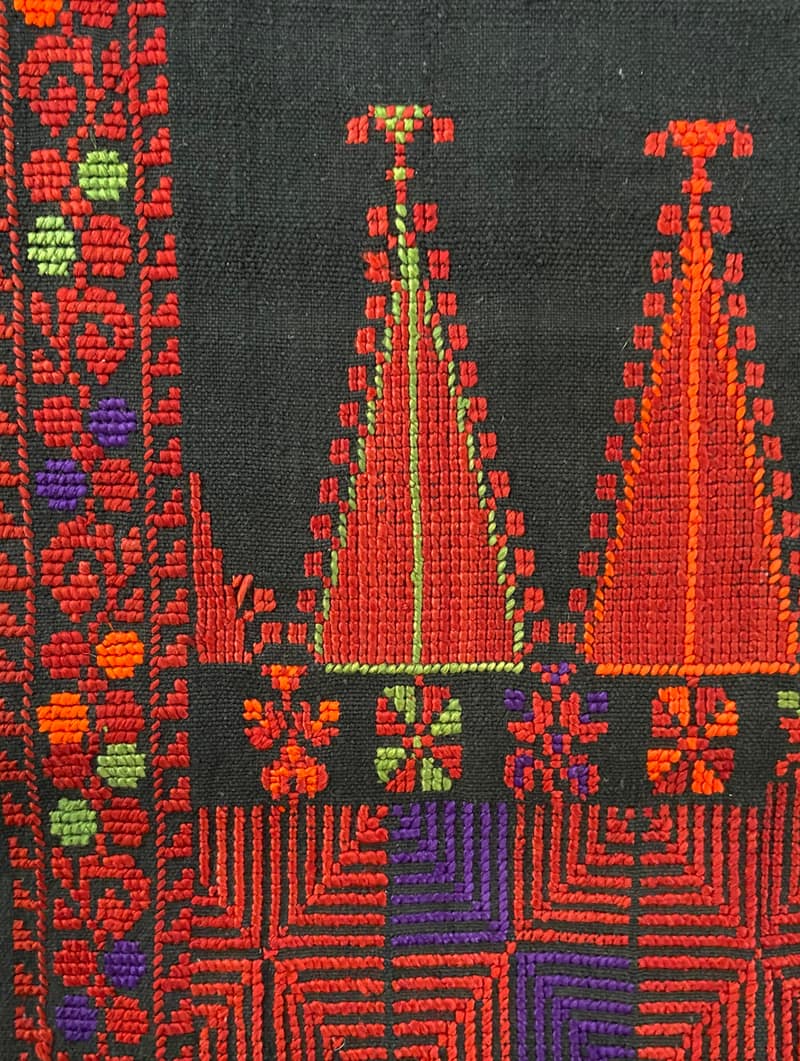
Detail of cross-stitch embroidery on black linen: two tall triangular cypress trees in scarlet with green cores, a band of small eight-petalled flowers beneath them, and a border of red, orange, green and purple blossom down the left side.
Jaffa district. Cypress trees and moons, cross-stitched in silk on black linen. Motifs carried names and belonged to places; a pattern could be read back to the district that used it. Photograph by Ma’moun Othman · CC BY-SA 4.0 · Source file on Wikimedia Commons for “Detail of cross-stitch embroidery on black linen: two tall triangular cypress trees in scarlet with green cores, a band of small eight-petalled flowers beneath them, and a border of red, orange, green and purple blossom down the left side.”
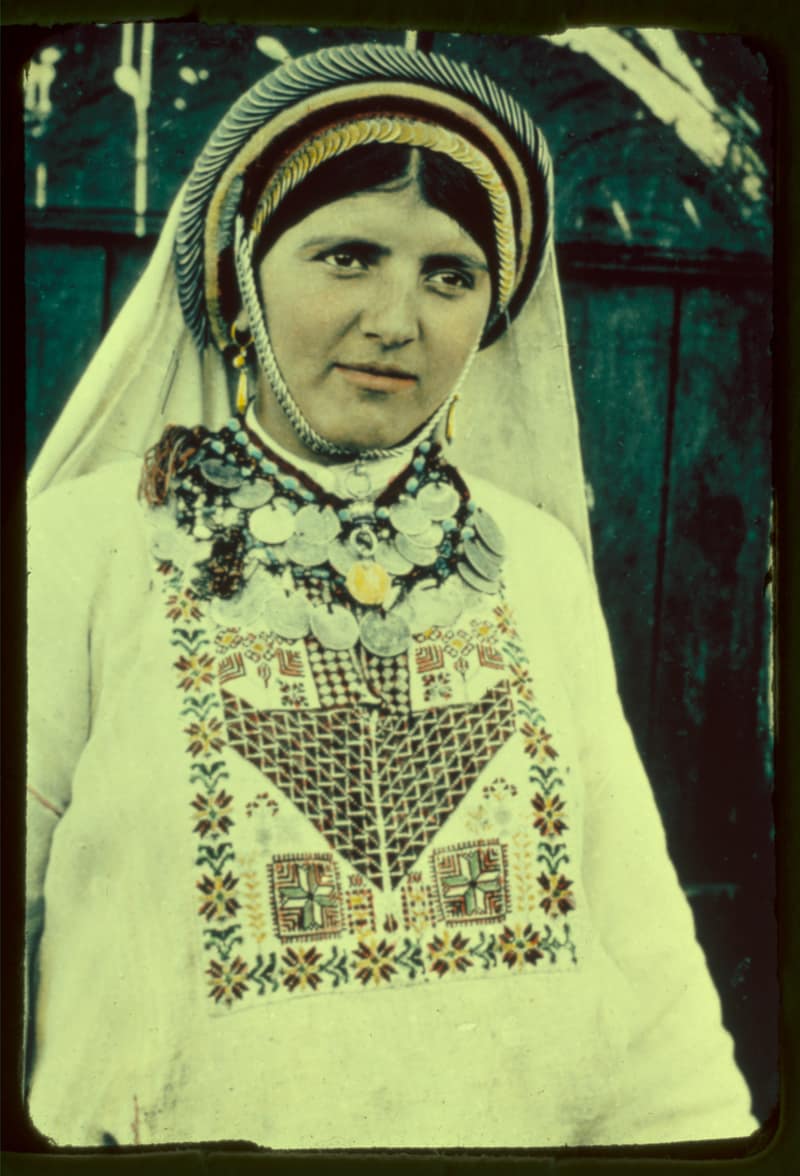
A woman in Ramallah dress photographed in colour. A padded cap ringed with rows of silver coins sits over her parted hair beneath a white veil; a heavy coin necklace lies at her throat, and the chest of her undyed linen dress carries a square panel of red, green and gold cross-stitch.
Ramallah. The smadeh, a padded cap ringed with silver, and a qabbeh cross-stitched in silk on undyed linen — motif and cap together named the district. Matson Photo Service colour slide; the Library of Congress dates this part of the collection between 1950 and 1977 (matpc.23089) · Source file on Wikimedia Commons for “A woman in Ramallah dress photographed in colour. A padded cap ringed with rows of silver coins sits over her parted hair beneath a white veil; a heavy coin necklace lies at her throat, and the chest of her undyed linen dress carries a square panel of red, green and gold cross-stitch.”
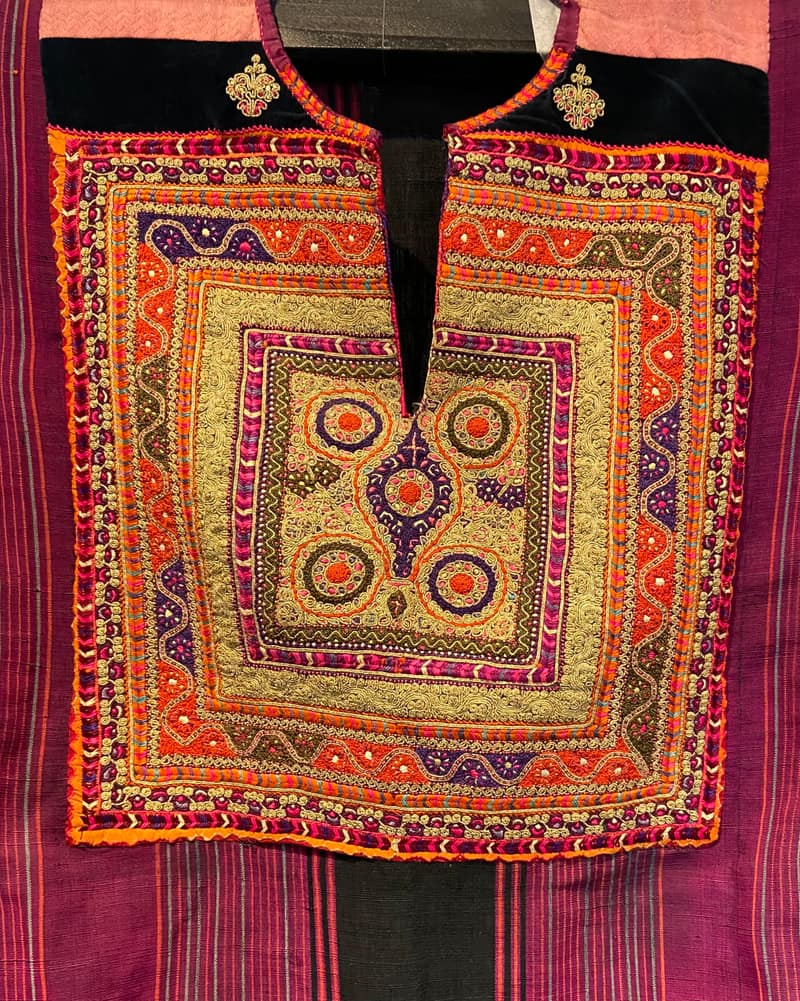
The embroidered chest panel of a Bethlehem dress, laid flat: concentric rectangular borders in orange, magenta, violet and gold cord surrounding four circular rosettes, set on black velvet above a striped purple ground.
Bethlehem, 1930s. A qabbeh in tahriri silk cord and qasab gold thread. Bethlehem couched its embroidery onto the surface rather than counting it into the weave — a technique out of church and court workshops. Tiraz: Widad Kawar Home for Arab Dress, Amman. Photograph by Ma’moun Othman · CC BY-SA 4.0 · Source file on Wikimedia Commons for “The embroidered chest panel of a Bethlehem dress, laid flat: concentric rectangular borders in orange, magenta, violet and gold cord surrounding four circular rosettes, set on black velvet above a striped purple ground.”
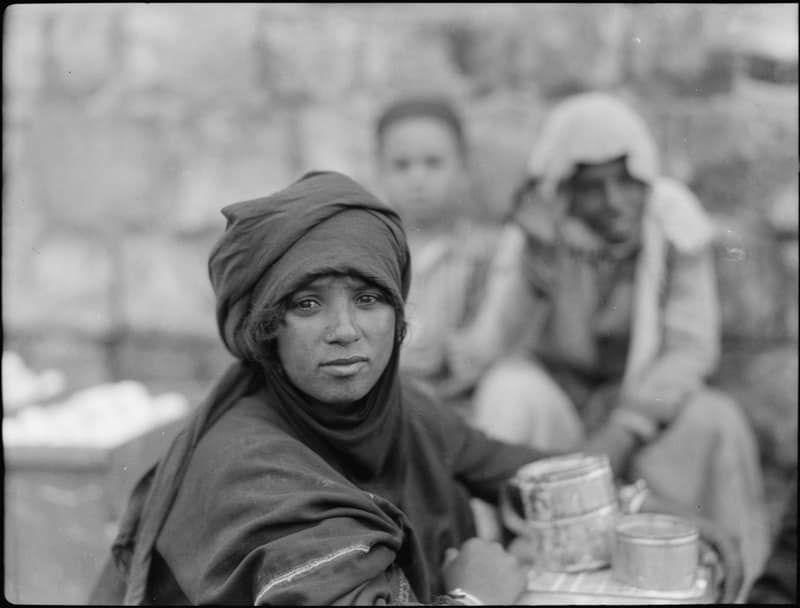
Close portrait of a young woman in a dark head-wrap looking directly at the camera, a small ring through her nose and a short dark mark below her lower lip. Two people and a set of metal vessels are out of focus behind her.
Tiberias, 1935. The Library of Congress catalogues this negative as “Bedouin girl in Tiberias with tatoo [i.e., tattoo] face” (matpc.16522) — a record of deqq, the marks tattooed at the chin, the lip and the backs of the hands · Source file on Wikimedia Commons for “Close portrait of a young woman in a dark head-wrap looking directly at the camera, a small ring through her nose and a short dark mark below her lower lip. Two people and a set of metal vessels are out of focus behind her.”
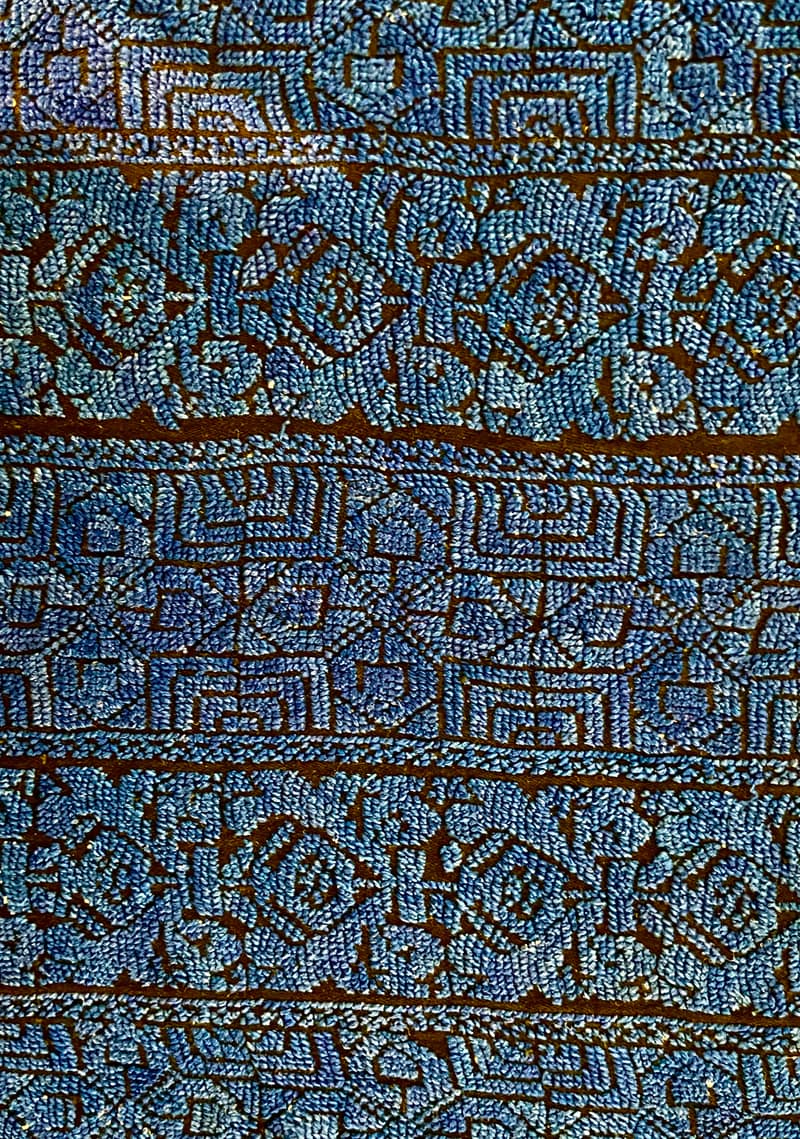
Dense bands of blue cross-stitch worked in geometric blocks across a dark brown ground, the pale blue thread almost covering the cloth.
Beersheba district. Blue was the thread of an unmarried woman or a widow; red and pink were worked in when a widow married again. The colour of the cloth stated a fact about the woman wearing it. Tiraz: Widad Kawar Home for Arab Dress, Amman. Photograph by Ma’moun Othman · CC BY-SA 4.0 · Source file on Wikimedia Commons for “Dense bands of blue cross-stitch worked in geometric blocks across a dark brown ground, the pale blue thread almost covering the cloth.”
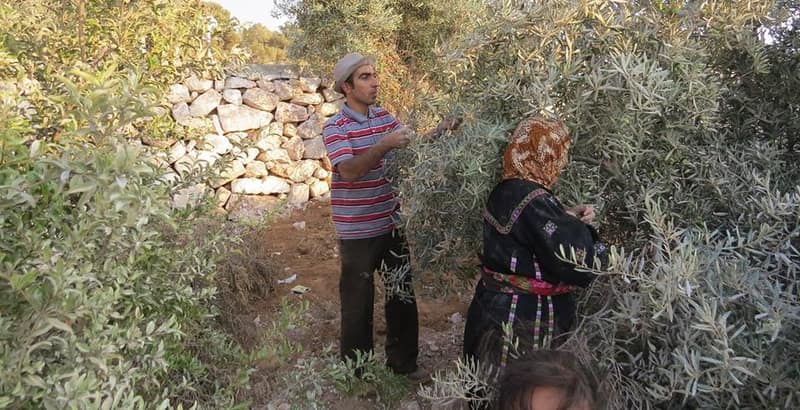
A man and a woman picking olives by hand in a grove beside a dry-stone wall. The woman wears an embroidered thobe and a patterned headscarf; a child stands at the edge of the frame.
Olive harvest, Palestine, 2014. The same work, the same month, the same dress worn into the grove — the embroidery is not in a case. Photograph by <span lang="ar" dir="rtl" class="font-arabic tracking-normal">بدارين</span> · CC BY-SA 4.0 · Source file on Wikimedia Commons for “A man and a woman picking olives by hand in a grove beside a dry-stone wall. The woman wears an embroidered thobe and a patterned headscarf; a child stands at the edge of the frame.”

Photographs from the Matson collection at the Library of Congress, garments from the Tiraz: Widad Kawar Home for Arab Dress in Amman and the Metropolitan Museum of Art. Licences are recorded per image.

The continuity

None of it stopped

الثقافة الفلسطينيّة الحيّة

Everything above this point is a record of what was done to Palestinians. The band before this one is a record of what Palestinians made. This is the part that is hardest to photograph and easiest to leave out: that the making never stopped — that the dance, the bread, the grain, the stitch and the language are being done today, by people who were never instructed to keep them and did not need instructing.

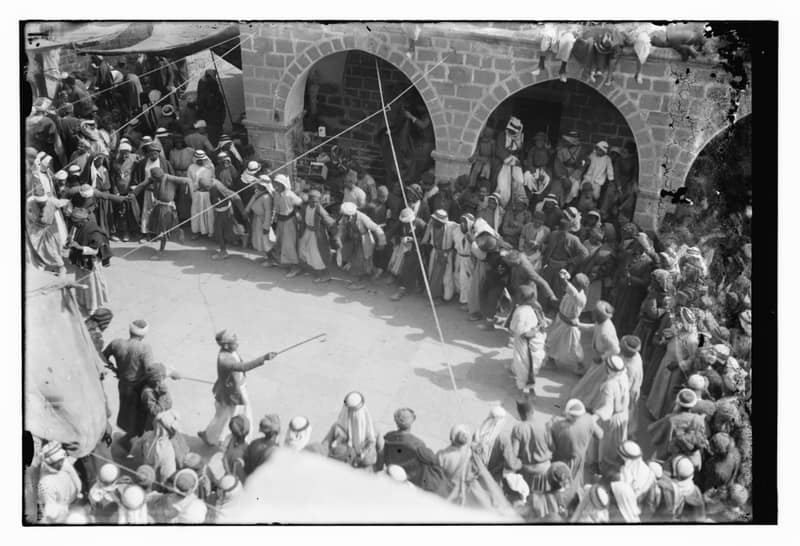
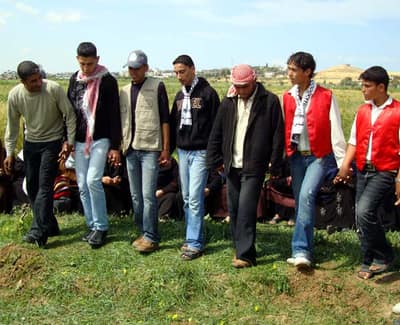
Look at the first two photographs together. A line of men with joined hands in a courtyard some time before 1948, and a line of men with joined hands in a Gaza field in 2009. That is not an echo and a source. It is one thing, done twice — somewhere between sixty and a hundred and ten years apart, with a catastrophe in between.
1898–1946

A dry-plate photograph looking down into a stone courtyard. Dozens of men in long robes and white head-cloths move in a long linked line with their arms joined, watched by a dense crowd standing under two arches and packed along the far wall. One man in the foreground holds a cane out at arm’s length.
The Nabi Musa season. Each spring in the week before Easter, Palestinians walked from Jerusalem to the shrine near Jericho — Hebron and Nablus sending their own flags ahead of them with bands of drums and cymbals — for a week of prayers, music, dancing and communal meals. The Library of Congress supplies the title “Peasants dancing before the Tomb of Moses” from the caption of a similar negative, and can date this one no closer than between 1898 and 1946; on its own sleeve someone had written “Arab protest demonstration.” At this mawsim those were not two different things. Matson Photograph Collection, LC-M32-50314-x · Source file on Wikimedia Commons for “A dry-plate photograph looking down into a stone courtyard. Dozens of men in long robes and white head-cloths move in a long linked line with their arms joined, watched by a dense crowd standing under two arches and packed along the far wall. One man in the foreground holds a cane out at arm’s length.”
2009

Seven young men in jeans, hoodies and keffiyehs stand shoulder to shoulder in a green field, hands joined in a line, stepping together. Other people sit on the grass behind them; low hills and buildings are visible on the horizon.
Gaza, 2009. Seven men, hands joined, dancing dabke in the fields to mark Land Day — 30 March 1976, the general strike against land confiscation in which six Palestinians were killed: Raja Abu Rayya, Khidr Khalayleh and Khadija Shawahna of Sakhnin, Khayr Yassin of Arraba, Muhsin Taha at Kafr Kanna, Ra’fat Zuheiri at al-Taybeh. The line and the joined hands are the ones in the photograph beside this. Photograph by ISM Palestine · CC BY-SA 2.0 · Source file on Wikimedia Commons for “Seven young men in jeans, hoodies and keffiyehs stand shoulder to shoulder in a green field, hands joined in a line, stepping together. Other people sit on the grass behind them; low hills and buildings are visible on the horizon.”

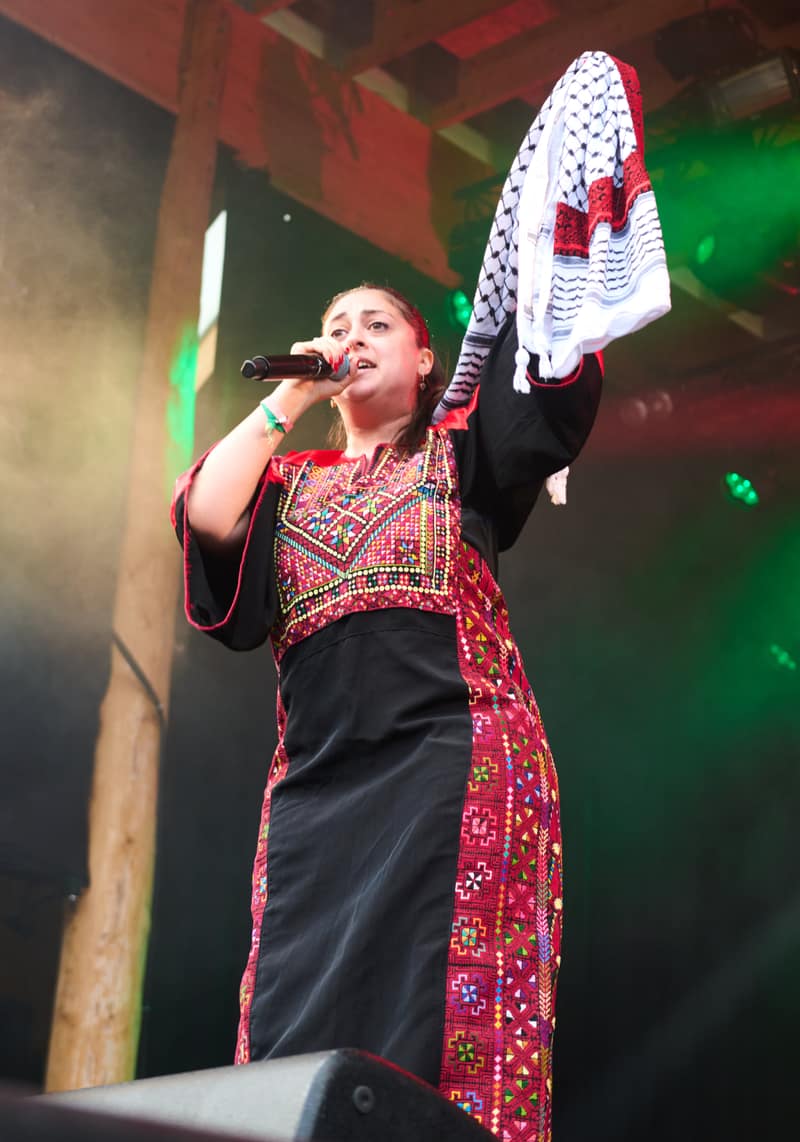
2025

A singer photographed from below on a stage under green lights, holding a microphone to her mouth and raising a black-and-white keffiyeh above her head. She wears a black thobe with a densely cross-stitched chest panel and a wide embroidered panel running the full length of the skirt.
Manndalen, northern Norway, 12 July 2025. Shadia Mansour on the Lávdi stage at Riddu Riđđu, the international Indigenous festival held annually in Sámi country. She entered the scene in 2002 as a teenager at Palestine protests in London; she raps and sings in Arabic; and, as the festival puts it, her signature is that blend “paired with performing in a traditional Palestinian thobe.” Photograph by Camilla Lorentsen for Riddu Riđđu · CC BY-SA 4.0 · Source file on Wikimedia Commons for “A singer photographed from below on a stage under green lights, holding a microphone to her mouth and raising a black-and-white keffiyeh above her head. She wears a black thobe with a densely cross-stitched chest panel and a wide embroidered panel running the full length of the skirt.”

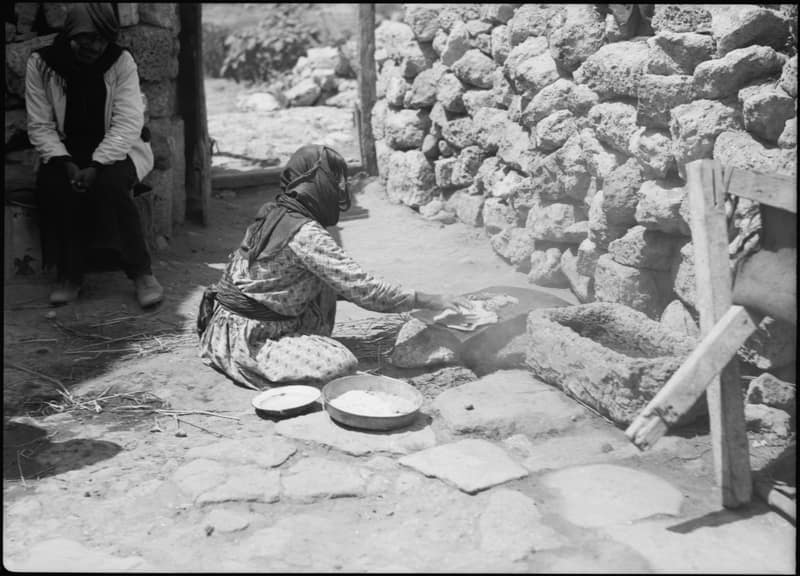
1938

A woman kneels on packed earth and reaches forward to lay a thin sheet of dough over a low domed griddle set on a fire. Two metal basins of dough stand beside her knee. Behind her a rough wall is built of reused stone blocks and a man in a head-cloth sits watching from a doorway.
Qisarya, Haifa district, June 1938. A woman lays a sheet of dough over the saj — the domed metal griddle set straight on the fire, the oven that can be carried — with two basins of dough beside her. The Matson registers give the picture as “Caesarea. (Kaisarieh). Baking” and nothing further. The village had 960 Arab inhabitants at the last Mandate count. On 15 February 1948 a Palmach unit captured it and, in the words of the Institute for Palestine Studies’ record, they “fled or were ordered to leave.” Matson Photograph Collection, LC-M33-9639 · Source file on Wikimedia Commons for “A woman kneels on packed earth and reaches forward to lay a thin sheet of dough over a low domed griddle set on a fire. Two metal basins of dough stand beside her knee. Behind her a rough wall is built of reused stone blocks and a man in a head-cloth sits watching from a doorway.”

1980s

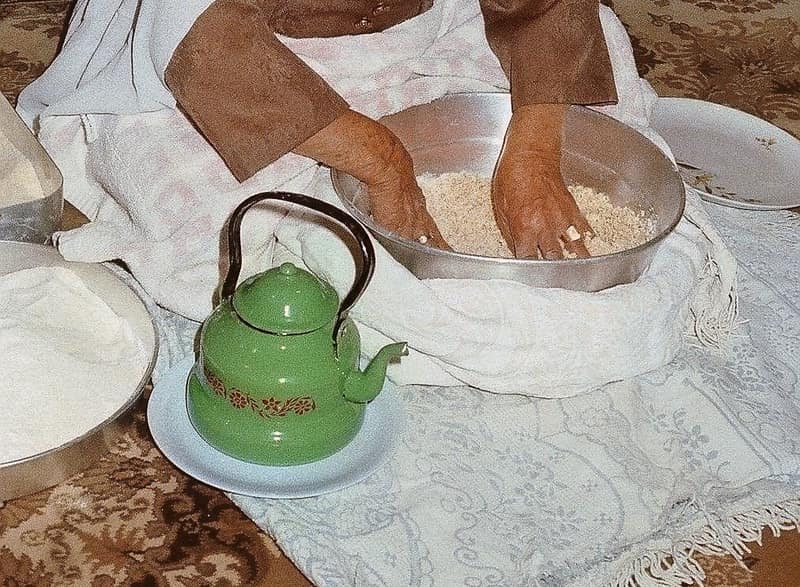
A close colour photograph of two hands working a mound of pale grain in a metal bowl set on a white cloth. The woman’s brown sleeves are pushed back; a green enamel teapot on a saucer and two trays of flour sit around her on a patterned carpet.
Kuwait, 1980s. Maftoul — Palestinian couscous — rolled by hand: bulgur turned in the bowl while flour is sifted over it until each grain takes a coat and becomes a pearl. The woman making it had left Gaza in 1949, and the photograph is published on Wikimedia Commons by Salwa Farwaneh Dameh, whose description records that she went on making it and teaching it in exile. By 1965 Palestinians were almost seventeen per cent of Kuwait’s population, on BADIL’s figures; between March and June 1991 that community was expelled almost in its entirety. Photograph published by Salwa Farwaneh Dameh · Source file on Wikimedia Commons for “A close colour photograph of two hands working a mound of pale grain in a metal bowl set on a white cloth. The woman’s brown sleeves are pushed back; a green enamel teapot on a saucer and two trays of flour sit around her on a patterned carpet.”

2015

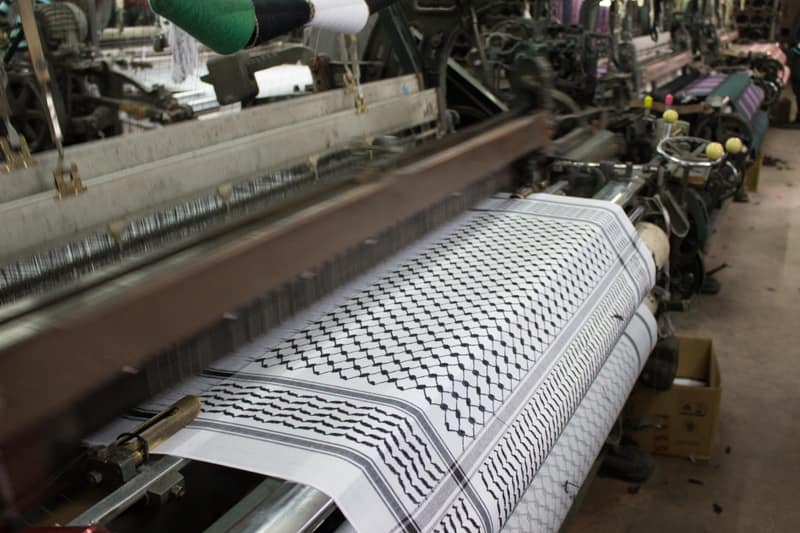
A black-and-white keffiyeh emerging from an industrial loom, the fishnet pattern and its banded border fully formed in the woven cloth. Behind it the machine’s beams, heddles and coloured thread cones recede down the length of the workshop.
Hebron, 19 December 2015. A keffiyeh coming off a loom at the Hirbawi factory, opened by Yasser Hirbawi in 1961 and now — in the words of the platform through which the factory sells — “the last kufiya still actively produced in Palestine.” The fishnet ground and the hooked border are structural: they are woven, not printed. Photograph by TrickyH · CC BY-SA 4.0 · Source file on Wikimedia Commons for “A black-and-white keffiyeh emerging from an industrial loom, the fishnet pattern and its banded border fully formed in the woven cloth. Behind it the machine’s beams, heddles and coloured thread cones recede down the length of the workshop.”

1980s–90s

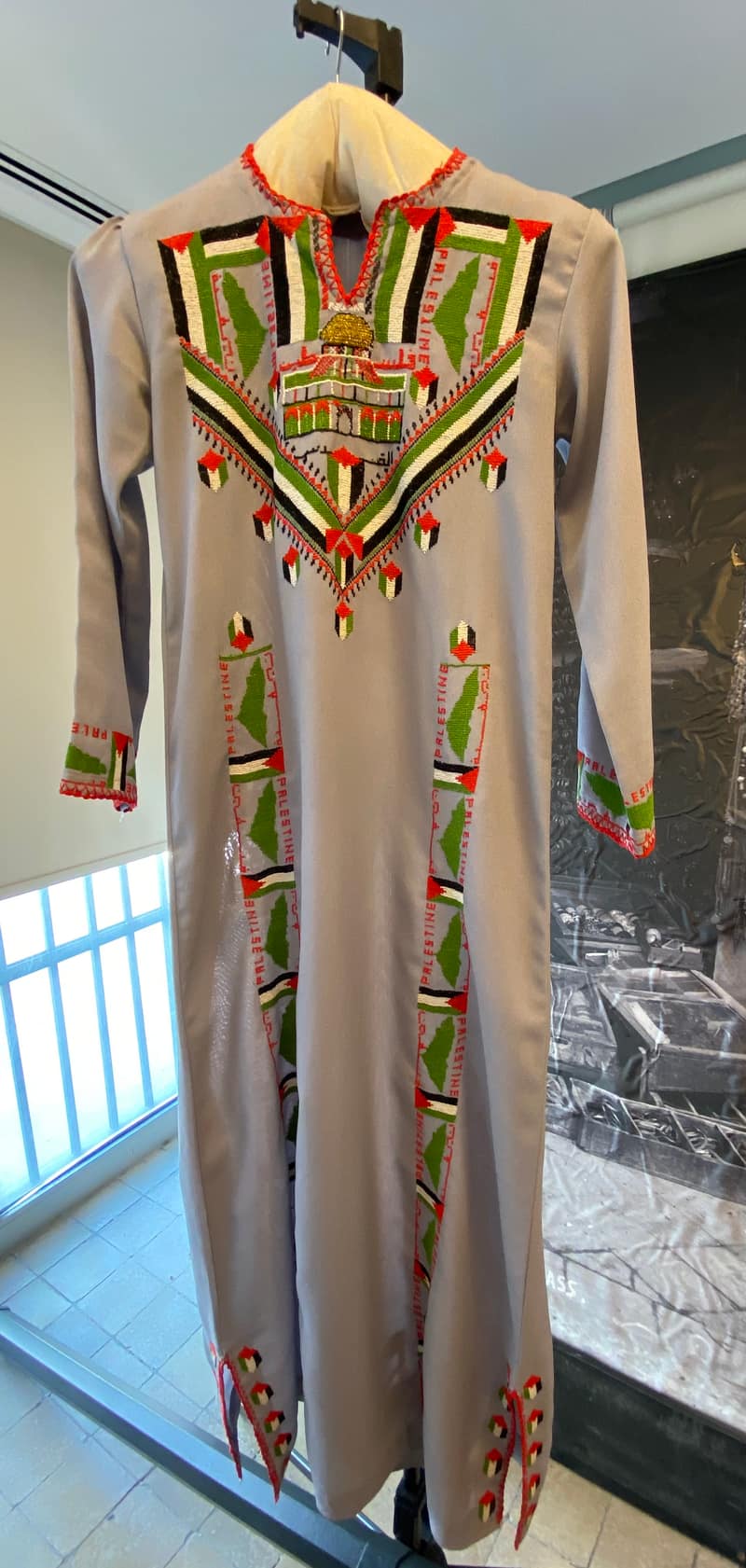
A long grey dress on a hanger behind museum glass. Cross-stitch in red, green, black and white forms a wide chest yoke around an embroidered Dome of the Rock with a gold cupola; the outline of Palestine in green and the word PALESTINE in red capitals repeat down two vertical panels of the skirt and around both cuffs.
The Intifada dress, photographed on display in 2021. With the public display of the Palestinian flag banned, women stitched it instead: the Institute for Palestine Studies records dresses of the late 1980s and early 1990s embroidered with “cross-stitched maps of Palestine, the acronym ‘PLO,’ the word ‘Palestine’ in English and Arabic, and even flags using thread in the four colors — red, green, white, and black.” This one carries the map down both panels and around the cuffs, the Dome of the Rock in gold at the chest, and PALESTINE in Latin capitals along the borders. Photograph by Ma’moun Othman · CC BY-SA 4.0 · Source file on Wikimedia Commons for “A long grey dress on a hanger behind museum glass. Cross-stitch in red, green, black and white forms a wide chest yoke around an embroidered Dome of the Rock with a gold cupola; the outline of Palestine in green and the word PALESTINE in red capitals repeat down two vertical panels of the skirt and around both cuffs.”

2023

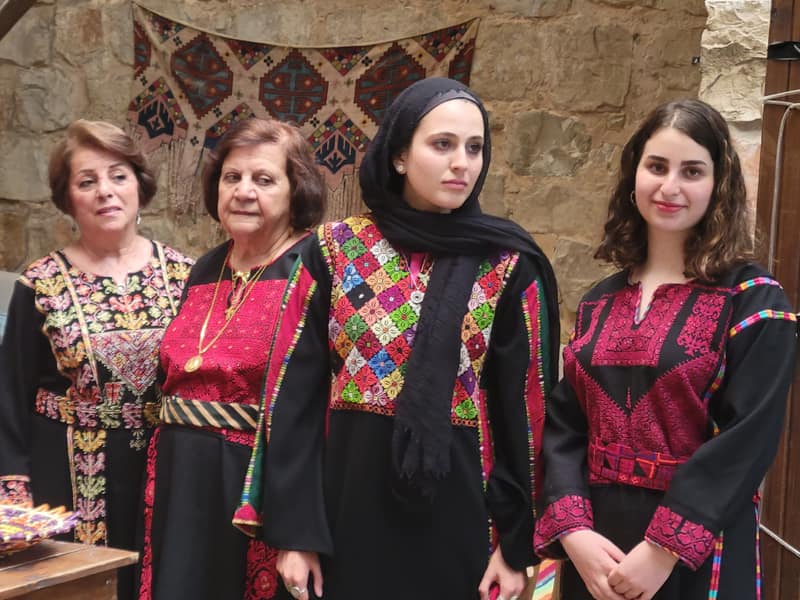
Four women of different ages stand side by side in front of a stone wall hung with a patterned kilim, each in a black thobe embroidered differently: one with a magenta chest panel and rose-worked cuffs, one with a chest panel of multicoloured diamonds, one with a crimson couched panel under a long gold chain.
Palestine, 7 August 2023 — and the record is explicit that this is a shoot, not a wedding: the four are waiting for the filming of a video clip for a wedding song. What is not staged is what they are wearing. Four women of visibly different generations, and no two of the four chest panels worked in the same tradition: a dense magenta panel, a diamond lattice in a dozen colours, a crimson couched qabbeh under a long gold chain. Photograph by Manintheopt · CC BY-SA 4.0 · Source file on Wikimedia Commons for “Four women of different ages stand side by side in front of a stone wall hung with a patterned kilim, each in a black thobe embroidered differently: one with a magenta chest panel and rose-worked cuffs, one with a chest panel of multicoloured diamonds, one with a crimson couched panel under a long gold chain.”

2025

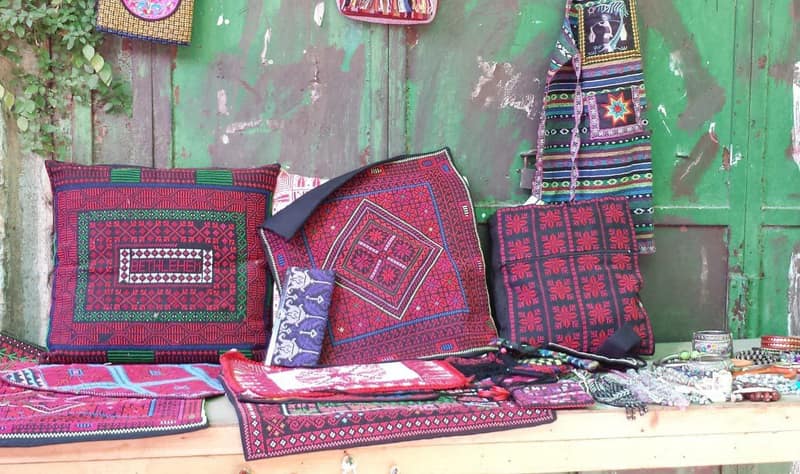
Cross-stitched cushion covers, a long shoulder bag and folded runners propped and laid out on a wooden bench against a chipped green-painted door. The largest cushion is worked in red and green on black with a word cross-stitched across its central panel.
Old city of Hebron, 6 March 2025. A stall of cushion covers, a shoulder bag and folded runners, counted in the same grammar as a nineteenth-century thobe — and across the central panel of the largest piece, cross-stitched in Latin capitals, the word BETHLEHEM. Work of this kind has been sold continuously since the cooperatives of the 1960s: it is on a bench with a price on it, not behind glass. Photograph by Randa107 · CC BY-SA 4.0 · Source file on Wikimedia Commons for “Cross-stitched cushion covers, a long shoulder bag and folded runners propped and laid out on a wooden bench against a chipped green-painted door. The largest cushion is worked in red and green on black with a word cross-stitched across its central panel.”

Nine photographs, three countries: the oldest negative may be as early as 1898, the most recent is from July 2025. It is a small and uneven sample, and deliberately so — freely-licensed photographs of Palestinians living now are far scarcer than public-domain ones of Palestinians a century ago, and this archive would rather show nine images it can date and place than thirty it cannot. Where the record fixes only a decade, or where a scene was staged for a camera, the caption says so. Licences are recorded per image.

“We have on this earth what makes life worth living: the final days of April, the smell of bread at dawn, a woman’s opinion of men, the works of Aeschylus, the beginnings of love, grass on a stone.”

— Mahmoud Darwish, On This Earth

VIIThe shelf

Read the record

The Library

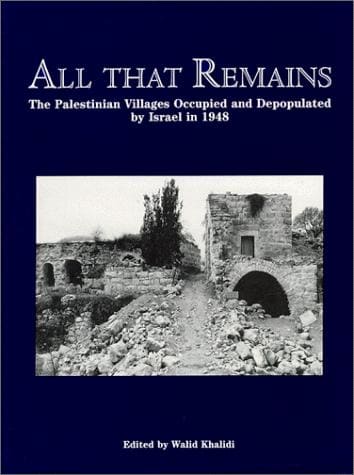
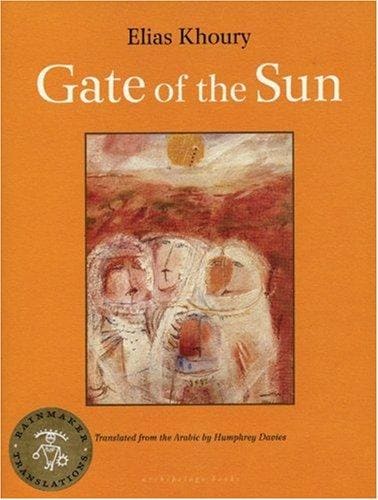
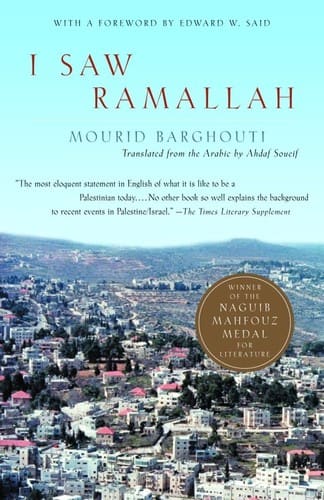
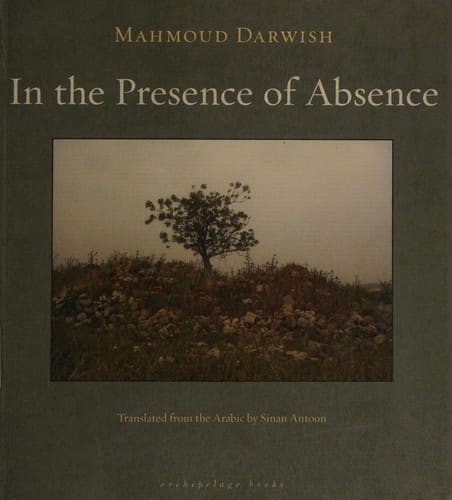
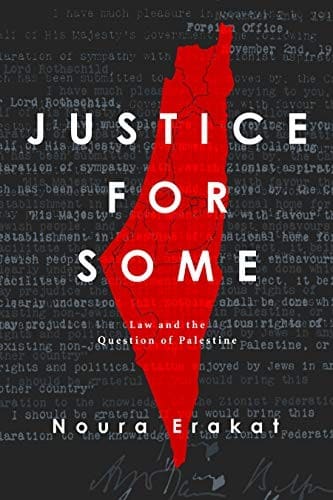
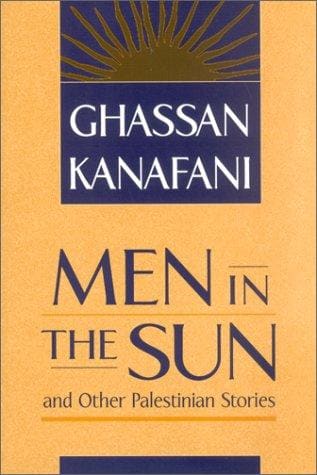
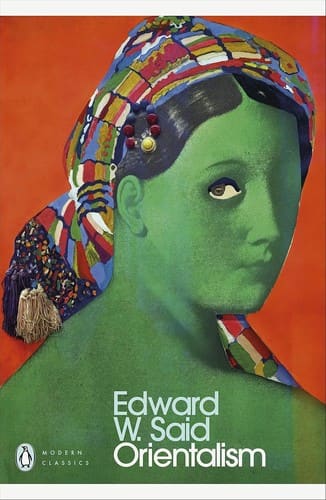
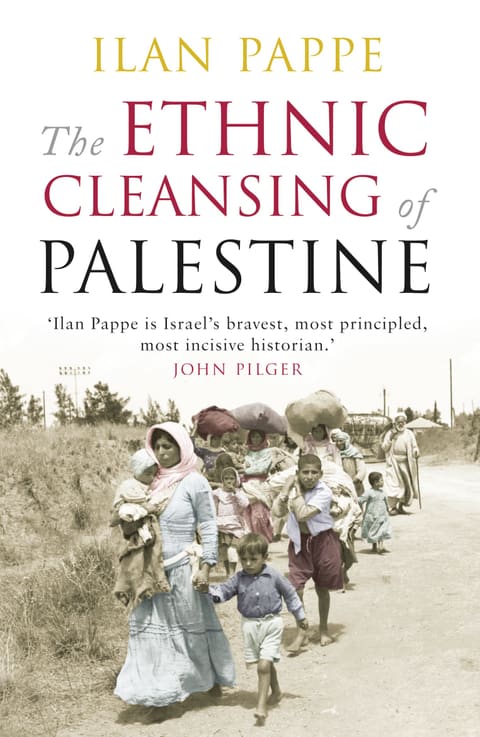
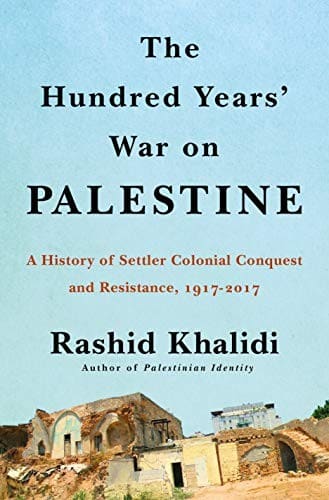
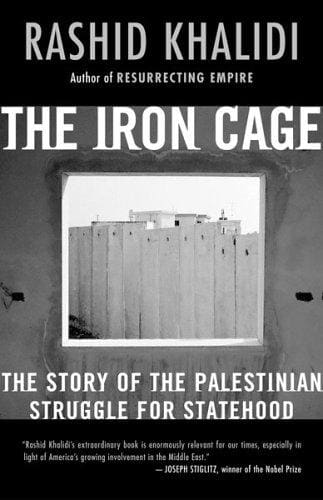
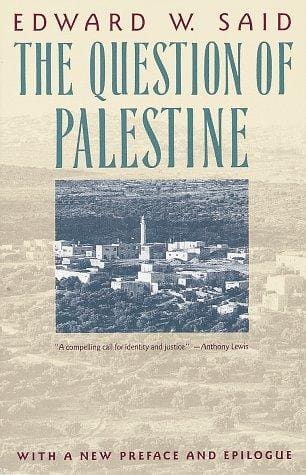
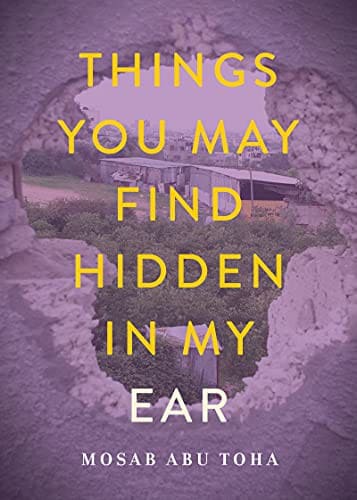
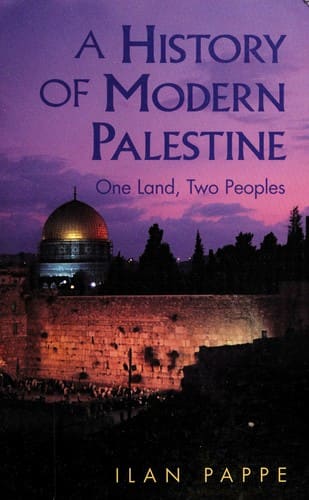
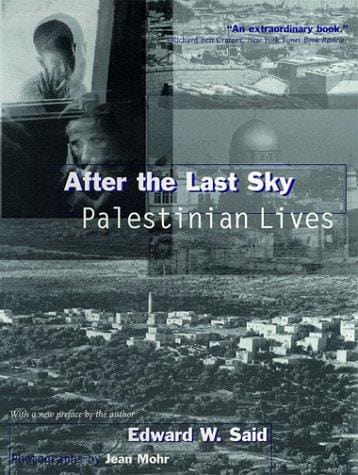
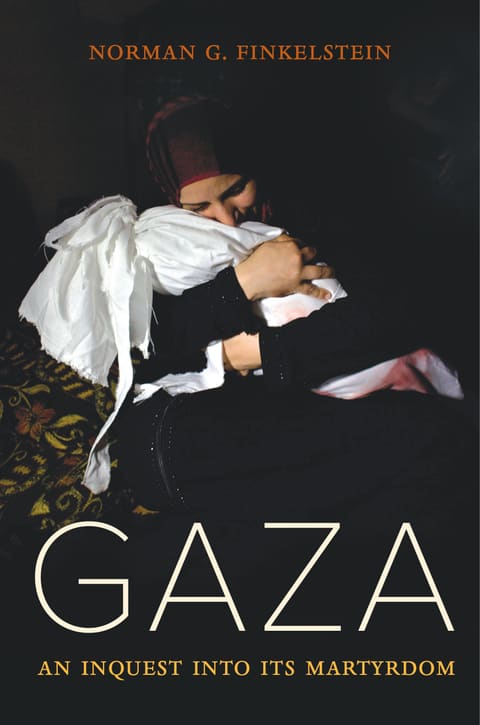
50 books, shelved by kind — the histories the record is built on, the memoirs of return, the novels of exile, the poetry that carried a people. Take one down.

Enter the Library

18 of 50 shown · 18 standing faced · every title links to its entry

VIIIThe Majlis

Take a seat

A majlis is the room where the coffee is poured and the stories are told. The public board is open: ask a question, reply to a published message, suggest a correction or bring a source. Every submission waits for human review before it enters the record.

“The Palestinian cause is not a cause for Palestinians only, but a cause for every revolutionary, wherever he is, as a cause of the exploited and oppressed masses in our era.”
— Ghassan Kanafani