Bir al-Saba
بئر السبع
Bir al-Saba — Beersheba, the 'well of the seven' — was the Ottomans' planned capital of the Naqab and the market town of its Bedouin tribes until October 1948, when the town fell and most of the Naqab's people were driven into exile. The wells remain; so does the Bedouin struggle for the land around them.
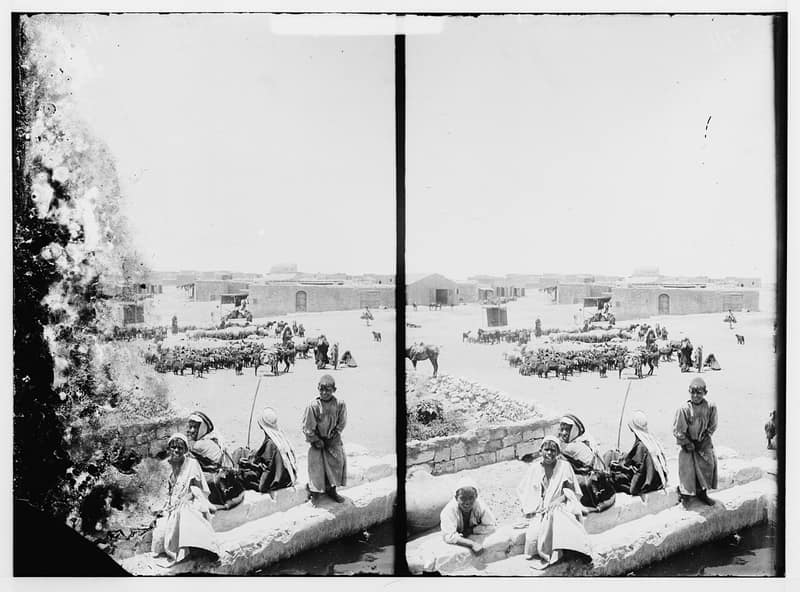
The wells came first. At Bir al-Saba, the Bible’s Beersheba, Abraham and Abimelech swore their covenant — the “well of the oath,” or “well of the seven,” of Genesis — and the Iron Age town at nearby Tel Be’er Sheva guarded the desert road three thousand years ago. The Ottomans founded the modern town around 1900 as an administrative seat for the tribes of the Naqab: a planned grid of stone streets with a seraya, a mosque, a school and, from 1915, a railway station on the line toward the Hejaz. In October 1917 Australian light horsemen took the town from the Ottomans in the First World War’s most celebrated cavalry charge.
By the 1940s Bir al-Saba was the undisputed capital of the Naqab. The town itself held some six thousand people, nearly all of them Muslim; around it ranged the great Bedouin tribes — Tarabin, Tiyaha, Azazmeh and others — whose numbers in the district are put anywhere between sixty-five and ninety-five thousand. On market day the desert came to town: camels and sheep by the thousand, grain, ghee and wool changing hands, disputes settled by tribal custom, and the shops of the grid streets selling on to Gaza and Hebron.
In May 1948 the Egyptian army entered the Naqab and held it through the summer. When Israel launched Operation Yoav in the autumn, Bir al-Saba fell on 21 October 1948; its townspeople and most of the Bedouin of the western Naqab fled or were driven toward Gaza and the Hebron hills. Perhaps eleven thousand Bedouin remained of the tens of thousands who had held the district; they were confined under military rule until 1966 in the Siyag, an enclosed zone northeast of the town, while their grazing lands were declared state land. The emptied town was renamed Be’er Sheva and settled with new immigrants.
The Ottoman town endures in pieces — the mosque, the seraya, the railway station, the old well — and the Bedouin market still convenes each week. Around it stretches the unfinished struggle of the Naqab: the recognized townships like Rahat and the unrecognized villages like al-Araqib, demolished and rebuilt by its people scores of times. For Palestinians, Bir al-Saba is the gate of the Naqab — and the Naqab is still contested ground.
Sources
Cited works
2- britannica.com — Beersheba(opens in a new tab)https://www.britannica.com/place/Beersheba
- palestineremembered.com — index(opens in a new tab)https://www.palestineremembered.com/Beersheba/Beersheba/index.html
Cite this page
Every claim above carries its sources — citation is the point.
- Chicago
“Bir al-Saba.” Places, FALASTEEN.AI. Accessed 22 August 2026. https://falasteen.ai/places/bir-al-saba.- MLA
“Bir al-Saba.” Places, FALASTEEN.AI, 2026, https://falasteen.ai/places/bir-al-saba. Accessed 22 August 2026.- BibTeX
@misc{falasteen-bir-al-saba,
  title        = {Bir al-Saba},
  howpublished = {\url{https://falasteen.ai/places/bir-al-saba}},
  organization = {FALASTEEN.AI — A Living Archive for Palestine},
  year         = {2026},
  note         = {Accessed 2026-08-22}
}