Their own words
Testimonies
Kept in the world's oral history archives. Each excerpt is quoted exactly as published and linked back to the archive that recorded it.
27 witnesses · 20 archives
A Nakba at the beginning of my life … and another Nakba at the end of it. What can we even say?
Abdel Mahdi al-Wuheidi
Bir al-Saba (Beersheba)b. 1940
Driven from Bir al-Saba as a child in 1948 and from Jabalia camp in 2023, he returned after the October 2025 ceasefire to a house standing in rubble.
The Jews ordered all our family to line up against the wall and they started shooting us. I was hit in the side, but most of us children were saved because we hid behind our parents. The bullets hit my sister Kadri [four] in the head, my sister Sameh [eight] in the cheek, my brother Mohammed [seven] in the chest. But all the others with us against the wall were killed: my father, my mother, my grandfather and grandmother, my uncles and aunts and some of their children.
Fahimi Zeidan
Deir Yassin
A twelve-year-old survivor of the 9 April 1948 massacre at Deir Yassin describes the killing of her family, in a statement recorded by British police officers days after the attack.
The militias forced the remaining inhabitants onto trucks and took them to the Egyptian Sinai Peninsula. I barely made it out alive, and walked down the coast with my family over 36 miles, insisting my wife need not take her favorite clay pot because it would be only a matter of days before we returned.
Mutlaq Mahmoud Abu Elkhair
Barqa
A 96-year-old survivor from Barqa, depopulated in May 1948, recalls walking down the coast into Gaza with his family, expecting to be home again within days.
They took my home by brute force and made me a refugee and I want my home back, and I want to live in it in freedom and dignity. [...] Nakba to me is an earthquake, not by the forces of nature, but by the powers of evil. It is not instantaneous but lasting for decades.
Salman Abu Sitta
Ma'in, Beersheba district
Salman Abu Sitta, expelled from Ma'in near Beersheba at the age of ten, speaks to Al Jazeera about the Nakba and his life's work mapping the destroyed villages of Palestine.
We owned a few dunums, where we planted wheat and barley. We lived off the land, and there was plenty to eat and drink. Everything was lovely.
Abdullah Nashwan
al-Dawayima, Hebron districtb. c. 1937
Eleven years old when his family fled the massacre at al-Dawayima in October 1948; displaced again in 1967, he has lived in Jordan's Baqa'a camp since.
My memory of those moments is like a treasure to me. I remember the masses of people at the Haifa port. I remember the suffering of the people.
Abed Abdi
Haifa
A six-year-old expelled from Haifa in April 1948 recalls the crowds fleeing to the port; he returned with his family three years later and became a renowned visual artist.
My family lived up the hill on the eastern end of the village, and we fled towards Yalu, but upon reaching that village we realized the Israeli army was already there and we could not enter. We ended up walking for sixteen hours to reach Ramallah, thirty-two kilometers away.
Ahmad Abughoush
Imwas, Latrunb. 1953
Expelled from Imwas at fourteen during the 1967 war, he describes his family's flight on foot to Ramallah before Israeli bulldozers razed the village and Canada Park was planted over its ruins.
My village was brutally attacked and burned down by the Zionist army and we were forced to flee the burning village to the adjacent village of Hatta. [...] A man pushed me out and took my position when the warplanes attacked again. In a split second, he died in front of my eyes. I survived.
Ahmad al-Haj
al-Sawafir al-Sharqiyya
A survivor from al-Sawafir al-Sharqiyya in the Gaza district, fifteen in 1948, describes the burning of his village and a warplane attack during the family's flight.
They bombed us from the air just as we were breaking the fast for Ramadan – they knew we would all be in our homes.
Ameen Muhammad Ali (Abu Arab)
Saffuriyya, Nazarethb. c. 1935
Thirteen years old when Saffuriyya was attacked in July 1948, he describes the air raid that emptied the village during the Ramadan iftar.
We left before the killing reached us. People from other villages were fleeing and told stories of what they were running from, so people from the farther villages packed up and fled.
Daiffallah Abu Al-Gussain
Al-Shalalah, Beer al-Sabe districtb. 1940
A Gaza elder born before the state of Israel, he fled his village in the Beer al-Sabe area at the age of seven and still keeps the 1938 deed proving his family's land, to pass to his grandson.
The situation was as if we were experiencing the Day of Judgment (...) Crowds of people escaping from the death on foot and others riding donkeys and camels, while children ran in front of their families as the sound of bullets fired by the Zionist gangs towards us [...] Living in tents is the height of tragedy, without protection and privacy for you and your family (...) We felt naked in front of each other and felt ashamed all the time, even when we had to relieve ourselves inside tents.
Dalal Nassar
Julis
An 84-year-old refugee from Julis recalls walking to Gaza as a girl during the 1948 exodus and the humiliation of the first years in tents at Deir al-Balah.
We never set eyes on Fatima or our dog or the city we had known ever again. Like a body prematurely buried, unmourned, without coffin or ceremony, our hasty, untidy exit from Jerusalem was no way to have said goodbye to our home, our country and all that we knew and loved.
Ghada Karmi
Qatamon, Jerusalemb. 1939
A Jerusalem childhood ended in April 1948: days after Deir Yassin, nine-year-old Ghada Karmi's family packed a few summer clothes and left their Qatamon home, believing they would be back within weeks.
Of course we passed it. In May 1948, we left Jaffa. Jaffa fell, and I became a refugee in Nablus.
Ibrahim Abu-Lughod
Jaffab. 1929
A nineteen-year-old Jaffa high-school student, he sat his matriculation exams in March 1948 under nightly mortar bombardment — 'Daily we knew people who got killed. We buried them.' — and weeks later fled the falling city by sea.
At that moment, a jeep pulled up with three people. One of them, a Zionist officer, got out. He pulled a gun and put it to my head and ordered me to put the water down.
Ismail Shammout
Lyddab. 1931
Expelled from Lydda at eighteen during the July 1948 "death march," he recalls an Israeli soldier stopping him at gunpoint from filling a pot with water as thousands trudged toward Ramallah in the heat.
On 14 May 1948, Simsim village faced a fierce attack by Israeli troops. As a result, my father removed the family to the Seifa area, north of Beit Lahiya in northern Gaza. About three months later, we and many villagers came back to the village to protect our lands and properties.
Jaber Ahmad Mohammad Shaban
Simsimb. 1938
A survivor from Simsim, northeast of Gaza, describes the May 1948 attack that drove his family out of the village when he was ten years old.
We fled on foot. We had only the clothes on our back.
Leila Giries
Ayn Karim, Jerusalemb. c. 1940
Eight years old when her family fled Ayn Karim on the western edge of Jerusalem in 1948; the family moved to the United States in 1958, and she now lives in a suburb of Los Angeles with the key to the house framed on her wall.
You are still living in the same place, but you ask yourself, 'Is this still my home? Is the air mine? Is the sky mine?'
Michael Kardoush
Nazareth
He left Nazareth in 1954 rather than live under the military government imposed on Palestinian citizens of Israel, walking 18 kilometres across the border to Lebanon.
My family and I were expelled from the village of Julis 76 years ago, after which we endured a difficult displacement journey. We migrated to several Palestinian cities, fleeing from shelling until we reached the Bureij camp in the middle of the Gaza Strip, where we settled for several years. We then lived in the Nuseirat camp for more than 60 years.
Mohammed Abdul Jabbar Abu Seif
Julis
A 91-year-old survivor from Julis, in the Gaza district, recalls his family's expulsion in 1948 and a lifetime in the refugee camps of Bureij and Nuseirat.
At 9 in the morning, the shooting stopped and the attackers rounded everyone up on the beach. They sorted them out, the women and children on one side, the men on the other. They searched the men and ordered them to keep their hands above their heads.
Muhammad Abu Hana
al-Tanturab. 1936
A twelve-year-old during the assault on al-Tantura in May 1948 describes the roundup on the beach that preceded the killing of scores of the village's men.
We left behind the most fertile fields in the area. Just months before the Nakba I was tending the land daydreaming about my future. My father worked that land. My father's father did before him and so many generations before.
Omar Abedelal
Burayr
A nine-year-old when Burayr was besieged and depopulated in 1948, he recalls the farmland his family had worked for generations and the return they never stopped expecting.
In 1948 our village in the Beer El-Sabe district was subjected to a brutal Israeli attack, during which children, women and elderly people were killed, creating a state of terror and fear among the remaining villagers. This led to a further mass exodus of occupants of neighboring villages.
Ouda Salem Ouda Abu Haddaf
A village near Beer al-Sabe, Naqabb. 1936
A Bedouin survivor from the Naqab, born in 1936, describes the 1948 attack on his village and the chain of displacements that ended in the refugee camps of Gaza.
The Jews were stationed here and there with loudspeakers and guns, loaded and ready. One loudspeaker repeated that we better leave in order to avoid what happened in the mosque.
Reja-e Busailah
Lydda
A visually impaired teenager during the July 1948 expulsion from Lydda, he recalls being herded east on foot in the exodus that became known as the Lydda death march.
This is always the case with us Palestinians, we're always getting pushed from one place to the next. I wish they'd give us a traffic light for once.
Salwa Naser
Jaffab. c. 1942
Six years old when her family left Jaffa by boat in 1948, and a refugee for the second time in 2012 when the war in Syria destroyed her home in Damascus.
We had wheat, flour and goats. We never saw another happy day after we left.
Umm Omar
Jusayr, Gaza districtb. c. 1940
Eight years old when her family was expelled from Jusayr in 1948; she has lived in Jabaliya refugee camp ever since.
We left the house in panic. We didn't know what was going on…. Eventually, we ended up here. More than seventy years went by… I'm afraid of dying before returning to beautiful Jaffa.
Wajiha al-Harsh
Jaffa
An 80-year-old refugee from Jaffa, living in the Jabaliya camp's 'Jaffa neighborhood' in Gaza, recalls the panic of the May 1948 flight from her city.
We were only wearing the clothing we had on because we are coming back tomorrow. We are coming back. Now we just want to be far from the shooting.
Yacoub Odeh
Lifta, Jerusalemb. 1940
An eight-year-old when Lifta was emptied in early 1948, he recalls fleeing with nothing but the clothes his family wore, certain they would be back the next day.
...one early morning around thirty trucks entered the village, the soldiers was dressed Arabian style, so we thought they are Arabs coming to defend us, but they began shooting every one they saw. Most of the residences escaped to the north, because the Zionists made a save side in the north to kick out everyone, we escaped to Lebanon, through Albassa and Tarshiha. After we left the village the Zionists destroyed all the village except the mosque and old Romanian building.
Zakaria Elnatour
al-Sumayriyya
A refugee from al-Sumayriyya, between Acre and Nahariya, describes the 1948 capture of his village and his family's flight to Lebanon and Syria, in a letter to a Jewish student.
“We teach life, sir.”
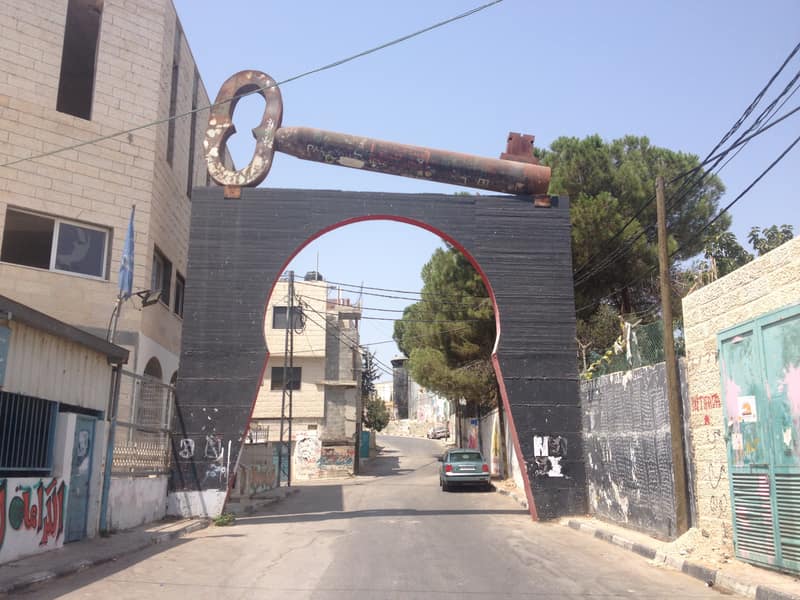
Photograph: The entrance arch of Aida refugee camp, Bethlehem, crowned with a key of return · Jj M Ḥtp (CC0), via Wikimedia Commons
Have a testimony of your own?
Record an elder's story with care and consent. The oral-history guide explains how.
Open the recording guide