The record
Timeline
A century and a half, read in order. Every entry is dated, summarised, and carried back to primary and scholarly sources.
- Span
- 1858–2024
- Entries
- 68
- Eras
- 8
Ottoman era
1858–19114 entries
1858
The Ottoman Land Code
A reform meant to raise revenue introduced individual land registration and allowed private ownership of vast tracts — restructuring who owned Palestine, and creating the paper record that later dispossession would be built on.
1872
Jerusalem Made a Separate District
Ottoman administrative reorganisation enlarged the district of Jerusalem and raised it to separate status reporting directly to Istanbul — drawing, decades before the Mandate, the outline of the territory that would be called Palestine.
1897
The First Zionist Congress
The congress that sat at Basel from 29 to 31 August 1897 — its own stenographic protocol records 204 delegates present — founded the Zionist Organization and adopted a programme seeking a 'publicly and legally secured home in Palestine for the Jewish people'. The country in question already had a population. The programme did not mention it.
1911
Filastin Newspaper Founded
Isa al-Isa began publishing Filastin in Jaffa in January 1911. It addressed its readers as Palestinians, warned of the consequences of Zionist land purchase, and was shut down by the Ottoman authorities in 1913 for 'inciting ethnic prejudice.'
British Mandate
1917–19477 entries
1917
The Balfour Declaration
Britain publicly commits to the establishment of a 'national home for the Jewish people' in Palestine, without consulting its overwhelmingly Arab population.
1922
The Mandate for Palestine
The League of Nations approved the Mandate on 24 July 1922. Its preamble wrote the Balfour Declaration into international law, and its articles obliged Britain to facilitate Jewish immigration and settlement — while referring to the Arab majority only as 'the existing non-Jewish communities.'
1929
The Buraq Uprising
A year-long dispute over access to al-Buraq — the Western Wall — erupted in August 1929 into violence that spread from Jerusalem to Hebron and Safed. The Shaw Commission counted 133 Jews and 116 Arabs killed; many of the Arab casualties, it found, were caused by rifle fire from the police and military.
1930
Red Tuesday — the executions at Acre prison
On 17 June 1930 the British Mandate hanged Fuad Hijazi, Muhammad Jamjoum and Atta al-Zir at Acre prison for the events of August 1929. The day entered Palestinian memory through the songs sung for them — above all the funeral song from Acre prison that is still sung a century later.
1936–1939
The Great Arab Revolt
A nationwide uprising against British colonial rule and mass immigration, beginning with a six-month general strike and crushed by overwhelming military force.
1937
The Peel Commission
The first official proposal to partition Palestine, published on 7 July 1937, also contained the first official proposal to move its people: a transfer of land and, 'if necessary', of population, from the territory assigned to the Jewish state.
1947
The UN Partition Plan
The UN General Assembly votes to partition Palestine into two states, assigning the majority of the land to a Jewish state at a time when Jews were a third of the population.
The Nakba
1948–19496 entries
1948
The Battle of al-Qastal
Abd al-Qadir al-Husayni, commander of the Army of the Holy War, is killed retaking the village of al-Qastal on the Jerusalem road — a loss from which Palestinian irregular forces never recovered.
1948
The Expulsion of Lydda and Ramle
Between the two UN truces of July 1948, Israeli forces took the twin cities of Lydda and Ramle and expelled their populations on foot toward the Arab lines. Close to a thousand people died in the cities and on the road.
1948
Plan Dalet
The Haganah's Plan D, finalised on 10 March 1948 and set in motion in early April, provided for securing the area of the Jewish state and the settlements beyond it — including, where villages resisted, their destruction and the expulsion of their inhabitants.
1948
The Nakba
More than 700,000 Palestinians are expelled or flee from their homes during the war surrounding Israel's establishment; over 400 villages are depopulated or destroyed.
1948
UN General Assembly Resolution 194
Adopted on 11 December 1948, resolution 194 (III) established the Conciliation Commission for Palestine and, in paragraph 11, resolved that refugees wishing to return to their homes should be permitted to do so at the earliest practicable date, with compensation for those choosing not to return.
1949
The Armistice Agreements
Four agreements signed between February and July 1949 — Egypt's and Jordan's on Rhodes, Lebanon's at Ras al-Naqoura, Syria's at Hill 232 near Mahanayim — ended the fighting and drew the Green Line, a military demarcation the parties expressly agreed was not a political border. No peace treaty followed for thirty years.
Occupation
1956–199621 entries
1956
The Suez War and the Kafr Qasim Massacre
Israel joins Britain and France in a secret war on Egypt; on its first day, Border Police massacre 49 Palestinian citizens of Israel in Kafr Qasim.
1959
The Founding of Fatah
A core of Palestinian refugees in Kuwait, among them Yasser Arafat and Khalil al-Wazir, launches the Palestinian National Liberation Movement — announced to the world in the Beirut magazine Filastinuna.
1964
Founding of the PLO
The Palestine Liberation Organization is established in Jerusalem, creating an umbrella body that comes to represent Palestinians in exile and under occupation.
1967
The Six-Day War
Israel captures the West Bank, East Jerusalem, Gaza, Sinai, and the Golan Heights in six days, beginning a military occupation that continues to this day.
1967
UN Security Council Resolution 242
Adopted unanimously on 22 November 1967, resolution 242 emphasised the inadmissibility of the acquisition of territory by war and called for withdrawal from territories occupied in the recent conflict. It mentioned Palestinians only once, as a refugee problem.
1968
The Battle of Karameh
Palestinian fedayeen and the Jordanian army fight a full Israeli armored incursion at the Karameh refugee camp. The costly stand transforms Fatah into a mass movement almost overnight.
1968
The Palestinian National Charter Revised
Meeting in Cairo in July 1968, the Palestine National Council rewrites the PLO's 1964 charter, declaring armed struggle 'the only way to liberate Palestine' — the constitutional text of the fedayeen era.
1970–1971
Black September
Jordan's army crushes the PLO's armed presence in the kingdom in ten days of civil war in September 1970, and by July 1971 expels the fedayeen altogether — relocating the Palestinian armed movement to Lebanon.
1972
The Assassination of Ghassan Kanafani
A Mossad car bomb in Beirut kills the novelist and PFLP spokesman Ghassan Kanafani, 36, and his seventeen-year-old niece Lamees — silencing the most celebrated literary voice of the Palestinian resistance.
1972–1973
Munich and the Wrath of God
Black September seizes the Israeli team at the Munich Olympics; eleven Israelis, five attackers and a German policeman die. Israel answers with a years-long assassination campaign across Europe and the Middle East.
1973
The Verdun Street Raid
Israeli commandos land by sea in Beirut and assassinate three senior PLO leaders — Muhammad Yusuf al-Najjar, Kamal Adwan, and the poet-spokesman Kamal Nasser — in their homes on Verdun Street.
1973
The October War and Resolution 338
Egypt and Syria attacked on 6 October 1973 to break the diplomatic deadlock over the occupied territories. The war ended with Security Council resolution 338, which ordered a ceasefire and, for the first time, negotiations 'between the parties concerned' to implement resolution 242.
1974
Arafat's Olive Branch at the United Nations
PLO chairman Yasser Arafat addresses the UN General Assembly for the first time — and days later the General Assembly grants the PLO observer status.
1974
The Rabat Summit
Twenty Arab states unanimously recognize the PLO as the sole legitimate representative of the Palestinian people — stripping Jordan's claim to the West Bank and clearing Arafat's road to the UN.
1974
The Ten Point Program
The 12th Palestine National Council adopts a phased program: a 'combatant national authority' on any liberated part of Palestinian territory. The first crack in the all-or-nothing position — and the birth of the Rejectionist Front.
1976
Land Day
A general strike against land confiscation in the Galilee is met with gunfire; six Palestinian citizens of Israel are killed, and a new national day is born.
1978
The 1978 Invasion of South Lebanon
Israel sends 25,000 troops into south Lebanon against the PLO. Up to a quarter of a million Lebanese are displaced; the Security Council answers with Resolution 425 and creates UNIFIL.
1981
The Founding of Islamic Jihad
Around Fathi Shiqaqi, Palestinian students returning from Egypt build a movement answering what he called the problem of 'nationalists without Islam, and Islamists without Palestine.'
1982
The 1982 Invasion of Lebanon
Israel invades Lebanon with 60,000 troops and besieges West Beirut for ten weeks. Some 14,000 PLO fighters evacuate under international guarantee; the leadership moves to Tunis — and the guarantees fail the camps within weeks.
1982
Sabra and Shatila Massacre
During Israel's occupation of West Beirut, a Lebanese Phalangist militia massacres Palestinian refugees in the Sabra and Shatila camps over three days.
1996
Grapes of Wrath and the Qana Massacre
During a sixteen-day Israeli offensive in Lebanon, artillery shells strike a UN compound sheltering displaced families at Qana, killing more than one hundred civilians.
Intifadas
1987–20049 entries
1987–1993
The First Intifada
A mass popular uprising erupts in Gaza and spreads across the occupied territories, defined by strikes, boycotts, and stone-throwing youth.
1987
The Founding of Hamas
Two days into the intifada, seven Muslim Brotherhood leaders meet in Gaza City under Shaykh Ahmad Yasin and form the Islamic Resistance Movement — Hamas — committing the Brotherhood to armed struggle.
1987
The Shooting of Naji al-Ali
The cartoonist who drew Handala — the barefoot refugee child with his back turned — is shot in a London street. He dies five weeks before the intifada his child witness seemed to foretell.
1988
The Palestinian Declaration of Independence
Meeting in Algiers, the Palestine National Council proclaims the State of Palestine and accepts UN Resolutions 242 and 338 — a de facto two-state formula.
1988
The UNLU and the Leaflets of the Uprising
A clandestine Unified National Leadership — Fatah, PFLP, DFLP, and the Communists — begins issuing the numbered communiqués that set the rhythm of the First Intifada, strike day by strike day.
2000–2005
The Second Intifada
Ariel Sharon's visit to the Haram al-Sharif ignites a far more violent uprising that leaves several thousand Palestinians and around a thousand Israelis dead.
2002
The Battle of Jenin
The fiercest battle of Operation Defensive Shield leaves the heart of Jenin refugee camp in ruins — and a bitter dispute over the death toll.
2004
The Death of Yasser Arafat
After two years confined by Israeli forces to his wrecked Ramallah compound, the PLO chairman dies in a French military hospital. The cause remains disputed; an era of Palestinian politics ends with him.
2004
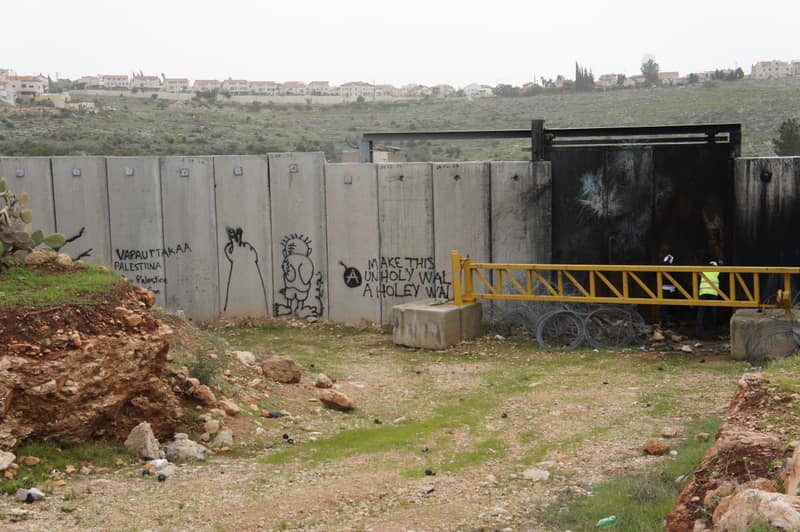
The ICJ Advisory Opinion on the Wall
On 9 July 2004 the International Court of Justice found that the wall Israel was building inside the occupied West Bank was contrary to international law, that Israel must stop building it, dismantle what stood and make reparation — and that other states must not recognise the situation it created.
Oslo years
1991–19954 entries
1991
The Madrid Peace Conference
The United States and the Soviet Union co-sponsor the first peace conference to bring Israel face to face with all its Arab neighbors, including the Palestinians.
1993
The Oslo Accords
Israel and the PLO sign the Declaration of Principles on the White House lawn, launching a peace process meant to end the conflict within five years.
1994
Ibrahimi Mosque Massacre
Israeli settler Baruch Goldstein guns down twenty-nine Palestinian worshippers at Hebron's Ibrahimi Mosque during Ramadan; the restrictions imposed in response fall on Palestinians and hollow out Hebron's Old City.
1995
Oslo II and the Division of the West Bank
The Interim Agreement signed on 28 September 1995 cut the occupied West Bank into Areas A, B and C for a five-year transition. Thirty years later the transition has not ended, and Area C — about sixty percent of the territory — remains under full Israeli control.
Gaza under siege
2005–202410 entries
2005
Israel's Disengagement from Gaza
Israel unilaterally evacuates some 8,000 settlers and withdraws its troops from Gaza while retaining control of its borders, airspace, and territorial waters — leaving the Strip's legal status as occupied territory in lasting dispute.
2006
Hamas Wins the Palestinian Elections
Hamas wins seventy-four of 132 seats in internationally observed legislative elections, and the boycott that follows sets in motion the Palestinian schism, the 2007 takeover of Gaza, and the blockade.
2007
The Gaza Blockade
Israel and Egypt impose a sweeping land, air, and sea blockade on Gaza after Hamas takes control, restricting the movement of two million people and essential goods.
2007
The Split: Gaza and Ramallah
Sixteen months after the election it lost, Fatah fights Hamas for control of Gaza and loses. Two administrations emerge on the same national territory, and every attempt to reunite them since has failed.
2008–2009
Operation Cast Lead
Israel's twenty-two-day offensive on a blockaded Gaza kills some 1,400 Palestinians and thirteen Israelis, and triggers a UN investigation that finds evidence of war crimes on both sides.
2012
Operation Pillar of Defense
An eight-day escalation, opened by Israel's assassination of Hamas military chief Ahmed Jabari, kills 167 Palestinians and six Israelis before an Egyptian-brokered ceasefire.
2014
Operation Protective Edge: The 51-Day War on Gaza
The deadliest escalation yet in Gaza: more than 2,200 Palestinians and 73 people in Israel are killed over fifty-one days, and a UN commission of inquiry finds evidence of war crimes by both sides.
2017
The Hamas Document of General Principles
Hamas issues a second founding text that defines Palestine in national rather than religious terms, separates Zionism from Judaism, and names a state on the 1967 lines as a formula of national consensus — without recognising Israel.
2018
The Great March of Return
Tens of thousands of Gazans join weekly protests at the boundary fence demanding the right of return; Israeli snipers kill more than 180 demonstrators.
2024
The flour massacre
In the pre-dawn dark of 29 February 2024, Israeli forces opened fire on crowds waiting for a rare aid convoy on Gaza City's coastal road. Gaza's Health Ministry counted at least 112 killed and more than 750 wounded — people who had come out in the cold, in a starving north, for flour.
The present
2005–20247 entries
2005
The BDS Call
Over 170 Palestinian unions, refugee networks, and civil society organizations call on the world to impose boycotts, divestment, and sanctions on Israel until it complies with international law.
2011
Palestine Joins UNESCO
On 31 October 2011 UNESCO's General Conference admitted Palestine as a member state — the first UN agency to do so. The United States cut off its funding within days; Palestine went on to inscribe Bethlehem, Battir and Hebron on the World Heritage List.
2012
Palestine Becomes a UN Observer State
The UN General Assembly votes 138 to 9 to accord Palestine non-member observer state status, on the 65th anniversary of the partition plan.
2021
The Unity Intifada and the May War on Gaza
Protests over Sheikh Jarrah and raids on Al-Aqsa ignite a rare uprising across all of historic Palestine — and an eleven-day escalation in Gaza.
2024
ICC Arrest Warrants
On 21 November 2024 the International Criminal Court rejected Israel's challenges to its jurisdiction and issued arrest warrants for Benjamin Netanyahu and Yoav Gallant for war crimes and crimes against humanity in Gaza, and for the Hamas commander Mohammed Deif.
2024
The ICJ Advisory Opinion on the Occupation
On 19 July 2024 the International Court of Justice found Israel's continued presence in the occupied Palestinian territory unlawful and held that it must be brought to an end as rapidly as possible, settlements evacuated and reparation made. The General Assembly demanded compliance within twelve months.
2024
The ICJ Genocide Case
The International Court of Justice orders provisional measures in South Africa's genocide case against Israel over Gaza, finding the rights claimed plausible.
No entries in this era yet.
“We know too well that our freedom is incomplete without the freedom of the Palestinians.”
Photograph: Naji al-Ali's Handala — the barefoot refugee child, back turned — painted on the separation wall at Ni'lin · Friends123 (CC0), via Wikimedia Commons