The Thobe
الثوب
The Palestinian dress and its regional grammar — the chest panel, the coin headdress of Ramallah, the gold-couched malak of Bethlehem — and what happened to that geography after 1948.
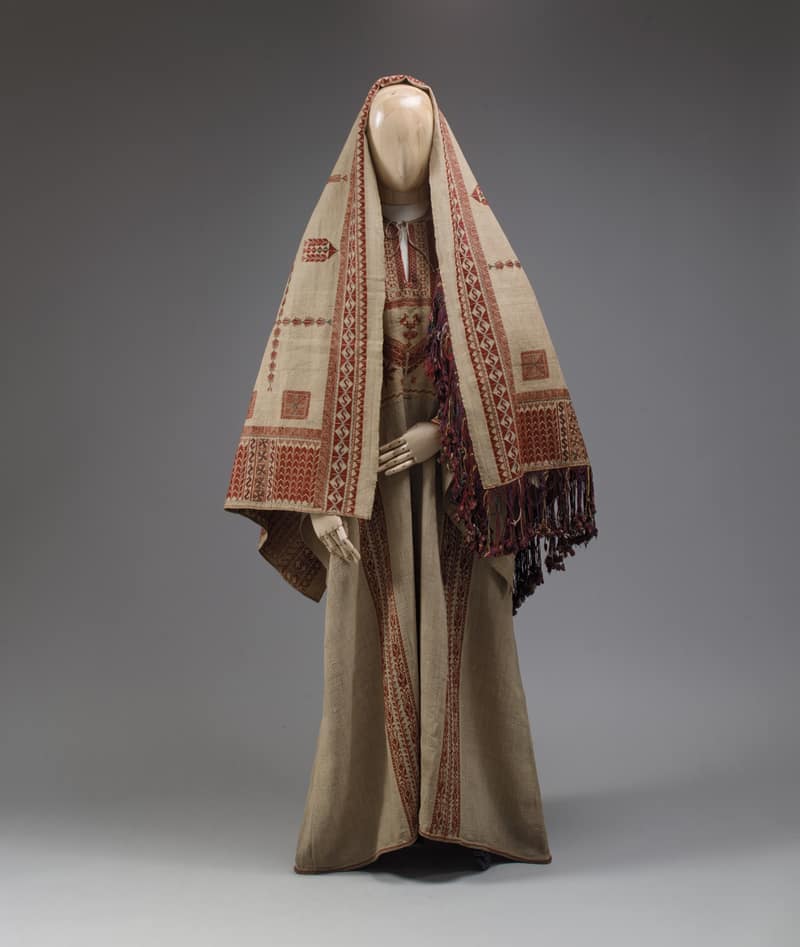
The thobe is the long, loose, sleeved dress worn by Palestinian women, cut differently from district to district. Its decorated elements have names and fixed positions: the qabbeh, the embroidered square at the chest; the banayiq, the side panels; the shinyar, the panel across the lower back. Over it might go a jillayeh, an embroidered coat often worn as the outer wedding garment. Where the embroidery itself is the subject of tatreez, the thobe is the architecture that embroidery is fitted to — and it is the cut, the ground fabric, and the headdress as much as the stitch that identified where a woman came from.
The regional differences were sharp. Southern Palestine dressed in heavy cotton and linen dyed deep indigo, a colour also held to turn away the evil eye. Bethlehem, called the Paris of central Palestine, specialised in couching rather than cross-stitch: the malak or “queen” wedding dress carried panels of gold-thread couched work descended from Byzantine vestment technique, and the brocaded back hem panel, the diyal, was fine enough that Bethlehem work was made commercially for buyers elsewhere. Headdresses were equally local. In Bethlehem and Lifta married women wore the shatweh, a tall conical cap that anchored the iznaq, the chin chain of coins. Around Ramallah the smadeh was an embroidered cap with a stiff padded rim covered in coins packed tightly across the top — a woman’s own cash reserve, worn on her head.
Nineteen forty-eight ended the system. With villages emptied and their populations mixed together in camps and cities, individual village styles stopped being made and were gradually replaced by a recognisably “Palestinian” style not tied to any one place. New forms then emerged from the camps themselves in the 1960s, among them the so-called six-branched dress. The thobe went on being made and worn — but as a national garment rather than a local address.
Sources
Connected in the archive
18 connected records18 records elsewhere in the archive are linked to this one, each by a piece of evidence you can read below.
named in this record — 6 records
One record names the other. A pointer for reading, not a claim that they belong to each other.
- Bethlehemبيت لحم
Evidence — Inferred from the text — read the evidence: In Bethlehem and Lifta married women wore the shatweh, a tall conical cap that anchored the iznaq, the chin chain of coins.
- Ramallahرام الله
Evidence — Inferred from the text — read the evidence: Around Ramallah the smadeh was an embroidered cap with a stiff padded rim covered in coins packed tightly across the top — a woman's own cash reserve, worn on her head.
- Tatreez
Evidence — Inferred from the text — read the evidence: Where the embroidery itself is the subject of tatreez, the thobe is the architecture that embroidery is fitted to — and it is the cut, the ground fabric, and the headdress as much as the stitch that identified where a woman came from.
- Tatreez
Evidence — Inferred from the text — read the evidence: Where the embroidery itself is the subject of tatreez, the thobe is the architecture that embroidery is fitted to — and it is the cut, the ground fabric, and the headdress as much as the stitch that identified where a woman came from.
- The Shatweh
Evidence — Inferred from the text — read the evidence: In Bethlehem and Lifta married women wore the shatweh, a tall conical cap that anchored the iznaq, the chin chain of coins.
- The Smadeh
Evidence — Inferred from the text — read the evidence: Around Ramallah the smadeh was an embroidered cap with a stiff padded rim covered in coins packed tightly across the top — a woman's own cash reserve, worn on her head.
names this record — 3 records
One record names the other. A pointer for reading, not a claim that they belong to each other.
- What a People Made
Evidence — From a recorded field in this archive: What the thread was for. The chest panel, the Ramallah coin headdress, the couched gold of Bethlehem: a dress you could read a district off.
- Palestinian Hip-Hop
Evidence — Inferred from the text — read the evidence: Her signature, the festival notes, is a blend of rapping and singing "paired with performing in a traditional Palestinian thobe."
- Widad Kawarوداد قعوار
Evidence — Inferred from the text — read the evidence: The value of the collection is that it is documented: a Bethlehem malak dress with its couched gold thread, a Ramallah thobe with its cypress and star motifs, a Galilee or Gaza piece with its own stitch vocabulary, each recorded with its place and its maker where known.
on a related subject — 9 records
Filed near each other — the same Mandate district, or the same uncommon subject tags.
- All That Remains: The Palestinian Villages Occupied and Depopulated by Israel in 1948
Evidence — Inferred from the text — read the evidence: Shared tag: "villages".
- Deqq
Evidence — Inferred from the text — read the evidence: Shared tag: "heritage".
- Emily Jacirإميلي جاسر
Evidence — Inferred from the text — read the evidence: Shared tag: "villages".
- Hebron Glass
Evidence — Inferred from the text — read the evidence: Shared tag: "heritage".
- Keffiyeh
Evidence — Inferred from the text — read the evidence: Shared tag: "dress".
- Samiha Khalilسميحة خليل
Evidence — Inferred from the text — read the evidence: Shared tag: "heritage".
- and 3 more
Cite this page
Every claim above carries its sources — citation is the point.
- Chicago
“The Thobe.” Culture, FALASTEEN.AI. Accessed 22 August 2026. https://falasteen.ai/culture/the-thobe.- MLA
“The Thobe.” Culture, FALASTEEN.AI, 2026, https://falasteen.ai/culture/the-thobe. Accessed 22 August 2026.- BibTeX
@misc{falasteen-the-thobe,
  title        = {The Thobe},
  howpublished = {\url{https://falasteen.ai/culture/the-thobe}},
  organization = {FALASTEEN.AI — A Living Archive for Palestine},
  year         = {2026},
  note         = {Accessed 2026-08-22}
}