Deqq
الدقّ
The tattooed marks worn on the chin, lips and hands by village and bedouin women in Palestine — recorded in photographs far more thoroughly than in writing.
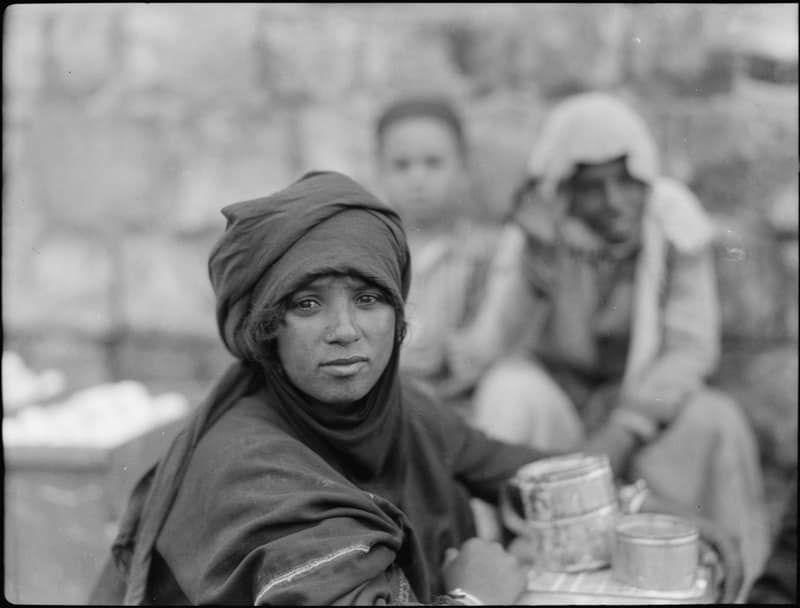
Deqq — also given as daqq, and as washm — is the tattooing worn by women across Palestine and the wider region: a short line or a small figure below the lower lip, marks at the chin and temple, bands and dots across the backs of the hands and the wrists. The pigment was worked into the skin with a needle along a design first drawn on the surface. The marks were permanent, and they were made in adolescence or at marriage, so that a woman carried them for the rest of her life.
The practice is far better recorded in photographs than in text. It appears repeatedly in the photographic collections made in Palestine before 1948 — the Library of Congress catalogues one 1935 Matson negative simply as “Bedouin girl in Tiberias with tatoo [i.e., tattoo] face” — and in the accounts of what the marks were for: beauty, protection from the evil eye, health and fertility, and in some communities identification with a particular group. This archive states that much and no more. Detailed, verifiable accounts of Palestinian deqq specifically — who did the tattooing, what each motif meant, how it varied by district — are thin in the published record, and where sources disagree we do not choose between them.
What can be said plainly is that the practice was ordinary, that it declined through the twentieth century, and that the women who still wear these marks are now the oldest generation. They are among the last people alive who were marked in a village that in many cases no longer exists.
Sources
Connected in the archive
16 connected records16 records elsewhere in the archive are linked to this one, each by a piece of evidence you can read below.
named in this record — 1 record
One record names the other. A pointer for reading, not a claim that they belong to each other.
- Tiberiasطبريا
Evidence — Inferred from the text — read the evidence: It appears repeatedly in the photographic collections made in Palestine before 1948 — the Library of Congress catalogues one 1935 Matson negative simply as "Bedouin girl in Tiberias with tatoo [i.e., tattoo] face" — and in the accounts of what the marks were for: beauty, protection from the evil eye, health and fertility, and in some communities identification with a particular group.
on a related subject — 15 records
Filed near each other — the same Mandate district, or the same uncommon subject tags.
- al-Araqibالعراقيب
Evidence — Inferred from the text — read the evidence: Shared tag: "bedouin".
- Gate of the Sun
Evidence — Inferred from the text — read the evidence: Shared tag: "memory".
- Hebron Glass
Evidence — Inferred from the text — read the evidence: Shared tag: "heritage".
- In the Presence of Absence
Evidence — Inferred from the text — read the evidence: Shared tag: "memory".
- Minor Detail
Evidence — Inferred from the text — read the evidence: Shared tag: "memory".
- Nakba Day
Evidence — Inferred from the text — read the evidence: Shared tag: "memory".
- and 9 more
Cite this page
Every claim above carries its sources — citation is the point.
- Chicago
“Deqq.” Culture, FALASTEEN.AI. Accessed 22 August 2026. https://falasteen.ai/culture/deqq.- MLA
“Deqq.” Culture, FALASTEEN.AI, 2026, https://falasteen.ai/culture/deqq. Accessed 22 August 2026.- BibTeX
@misc{falasteen-deqq,
  title        = {Deqq},
  howpublished = {\url{https://falasteen.ai/culture/deqq}},
  organization = {FALASTEEN.AI — A Living Archive for Palestine},
  year         = {2026},
  note         = {Accessed 2026-08-22}
}