Baladi Seeds
البذور البلدية
The heirloom varieties Palestinian farmers saved from harvest to harvest — jadu'i watermelon, abu samra wheat, baladi tomato — and the seed library in Battir working to put them back in the ground.
Baladi means “of the country” — local, native, ours. Applied to seed it names the varieties Palestinian farmers selected over generations for the conditions they actually farmed in: heat, thin soil, and rain that arrives in a narrow window and then stops. A baladi tomato tolerates drought. Baladi wheat and barley were bred by use, not by a breeding programme, and each season’s seed came from the previous season’s crop, kept back and stored rather than bought.
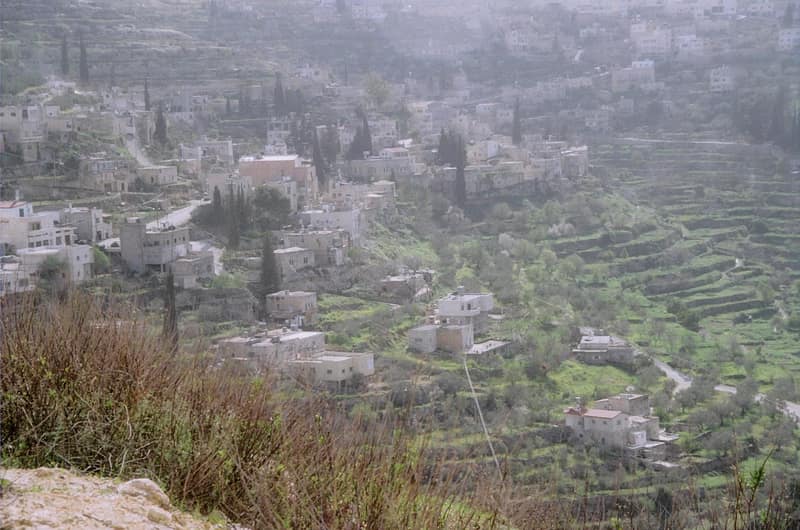
That cycle broke in the second half of the twentieth century, as it did across much of the world: hybrid and imported seed, sold annually and dependent on irrigation and inputs, displaced saved seed, and with it went both the varieties and the knowledge of how to keep them. In Palestine the loss compounded a political one, since land access, water, and movement were already constrained. The Palestine Heirloom Seed Library, founded by the conservationist and artist Vivien Sansour and based in the terraced village of Battir, works on the reverse: collecting surviving varieties, storing them, and getting them back into the hands of farmers who will grow them out.
The seeds carry their own histories. Abu Samra — “the dark handsome one” — is a wheat with black whiskers, known by that name rather than by a catalogue number. The jadu’i watermelon, once widely grown and famous for its size and flavour, had effectively vanished from Palestinian fields; Sansour searched for six years before finding seed of it in a farmer’s drawer. The library’s stores in Battir hold dozens of varieties, including baladi tomatoes, jadu’i watermelon, and yakteen gourds, kept coated in ash in jars. The argument behind the project is that a cuisine and a landscape are not separable from the plants they were built on, and that a seed is a document.
Sources
Connected in the archive
6 connected records6 records elsewhere in the archive are linked to this one, each by a piece of evidence you can read below.
on a related subject — 6 records
Filed near each other — the same Mandate district, or the same uncommon subject tags.
- The Olive Harvest
Evidence — From a recorded field in this archive: Shared tags: "farming", "land".
- Land Day
Evidence — Inferred from the text — read the evidence: Shared tag: "land".
- Sumud
Evidence — Inferred from the text — read the evidence: Shared tag: "land".
- The Sabr
Evidence — Inferred from the text — read the evidence: Shared tag: "land".
- Umm al-Fahmأم الفحم
Evidence — Inferred from the text — read the evidence: Shared tag: "land".
- Za'atar and Akkoub
Evidence — Inferred from the text — read the evidence: Shared tag: "land".
Cite this page
Every claim above carries its sources — citation is the point.
- Chicago
“Baladi Seeds.” Culture, FALASTEEN.AI. Accessed 22 August 2026. https://falasteen.ai/culture/baladi-seeds.- MLA
“Baladi Seeds.” Culture, FALASTEEN.AI, 2026, https://falasteen.ai/culture/baladi-seeds. Accessed 22 August 2026.- BibTeX
@misc{falasteen-baladi-seeds,
  title        = {Baladi Seeds},
  howpublished = {\url{https://falasteen.ai/culture/baladi-seeds}},
  organization = {FALASTEEN.AI — A Living Archive for Palestine},
  year         = {2026},
  note         = {Accessed 2026-08-22}
}