Za'atar and Akkoub
الزعتر والعكوب
Two wild plants at the centre of the Palestinian table — and the Israeli nature-protection laws that made picking them a criminal offence.
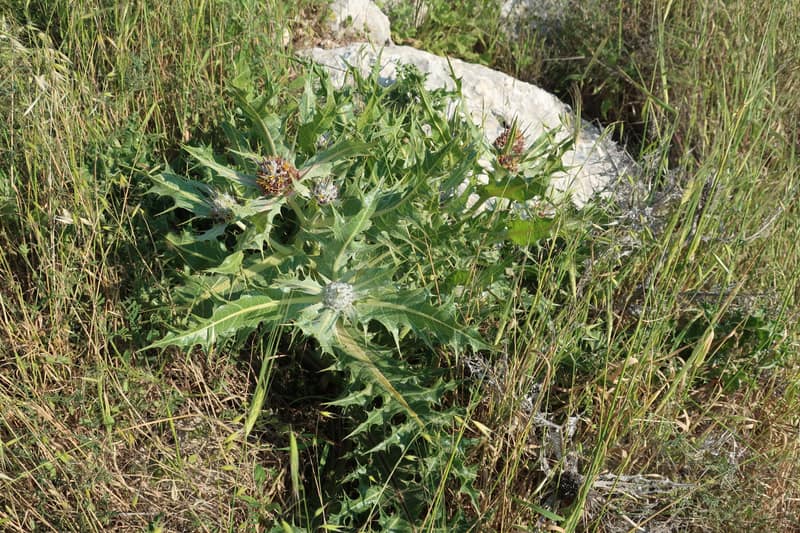
Za’atar — Origanum syriacum, wild Syrian oregano — grows on the limestone hills of the eastern Mediterranean, and Palestinians have gathered it there for as long as there is record of it. Dried, pounded with sumac, sesame and salt, it is eaten daily with olive oil and bread; fresh, it is folded into manaqish or eaten in salad. Akkoub (Gundelia tournefortii) is a spined thistle of the same hills, picked in a short spring season, its stems and hearts trimmed of thorns by hand — a laborious job usually done by women — and then stewed with lamb or with lemon and eggs. The picking is seasonal, social and generational: families go out together, and the routes are known.
In 1977 Ariel Sharon, then minister of agriculture, declared za’atar a protected plant under Israeli nature-protection law. Akkoub was added in 2005. The effect was to make foraging a criminal offence: picking, possessing or trading the plants can be punished by fines and, at the statutory maximum, up to three years’ imprisonment. Enforcement has fallen almost entirely on Palestinians — citizens of Israel in the Galilee and the Naqab, and residents of the occupied West Bank. Between 2016 and 2018, Israeli authorities issued 26 indictments and 151 fine notices for herb-gathering offences. Individual pickers have reported fines running into thousands of shekels.
The scientific case was always thin. The declarations rested largely on a single 1995 study of akkoub reflowering rates, which found that heavily harvested plants regrew at lower rates than untouched ones but did not recommend a blanket ban. Lawyers and ecologists have pointed out that the same regime does not restrict grazing, development or afforestation on the land where the plants grow, and that the burden of “protection” has fallen on the one activity that is culturally Palestinian.
In January 2019 Adalah — the Legal Center for Arab Minority Rights in Israel — wrote to the attorney general, the state attorney and the environmental protection minister demanding that the protected designation be cancelled and criminal enforcement suspended. The Nature and Parks Authority conceded that it was drafting a new policy, and told Adalah it expected to publish one by the beginning of August 2019. What followed was less than a reform. Rabea Eghbariah, the Adalah attorney who brought the case, records that in August 2019 the authority declared it would permit picking za’atar and akkoub in certain amounts from 2020, without cancelling the plants’ protected status or the criminal penalties attached to it; that contradictory statements about the permitted quantities followed; that enforcement was still being reported as of March 2020; and that a temporary policy allowing small amounts to be picked outside nature reserves was then suspended when the pandemic began. The authority also insisted throughout that the change was its own idea, unrelated to any legal demand or public criticism. Palestinians have continued to pick, and many describe the act, now, as a deliberate one.
Sources
Connected in the archive
9 connected records9 records elsewhere in the archive are linked to this one, each by a piece of evidence you can read below.
on a related subject — 9 records
Filed near each other — the same Mandate district, or the same uncommon subject tags.
- Baladi Seeds
Evidence — Inferred from the text — read the evidence: Shared tag: "land".
- Knafeh Nabulsiyeh
Evidence — Inferred from the text — read the evidence: Shared tag: "food".
- Land Day
Evidence — Inferred from the text — read the evidence: Shared tag: "land".
- Maftoul
Evidence — Inferred from the text — read the evidence: Shared tag: "food".
- Musakhan and Maqluba
Evidence — Inferred from the text — read the evidence: Shared tag: "food".
- Raja Shehadehرجا شحادة
Evidence — Inferred from the text — read the evidence: Shared tag: "law".
- and 3 more
Cite this page
Every claim above carries its sources — citation is the point.
- Chicago
“Za'atar and Akkoub.” Culture, FALASTEEN.AI. Accessed 22 August 2026. https://falasteen.ai/culture/zaatar-and-akkoub.- MLA
“Za'atar and Akkoub.” Culture, FALASTEEN.AI, 2026, https://falasteen.ai/culture/zaatar-and-akkoub. Accessed 22 August 2026.- BibTeX
@misc{falasteen-zaatar-and-akkoub,
  title        = {Za'atar and Akkoub},
  howpublished = {\url{https://falasteen.ai/culture/zaatar-and-akkoub}},
  organization = {FALASTEEN.AI — A Living Archive for Palestine},
  year         = {2026},
  note         = {Accessed 2026-08-22}
}