Maftoul
مفتول
Palestinian couscous, rolled by hand between the palms from bulgur and wheat flour — a grain that has to be made by somebody, and so is made in kitchens from Jenin to Kuwait to Amman.
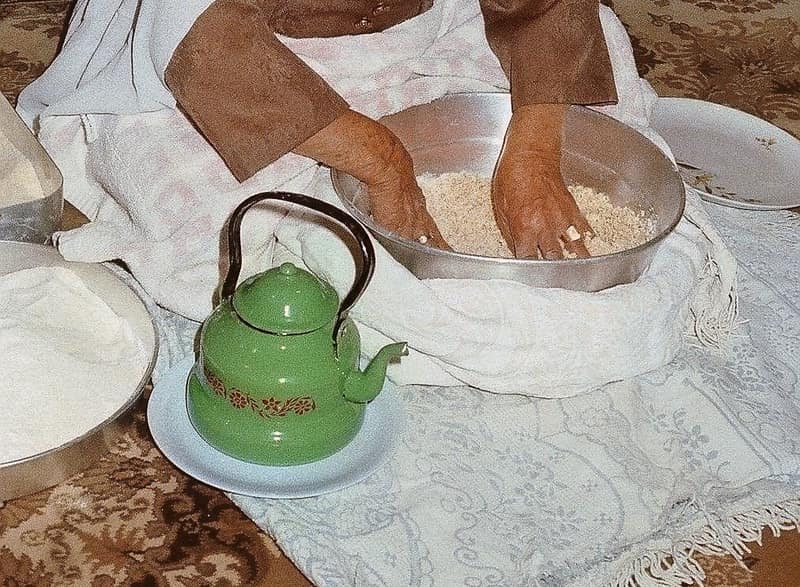
Maftoul means “rolled.” The name is the method: cracked bulgur is moistened and turned by hand in a wide bowl or tray while whole-wheat flour is sifted over it, so that each grain of bulgur takes a coat of dough and grows into a pearl. The pearls are sifted, graded and dried in the sun. Because it is rolled by human hands rather than extruded, no two grains are quite the same size, and a batch is visibly somebody’s work. It is usually cooked in chicken stock with chickpeas and onion, and it is winter food.
The making of it was never solo. Rolling maftoul is a day’s labour for several women together, and it is one of the household jobs that carried its own conversation — which is also why it survived displacement so well. The Palestinian producer Canaan Palestine, which buys from village women, describes its maftoul as “handmade the traditional way with whole wheat flour from local heirloom wheat” by “women cooperatives run by mothers who make it the same way as they do for their families.” The commercial form is recent; the practice it is built on is not.
The photograph on this page was taken in Kuwait in the 1980s. The woman rolling the maftoul had left Gaza in 1949; her family, publishing the picture, records that she went on making it, and teaching it, in exile. She was not unusual there. Palestinians began arriving in Kuwait in the late 1940s, and by 1965 they were almost seventeen percent of the country’s population — 78,000 of about 468,000, on BADIL’s figures — rising to roughly 400,000 by the end of the 1980s. Between March and June 1991 that community was expelled almost in its entirety, most of it to Jordan. The maftoul went to Jordan too.
Sources
Connected in the archive
14 connected records14 records elsewhere in the archive are linked to this one, each by a piece of evidence you can read below.
named in this record — 2 records
One record names the other. A pointer for reading, not a claim that they belong to each other.
- Canaan Palestine
Evidence — Inferred from the text — read the evidence: The Palestinian producer Canaan Palestine, which buys from village women, describes its maftoul as "handmade the traditional way with whole wheat flour from local heirloom wheat" by "women cooperatives run by mothers who make it the same way as they do for their families." The commercial form is recent; the practice it is built on is not.
- Jeninجنين
Evidence — Inferred from the text — read the evidence: Palestinian couscous, rolled by hand between the palms from bulgur and wheat flour — a grain that has to be made by somebody, and so is made in kitchens from Jenin to Kuwait to Amman.
on a related subject — 12 records
Filed near each other — the same Mandate district, or the same uncommon subject tags.
- Armed Struggle and the Search for State: The Palestinian National Movement, 1949–1993
Evidence — Inferred from the text — read the evidence: Shared tag: "diaspora".
- Enter Ghost
Evidence — Inferred from the text — read the evidence: Shared tag: "diaspora".
- Knafeh Nabulsiyeh
Evidence — Inferred from the text — read the evidence: Shared tag: "food".
- Laylat al-Henna
Evidence — Inferred from the text — read the evidence: Shared tag: "diaspora".
- Musakhan and Maqluba
Evidence — Inferred from the text — read the evidence: Shared tag: "food".
- Palestinian Hip-Hop
Evidence — Inferred from the text — read the evidence: Shared tag: "diaspora".
- and 6 more
Cite this page
Every claim above carries its sources — citation is the point.
- Chicago
“Maftoul.” Culture, FALASTEEN.AI. Accessed 22 August 2026. https://falasteen.ai/culture/maftoul.- MLA
“Maftoul.” Culture, FALASTEEN.AI, 2026, https://falasteen.ai/culture/maftoul. Accessed 22 August 2026.- BibTeX
@misc{falasteen-maftoul,
  title        = {Maftoul},
  howpublished = {\url{https://falasteen.ai/culture/maftoul}},
  organization = {FALASTEEN.AI — A Living Archive for Palestine},
  year         = {2026},
  note         = {Accessed 2026-08-22}
}