Musakhan and Maqluba
مسخن ومقلوبة
Two emblematic dishes of the Palestinian table: sumac-and-onion chicken over taboon bread, and the 'upside-down' rice pot.
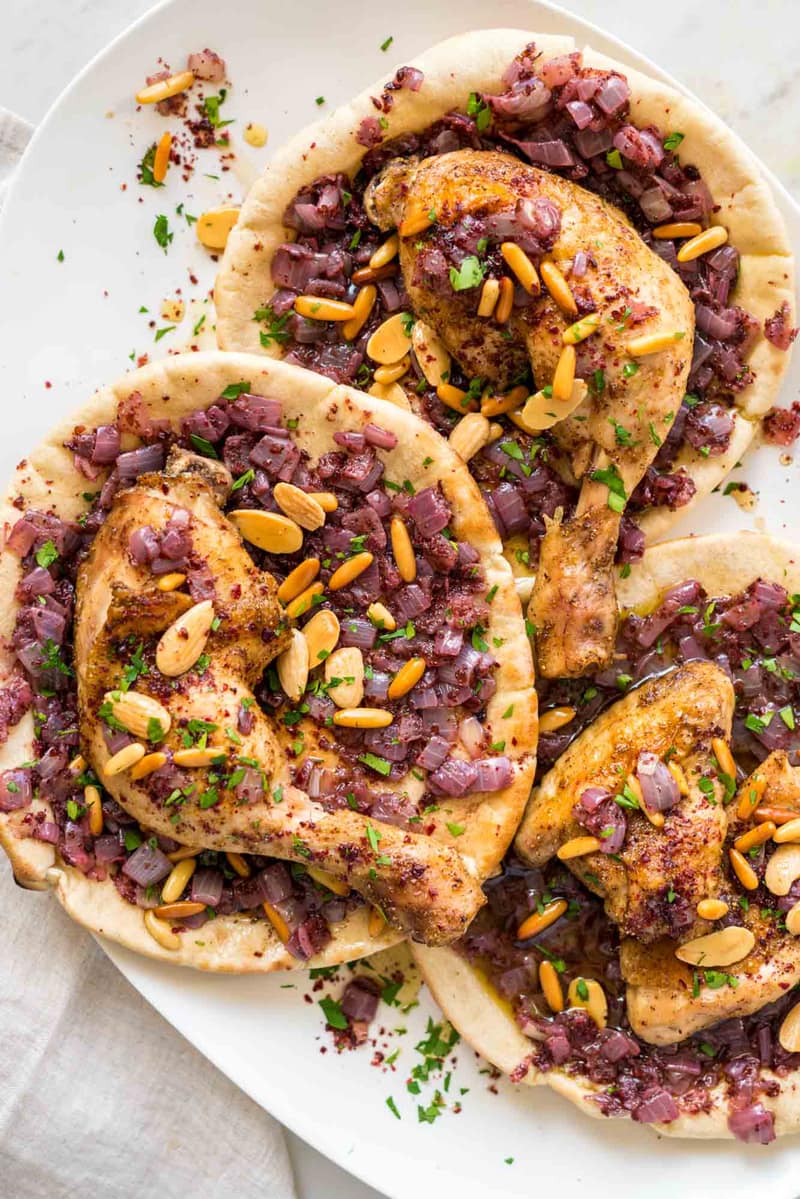
Musakhan is often called Palestine’s national dish. It layers roasted chicken, onions softened in olive oil, and a generous dusting of sumac over taboon bread, which absorbs the oil and juices. The dish is a celebration of the olive harvest itself — it is made with the new season’s oil — and its name, meaning “heated,” refers to the warming of the bread in the oil and onions. Cooking and sharing musakhan is a marker of hospitality and home.
Maqluba, meaning “upside-down,” is a one-pot dish of rice, fried vegetables — eggplant and cauliflower are classic — and meat or chicken, cooked in layers and then dramatically flipped onto a serving platter so the pot’s contents stand like a cake. The moment of inversion, in front of gathered family or guests, is the dish’s theater.
Both dishes are communal by design: food made to be eaten from a shared platter, with the hands, among family. In the diaspora, they are among the most-cooked dishes of memory — recipes carried across borders like the house keys of 1948.
Connected in the archive
7 connected records7 records elsewhere in the archive are linked to this one, each by a piece of evidence you can read below.
named in this record — 1 record
One record names the other. A pointer for reading, not a claim that they belong to each other.
- The Taboon
Evidence — Inferred from the text — read the evidence: It layers roasted chicken, onions softened in olive oil, and a generous dusting of sumac over taboon bread, which absorbs the oil and juices.
names this record — 1 record
One record names the other. A pointer for reading, not a claim that they belong to each other.
- What a People Made
Evidence — From a recorded field in this archive: What went on the bread, and what got turned out of the pot. Two dishes that carry the sumac and olive oil of the northern hills.
on a related subject — 5 records
Filed near each other — the same Mandate district, or the same uncommon subject tags.
- Knafeh Nabulsiyeh
Evidence — Inferred from the text — read the evidence: Shared tag: "food".
- Maftoul
Evidence — Inferred from the text — read the evidence: Shared tag: "food".
- Nabulsi Soap
Evidence — Inferred from the text — read the evidence: Shared tag: "olive oil".
- The Olive Harvest
Evidence — Inferred from the text — read the evidence: Shared tag: "olive oil".
- Za'atar and Akkoub
Evidence — Inferred from the text — read the evidence: Shared tag: "food".
Cite this page
Every claim above carries its sources — citation is the point.
- Chicago
“Musakhan and Maqluba.” Culture, FALASTEEN.AI. Accessed 22 August 2026. https://falasteen.ai/culture/musakhan-and-maqluba.- MLA
“Musakhan and Maqluba.” Culture, FALASTEEN.AI, 2026, https://falasteen.ai/culture/musakhan-and-maqluba. Accessed 22 August 2026.- BibTeX
@misc{falasteen-musakhan-and-maqluba,
  title        = {Musakhan and Maqluba},
  howpublished = {\url{https://falasteen.ai/culture/musakhan-and-maqluba}},
  organization = {FALASTEEN.AI — A Living Archive for Palestine},
  year         = {2026},
  note         = {Accessed 2026-08-22}
}