The Taboon
الطابون
The clay oven of the Palestinian village, its floor lined with stones that dimple the bread — the vessel that made taboon bread, and made bread-making a shared women's labour.
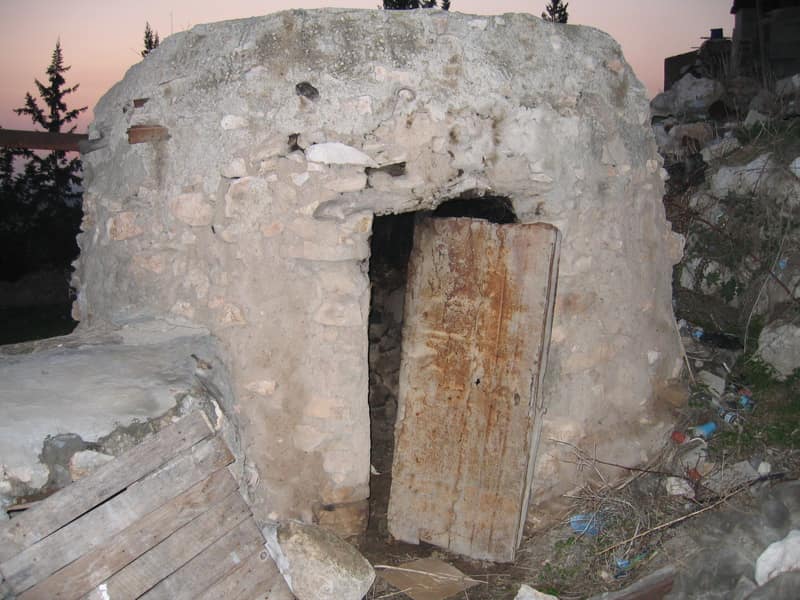
A taboon is a portable clay oven shaped like a truncated cone, roughly eighty centimetres across at the base and about thirty high, formed by hand from yellow pottery clay mixed with chopped straw and closed with a lid of clay or sheet metal. It sits over a shallow pit packed with material that holds heat — sand, gravel, broken glass, rock salt — into which smooth beach stones or flints are set. Unlike a tandoor, where dough is slapped onto the hot inner wall, taboon dough is laid directly on those stones. They are what gives the finished loaf its pocked, uneven underside, and its name.
Because the pit and its stones store heat over long hours, the taboon was rarely a single household’s affair. Communal taboons stood in Palestinian villages and were used in turn, and over the centuries bread-making around them became one of the organising social occasions of women’s daily life — a place where labour, news, and instruction moved together. The rhythm of the taboon set the rhythm of the day.
The bread that comes out is sturdy enough to serve as a plate, and that is the basis of musakhan, Palestine’s best-known dish, in which taboon bread sits beneath sumac-reddened onions and chicken and absorbs the new season’s olive oil without collapsing. The oven, the bread, and the dish are one continuous piece of technology: a village method for turning wheat, fuel, and oil into a meal.
Sources
Connected in the archive
5 connected records5 records elsewhere in the archive are linked to this one, each by a piece of evidence you can read below.
names this record — 3 records
One record names the other. A pointer for reading, not a claim that they belong to each other.
- What a People Made
Evidence — From a recorded field in this archive: The oven before the dish: a clay dome with a stone floor that dimples the loaf, and a bread-making that was shared labour among women.
- Musakhan and Maqluba
Evidence — Inferred from the text — read the evidence: It layers roasted chicken, onions softened in olive oil, and a generous dusting of sumac over taboon bread, which absorbs the oil and juices.
- The Saj
Evidence — Inferred from the text — read the evidence: Where the taboon is a clay oven built into the ground, its floor lined with stones that dimple the loaf, the saj is the opposite instrument: a domed or convex iron griddle, roughly sixty centimetres across, laid convex-side-up over an open fire.
on a related subject — 2 records
Filed near each other — the same Mandate district, or the same uncommon subject tags.
- Nabulsi Soap
Evidence — Inferred from the text — read the evidence: Shared tag: "olive oil".
- The Olive Harvest
Evidence — Inferred from the text — read the evidence: Shared tag: "olive oil".
Cite this page
Every claim above carries its sources — citation is the point.
- Chicago
“The Taboon.” Culture, FALASTEEN.AI. Accessed 22 August 2026. https://falasteen.ai/culture/taboon-bread.- MLA
“The Taboon.” Culture, FALASTEEN.AI, 2026, https://falasteen.ai/culture/taboon-bread. Accessed 22 August 2026.- BibTeX
@misc{falasteen-taboon-bread,
  title        = {The Taboon},
  howpublished = {\url{https://falasteen.ai/culture/taboon-bread}},
  organization = {FALASTEEN.AI — A Living Archive for Palestine},
  year         = {2026},
  note         = {Accessed 2026-08-22}
}