Nabulsi Soap
الصابون النابلسي
Ivory cubes of olive oil soap stacked in drying towers — an industry that made Nablus the soap capital of the Levant, and that has been dismantled by earthquake, border, and occupation.
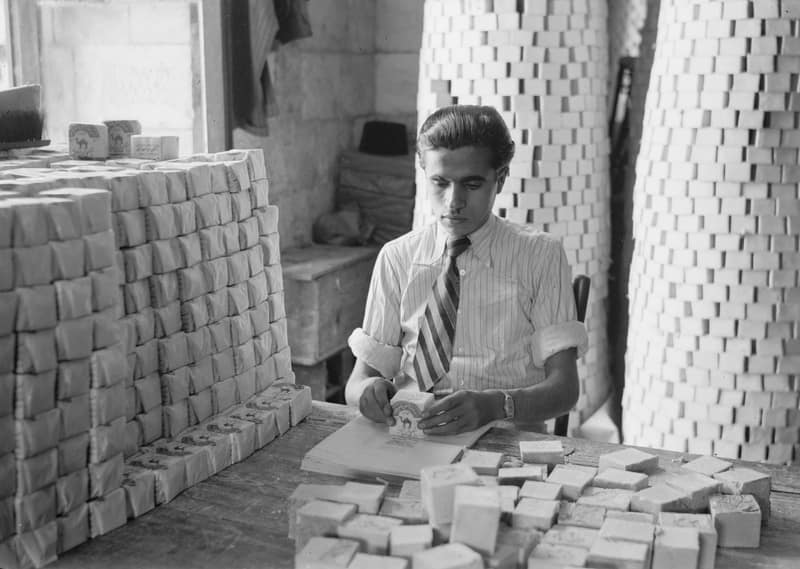
Nabulsi soap has three ingredients: virgin olive oil, water, and an alkali. Nothing else — no scent, no colour, no fat but the olive. Made first by women for their own households, it became an urban industry in Nablus by the fourteenth century, and in the nineteenth it became the dominant economic sector of the city. Owning a masbana was a marker of wealth and belonging among the great Nablus families — Touqan, Shaka’a, Nabulsi, Kan’an — and the soap was sold under brand names stamped into every cube: al-jamal (the camel), al-najma (the star), muftahein (the two keys), al-badr (the full moon). The alkali itself came from trade: until caustic soda was imported from Alexandria and Europe in the early twentieth century, the qilw — soda ash from desert plants — was supplied by Bedouin who alone could furnish it.
The process has changed little in two centuries. Olive oil, alkali and water are cooked for roughly three days in a ground-floor vat, the halla, until the foreman judges the texture by crumbling a sample in his hand. The hot soap is carried up in buckets and poured across the boards of the first floor, the mafrash, where it sets for a day. It is then scored into cubes, stamped with the factory’s mark, and built into hollow drying towers — the tananir, cones of stacked soap several metres high, through which air circulates for two to three months. Only then is it wrapped by hand, at five hundred to a thousand bars an hour.
At its height the industry was enormous. By 1907 the thirty factories of Nablus were producing close to 5,000 tons a year — more than half of all soap made in Palestine — and shipping it across Egypt, Syria and beyond. The decline came in stages, each one political. Egypt and Syria raised tariffs; the name “Nabulsi” was never protected against counterfeits; the British Mandate granted customs advantages to Jewish-owned competitors such as Haifa’s Shemen. The 1927 Jericho earthquake brought down much of the Old City and its factories with it. After 1948 the Palestinian and Egyptian markets closed at a stroke, and producers who had pressed local olives began importing oil from Syria, Lebanon, Spain and Italy.
What remained was reduced again by military force. Of the more than thirty soap factories in the Old City, several were damaged in the Israeli invasion of 2002 and two destroyed outright; most of the rest have been abandoned or put to other uses. Since 2007 only two have remained functional, belonging to the Touqan and Shaka’a families, who keep them going as heritage and export most of what they make to Jordan. The general manager of the Touqan factory put the loss plainly: before 2000 they produced 600 tons of soap a year; under closure and checkpoints, barely half that. In 2007 the director of the Nablus Chamber of Commerce told Al Jazeera that soap had fallen from 41.5 percent of the city’s exports in 2005 to 36.2 percent in 2006. The two surviving factories still fire their vats, and the once-defunct Arafat factory in the middle of the Old City has been restored as a cultural heritage centre, with exhibition space, a research centre and a working model factory that makes small batches by the old method — the craft surviving as heritage where it once survived as industry.
Sources
Connected in the archive
11 connected records11 records elsewhere in the archive are linked to this one, each by a piece of evidence you can read below.
named in this record — 1 record
One record names the other. A pointer for reading, not a claim that they belong to each other.
- Nablusنابلس
Evidence — Inferred from the text — read the evidence: Made first by women for their own households, it became an urban industry in Nablus by the fourteenth century, and in the nineteenth it became the dominant economic sector of the city.
names this record — 1 record
One record names the other. A pointer for reading, not a claim that they belong to each other.
- What a People Made
Evidence — From a recorded field in this archive: Olive oil cured into ivory cubes and stacked in drying towers. Nablus was the soap capital of the Levant; earthquake, border and occupation dismantled it.
on a related subject — 9 records
Filed near each other — the same Mandate district, or the same uncommon subject tags.
- Armenian Ceramics of Jerusalem
Evidence — Inferred from the text — read the evidence: Shared tag: "craft".
- Bethlehem Mother-of-Pearl
Evidence — Inferred from the text — read the evidence: Shared tag: "craft".
- Hebron Glass
Evidence — Inferred from the text — read the evidence: Shared tag: "craft".
- Knafeh Nabulsiyeh
Evidence — Inferred from the text — read the evidence: Shared tag: "nablus".
- Musakhan and Maqluba
Evidence — Inferred from the text — read the evidence: Shared tag: "olive oil".
- Palestinian Pottery
Evidence — Inferred from the text — read the evidence: Shared tag: "craft".
- and 3 more
Cite this page
Every claim above carries its sources — citation is the point.
- Chicago
“Nabulsi Soap.” Culture, FALASTEEN.AI. Accessed 22 August 2026. https://falasteen.ai/culture/nabulsi-soap.- MLA
“Nabulsi Soap.” Culture, FALASTEEN.AI, 2026, https://falasteen.ai/culture/nabulsi-soap. Accessed 22 August 2026.- BibTeX
@misc{falasteen-nabulsi-soap,
  title        = {Nabulsi Soap},
  howpublished = {\url{https://falasteen.ai/culture/nabulsi-soap}},
  organization = {FALASTEEN.AI — A Living Archive for Palestine},
  year         = {2026},
  note         = {Accessed 2026-08-22}
}