The Blue Thread of Beersheba
تطريز بئر السبع
In the Beersheba district the colour of the thread stated a woman's marital status: blue for the unmarried and the widowed, red and pink added when she married again.
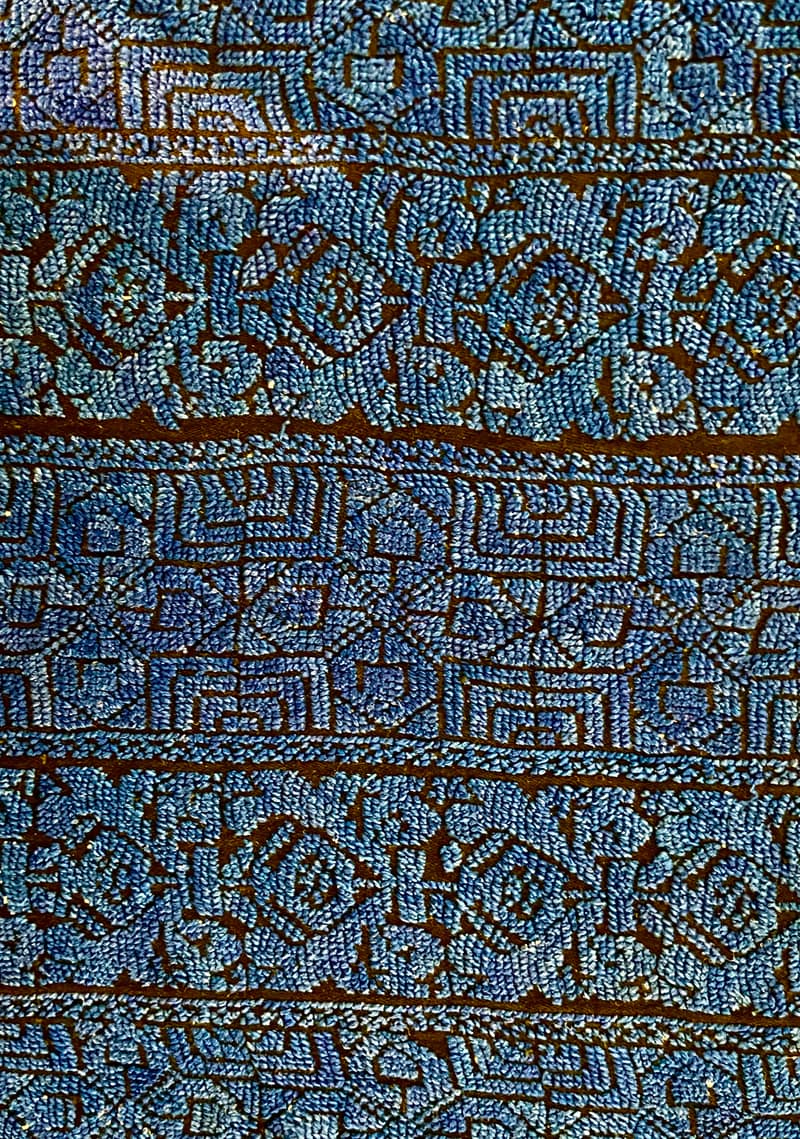
In the Beersheba district in the south, embroidery was not only decorative — it was legible. The thread colour on a woman’s dress stated where she stood: blue work was worn by an unmarried woman or a widow, and when a widow remarried, red and pink were worked into the blue. A stranger could read a woman’s circumstances across a courtyard without a word being spoken.
The stitching itself is dense counted cross-stitch on dark ground cloth, worked in tight bands of geometry rather than in the floral and tree motifs of the central hill districts. Southern Palestine also used heavy cotton and linen dyed deep indigo, a colour held to turn away the evil eye as well as to wear well.
The Beersheba district was emptied in and after 1948, and the dresses that survive are largely in collections — among them the Widad Kawar collection in Amman, assembled from the 1960s onward from women who had carried their dresses out with them. What is preserved there is not only cloth but a code that no longer has a village to be spoken in.
Sources
Connected in the archive
13 connected records13 records elsewhere in the archive are linked to this one, each by a piece of evidence you can read below.
set here — 1 record
- Bir al-Sabaبئر السبع
Evidence — From a recorded field in this archive: places: "Beersheba" → Bir al-Saba
named in this record — 1 record
One record names the other. A pointer for reading, not a claim that they belong to each other.
- Widad Kawarوداد قعوار
Evidence — Inferred from the text — read the evidence: The Beersheba district was emptied in and after 1948, and the dresses that survive are largely in collections — among them the Widad Kawar collection in Amman, assembled from the 1960s onward from women who had carried their dresses out with them.
on a related subject — 11 records
Filed near each other — the same Mandate district, or the same uncommon subject tags.
- Tatreez
Evidence — From a recorded field in this archive: Shared tags: "embroidery", "dress".
- The Qabbeh
Evidence — From a recorded field in this archive: Shared tags: "embroidery", "dress".
- Thob al-Intifada
Evidence — From a recorded field in this archive: Shared tags: "embroidery", "dress".
- al-Araqibالعراقيب
Evidence — Inferred from the text — read the evidence: Shared tag: "bedouin".
- Deqq
Evidence — Inferred from the text — read the evidence: Shared tag: "bedouin".
- Keffiyeh
Evidence — Inferred from the text — read the evidence: Shared tag: "dress".
- and 5 more
Cite this page
Every claim above carries its sources — citation is the point.
- Chicago
“The Blue Thread of Beersheba.” Culture, FALASTEEN.AI. Accessed 22 August 2026. https://falasteen.ai/culture/beersheba-embroidery.- MLA
“The Blue Thread of Beersheba.” Culture, FALASTEEN.AI, 2026, https://falasteen.ai/culture/beersheba-embroidery. Accessed 22 August 2026.- BibTeX
@misc{falasteen-beersheba-embroidery,
  title        = {The Blue Thread of Beersheba},
  howpublished = {\url{https://falasteen.ai/culture/beersheba-embroidery}},
  organization = {FALASTEEN.AI — A Living Archive for Palestine},
  year         = {2026},
  note         = {Accessed 2026-08-22}
}