Keffiyeh
كوفية
The black-and-white checkered headscarf that became the most recognizable emblem of Palestinian identity and resistance.
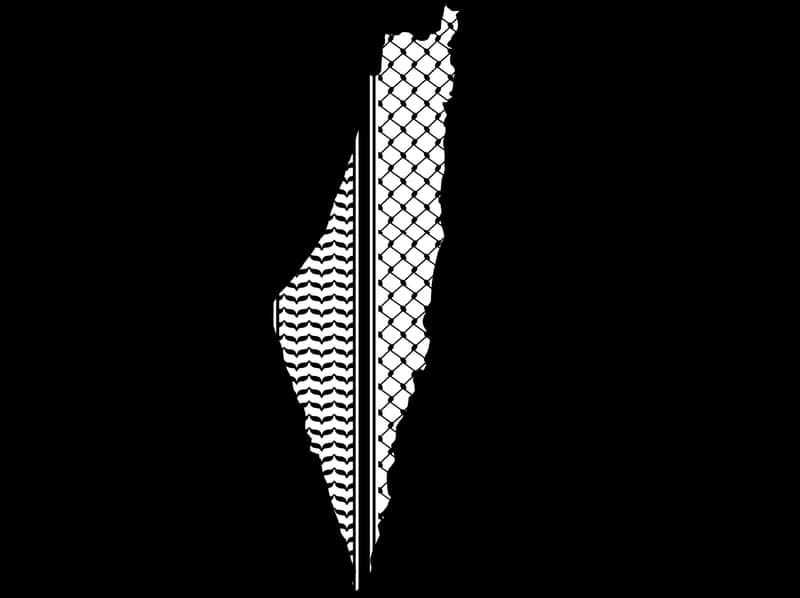
The keffiyeh is a square cotton headscarf, traditionally worn by farmers and villagers across Palestine and the Levant as protection against sun and dust. Its black-and-white fishnet pattern, held in place by the black agal cord, became over the twentieth century a marker of Palestinian rural identity.
During the 1936–1939 revolt, fighters adopted the keffiyeh as a uniform of resistance, and Palestinian urbanites wore it in solidarity. It gained global iconic status through Yasser Arafat, who draped it so its folds echoed the map of historic Palestine. After 1967, and again during the first intifada, wearing the keffiyeh became an act of defiance; Israel at times banned or confiscated it.
Today the keffiyeh is worn worldwide as a symbol of solidarity with Palestinians. Its appropriation as a fashion motif by companies with no connection to Palestine has been widely criticized, and campaigns have promoted keffiyehs woven at the Hirbawi factory in Hebron — the last remaining keffiyeh loom in Palestine, operating since 1961.
Sources
Connected in the archive
20 connected records20 records elsewhere in the archive are linked to this one, each by a piece of evidence you can read below.
named in this record — 4 records
One record names the other. A pointer for reading, not a claim that they belong to each other.
- Hebronالخليل
Evidence — Inferred from the text — read the evidence: Its appropriation as a fashion motif by companies with no connection to Palestine has been widely criticized, and campaigns have promoted keffiyehs woven at the Hirbawi factory in Hebron — the last remaining keffiyeh loom in Palestine, operating since 1961.
- Hirbawi
Evidence — Inferred from the text — read the evidence: Its appropriation as a fashion motif by companies with no connection to Palestine has been widely criticized, and campaigns have promoted keffiyehs woven at the Hirbawi factory in Hebron — the last remaining keffiyeh loom in Palestine, operating since 1961.
- Intifada
Evidence — Inferred from the text — read the evidence: After 1967, and again during the first intifada, wearing the keffiyeh became an act of defiance; Israel at times banned or confiscated it.
- Yasser Arafatياسر عرفات
Evidence — Inferred from the text — read the evidence: It gained global iconic status through Yasser Arafat, who draped it so its folds echoed the map of historic Palestine.
names this record — 2 records
One record names the other. A pointer for reading, not a claim that they belong to each other.
- Palestinian Hip-Hop
Evidence — Inferred from the text — read the evidence: A Palestinian raised in London, working in a form invented in the Bronx, on a stage at an Indigenous Sámi festival in Arctic Norway in July 2025 — singing in Arabic, in a dress whose cross-stitch grammar was worked out in Palestinian villages in the nineteenth century, holding a keffiyeh above her head.
- The Hirbawi Loom
Evidence — Inferred from the text — read the evidence: The keffiyeh's pattern is a weave, not a print: the fishnet ground, the bands of solid stripe at the ends, and the row of hooked motifs are structural, produced by the shedding of warp against weft on machines that have been kept running and repaired for six decades.
on a related subject — 14 records
Filed near each other — the same Mandate district, or the same uncommon subject tags.
- Abd al-Rahim Mahmoudعبد الرحيم محمود
Evidence — Inferred from the text — read the evidence: Shared tag: "resistance".
- Dammi Falastini
Evidence — Inferred from the text — read the evidence: Shared tag: "identity".
- Hamas Contained: The Rise and Pacification of Palestinian Resistance
Evidence — Inferred from the text — read the evidence: Shared tag: "resistance".
- Jeninجنين
Evidence — Inferred from the text — read the evidence: Shared tag: "resistance".
- Perfect Victims: And the Politics of Appeal
Evidence — Inferred from the text — read the evidence: Shared tag: "resistance".
- Sumud
Evidence — Inferred from the text — read the evidence: Shared tag: "resistance".
- and 8 more
Cite this page
Every claim above carries its sources — citation is the point.
- Chicago
“Keffiyeh.” Culture, FALASTEEN.AI. Accessed 22 August 2026. https://falasteen.ai/culture/keffiyeh.- MLA
“Keffiyeh.” Culture, FALASTEEN.AI, 2026, https://falasteen.ai/culture/keffiyeh. Accessed 22 August 2026.- BibTeX
@misc{falasteen-keffiyeh,
  title        = {Keffiyeh},
  howpublished = {\url{https://falasteen.ai/culture/keffiyeh}},
  organization = {FALASTEEN.AI — A Living Archive for Palestine},
  year         = {2026},
  note         = {Accessed 2026-08-22}
}