The Hirbawi Loom
مصنع الحرباوي
A weaving shed in Hebron, opened in 1961, that is the last place in Palestine where the Palestinian keffiyeh is still made.
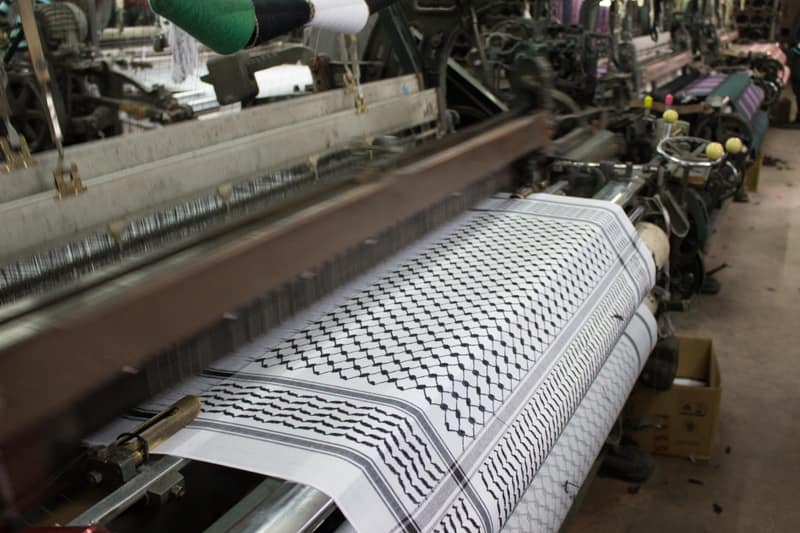
Yasser Hirbawi opened his factory in Hebron — al-Khalil — in 1961, when it was one of a number of workshops in Palestine weaving the black-and-white cotton headscarf. It is now the only one. Kufiya.org, the platform through which the factory sells, states the position plainly: “the Hirbawi Kufiya is the last kufiya still actively produced in Palestine.”
What the loom does is not sentimental. The keffiyeh’s pattern is a weave, not a print: the fishnet ground, the bands of solid stripe at the ends, and the row of hooked motifs are structural, produced by the shedding of warp against weft on machines that have been kept running and repaired for six decades. The photograph on this page shows a scarf coming off one of those looms in December 2015, the pattern building line by line as the cloth advances.
The scarf itself is old and rural — a farmer’s protection from sun and dust across Palestine and the Levant, taken up as a uniform during the revolt of 1936–39, and after 1967 an object that could be confiscated. What is new, and what the loom in Hebron measures, is the gap between the keffiyeh as a globally reproduced motif and the keffiyeh as a manufactured Palestinian good. Millions are printed elsewhere every year. One factory in Hebron still weaves them.
Sources
Connected in the archive
5 connected records5 records elsewhere in the archive are linked to this one, each by a piece of evidence you can read below.
set here — 1 record
- Hebronالخليل
Evidence — From a recorded field in this archive: places: "Hebron" → Hebron
named in this record — 2 records
One record names the other. A pointer for reading, not a claim that they belong to each other.
- Hirbawi
Evidence — Inferred from the text — read the evidence: Yasser Hirbawi opened his factory in Hebron — al-Khalil — in 1961, when it was one of a number of workshops in Palestine weaving the black-and-white cotton headscarf.
- Keffiyeh
Evidence — Inferred from the text — read the evidence: The keffiyeh's pattern is a weave, not a print: the fishnet ground, the bands of solid stripe at the ends, and the row of hooked motifs are structural, produced by the shedding of warp against weft on machines that have been kept running and repaired for six decades.
on a related subject — 2 records
Filed near each other — the same Mandate district, or the same uncommon subject tags.
- Hebron Glass
Evidence — Inferred from the text — read the evidence: Shared tag: "hebron".
- Palestinian Pottery
Evidence — Inferred from the text — read the evidence: Shared tag: "hebron".
Cite this page
Every claim above carries its sources — citation is the point.
- Chicago
“The Hirbawi Loom.” Culture, FALASTEEN.AI. Accessed 22 August 2026. https://falasteen.ai/culture/the-hirbawi-loom.- MLA
“The Hirbawi Loom.” Culture, FALASTEEN.AI, 2026, https://falasteen.ai/culture/the-hirbawi-loom. Accessed 22 August 2026.- BibTeX
@misc{falasteen-the-hirbawi-loom,
  title        = {The Hirbawi Loom},
  howpublished = {\url{https://falasteen.ai/culture/the-hirbawi-loom}},
  organization = {FALASTEEN.AI — A Living Archive for Palestine},
  year         = {2026},
  note         = {Accessed 2026-08-22}
}