Armenian Ceramics of Jerusalem
الخزف الأرمني في القدس
A craft born from two catastrophes: Armenian genocide survivors brought to Jerusalem in 1919 to retile the Dome of the Rock, whose workshops became a Palestinian tradition.
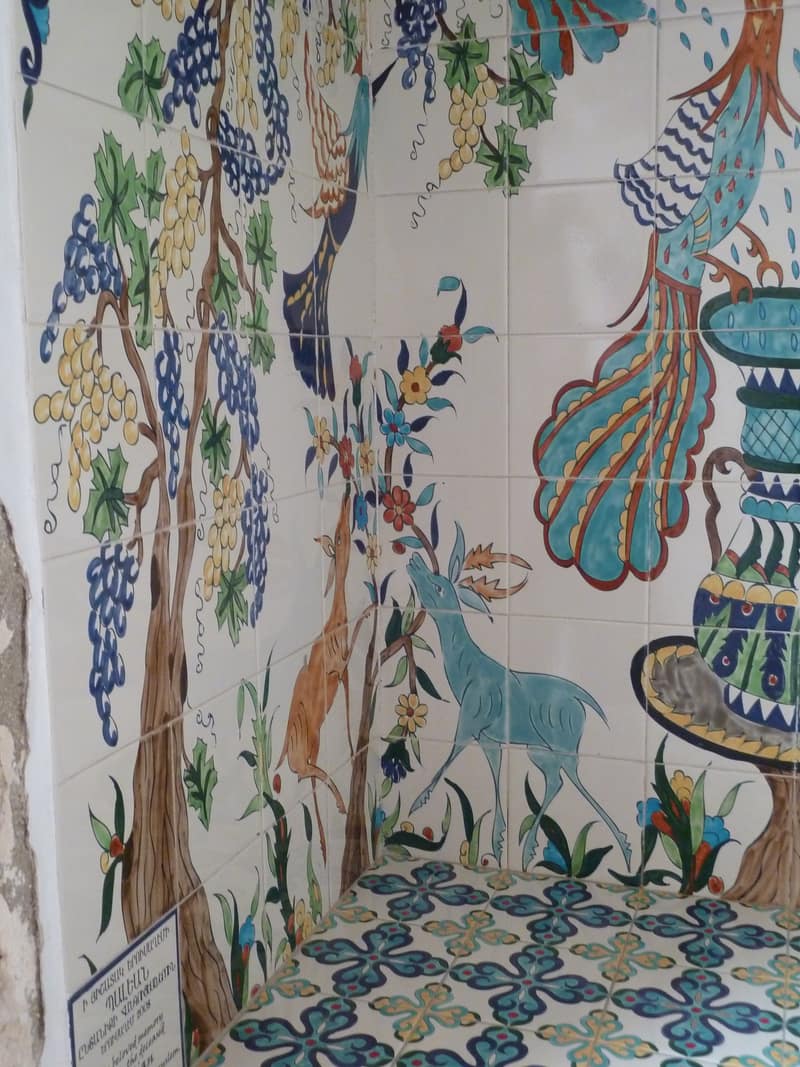
The blue-and-white tiles that mark shop fronts, street signs, church walls and house numbers across Jerusalem are barely a century old, and they arrived by way of a genocide. Tavit — David — Ohannessian was a master çiniçi from Kütahya in western Anatolia, a city whose largely Armenian-run potteries had carried the Iznik tile tradition for centuries. In 1911 the British diplomat Mark Sykes commissioned him to design some 2,700 tiles for a “Turkish Room” at the family estate at Sledmere in Yorkshire. In 1916 Ohannessian and his family were driven out of Kütahya with the rest of the Armenian population and survived a year-long deportation march to Aleppo.
At the end of 1918 Sykes found him among the Armenian refugees in Aleppo. The British administration in Jerusalem had concluded that the sixteenth-century Ottoman tilework of the Dome of the Rock was failing, and Sykes recommended Ohannessian for the work. He took his wife and three children to Jerusalem, then returned — carrying a transit document obtained through the British military administration — to the city from which he had been expelled, to recruit craftsmen. In the autumn of 1919 he brought back at least eight artisans, among them the thrower Neshan Balian and the master painter Mgrditch Karakashian, and opened a workshop on the Via Dolorosa under the name Dome of the Rock Tiles.
The restoration itself was never carried out. Funding failed, and there were objections to Christian craftsmen working on the Haram al-Sharif. The potters stayed. In 1922 Balian and Karakashian left Ohannessian to found their own studio, Palestine Pottery, on Nablus Road; the three families — Ohannessian, Balian, Karakashian — between them produced the tiled street signs of the Old City, the ceramic work of the Rockefeller Museum and the American Colony, and thousands of domestic pieces. What began as an Ottoman-Iznik idiom absorbed local subjects: gazelles, cypress and pomegranate, Jerusalem’s skyline, Arabic and Armenian calligraphy.
The craft was interrupted again in 1948, when the war cut through Jerusalem and Ohannessian, like the city’s other displaced residents, lost his home and workshop; the Balian and Karakashian families continued on Nablus Road, later separating into the workshops that still operate in East Jerusalem today, now in their fourth generation. Ohannessian’s story was reconstructed by his granddaughter, the flutist Sato Moughalian, in Feast of Ashes: The Life and Art of David Ohannessian (Stanford University Press, 2019) — the fullest account of how a Jerusalem art form was made by people who arrived as refugees.
Sources
Connected in the archive
24 connected records24 records elsewhere in the archive are linked to this one, each by a piece of evidence you can read below.
named in this record — 1 record
One record names the other. A pointer for reading, not a claim that they belong to each other.
- Jerusalemالقدس
Evidence — Inferred from the text — read the evidence: The British administration in Jerusalem had concluded that the sixteenth-century Ottoman tilework of the Dome of the Rock was failing, and Sykes recommended Ohannessian for the work.
names this record — 1 record
One record names the other. A pointer for reading, not a claim that they belong to each other.
- What a People Made
Evidence — From a recorded field in this archive: A craft founded by survivors of one genocide, brought to Jerusalem in 1919 to retile the Dome of the Rock, and left behind as a Palestinian tradition.
on a related subject — 22 records
Filed near each other — the same Mandate district, or the same uncommon subject tags.
- Abd al-Qadir al-Husayniعبد القادر الحسيني
Evidence — Inferred from the text — read the evidence: Shared tag: "Jerusalem".
- Aref al-Arefعارف العارف
Evidence — Inferred from the text — read the evidence: Shared tag: "Jerusalem".
- Bethlehem Mother-of-Pearl
Evidence — Inferred from the text — read the evidence: Shared tag: "craft".
- Dimitri Baramkiديمتري برامكي
Evidence — Inferred from the text — read the evidence: Shared tag: "Jerusalem".
- Edward W. Saidإدوارد سعيد
Evidence — Inferred from the text — read the evidence: Shared tag: "Jerusalem".
- Faisal al-Husseiniفيصل الحسيني
Evidence — Inferred from the text — read the evidence: Shared tag: "Jerusalem".
- and 16 more
Cite this page
Every claim above carries its sources — citation is the point.
- Chicago
“Armenian Ceramics of Jerusalem.” Culture, FALASTEEN.AI. Accessed 22 August 2026. https://falasteen.ai/culture/armenian-ceramics-of-jerusalem.- MLA
“Armenian Ceramics of Jerusalem.” Culture, FALASTEEN.AI, 2026, https://falasteen.ai/culture/armenian-ceramics-of-jerusalem. Accessed 22 August 2026.- BibTeX
@misc{falasteen-armenian-ceramics-of-jerusalem,
  title        = {Armenian Ceramics of Jerusalem},
  howpublished = {\url{https://falasteen.ai/culture/armenian-ceramics-of-jerusalem}},
  organization = {FALASTEEN.AI — A Living Archive for Palestine},
  year         = {2026},
  note         = {Accessed 2026-08-22}
}