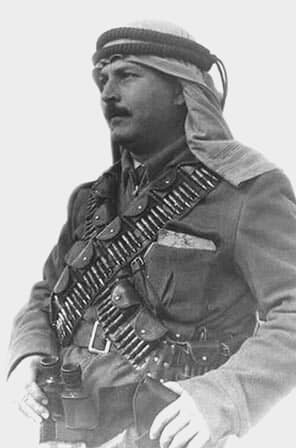
Abd al-Qadir al-Husayni
عبد القادر الحسيني
Commander of the Army of the Holy War, killed at al-Qastal in April 1948
The most prominent Palestinian field commander of his generation, who fought in the 1936–39 rebellion, rebuilt the Army of the Holy War after the partition resolution, and was killed retaking al-Qastal on 8 April 1948.
When Abd al-Qadir al-Husayni fell at al-Qastal, the Arab Higher Committee eulogized him as “a great and heroic commander who has gallantly led the battles of jihad in defense of Palestine ever since the year 1936.” He was born in Istanbul in 1908, son of Musa Kazim Pasha al-Husayni, and educated at the Rawdat al-Ma’arif school and Bishop Gobat’s School in Jerusalem before enrolling in the science faculty of the American University in Cairo to study mathematics. At his graduation ceremony in 1932 he stood up, accused the university of being a tool of imperialism, and was promptly expelled from Egypt. Back in Jerusalem he worked in the Land Settlement Office, wrote for the press, joined the Palestine Arab Party and ran its Jerusalem bureau — then resigned his post for full-time nationalist work.
With the outbreak of the Great Rebellion in April 1936 he became one of the founders of the Holy War Organization (al-Jihad al-Muqaddas) in the Jerusalem district, fighting alongside the Syrian commander Sa’id al-‘As. Wounded and captured at the battle of al-Khudr near Bethlehem in October 1936, he escaped from the Jerusalem Military Hospital to Damascus; he slipped back into Palestine in 1938 as the revolt escalated and was severely wounded again at Bani Na’im that October. Pursued by the British military, he moved to Iraq, trained as a reserve officer in Baghdad, taught mathematics at the Military Academy, and took part in the April 1941 revolt of Rashid Ali al-Kailani against the British — for which he was interned, then imprisoned in the al-‘Amara camp until the end of 1943. Two years as the guest of King Abdulaziz Ibn Saud followed, during which he travelled secretly to Germany and spent six weeks training in the manufacture and use of explosives and mines.
From Cairo in 1946 he organized the purchase of weapons left in the western desert battlefields of the world war and their smuggling into Palestine through al-Arish and Sidon. In December 1947, after the UN partition resolution and the Arab Higher Committee’s call to jihad, he crossed back into Palestine and reformed the Army of the Holy War under his command. Its forces fought Zionist units around Jerusalem, its settlements and its lines of communication; its explosives unit carried out major operations, the most notable the blowing up of the Jewish Agency building in Jerusalem.
At the end of March 1948 he travelled to Damascus to demand that the Arab League’s Military Committee supply him with arms equal to what the Zionist forces possessed to defend Jerusalem. He failed, and while he was there Zionist forces took al-Qastal, the strategic village commanding the Jerusalem–Jaffa road. He returned deeply disappointed, went directly to the field, and led the counter-attack that recovered the village; he was killed in the battle on 8 April 1948. Massive crowds attended his funeral, and he was buried in the vicinity of the Haram al-Sharif beside his father. His son Faisal al-Husseini later led the Palestinian national institutions in Jerusalem.
Sources
Further reading
An external biography or archive holding more on this life than the entry above.
Connected in the archive
17 connected records17 records elsewhere in the archive are linked to this one, each by a piece of evidence you can read below.
named in this record — 4 records
One record names the other. A pointer for reading, not a claim that they belong to each other.
- Al-Qastalالقسطل
Evidence — Inferred from the text — read the evidence: …When Abd al-Qadir al-Husayni fell at al-Qastal, the Arab Higher Committee eulogized him as "a great and heroic commander who has gallantly led the battles of jihad in defense of Palestine ever since the year 1936." He was born in Istanbul in…
- Bethlehemبيت لحم
Evidence — Inferred from the text — read the evidence: Wounded and captured at the battle of al-Khudr near Bethlehem in October 1936, he escaped from the Jerusalem Military Hospital to Damascus; he slipped back into Palestine in 1938 as the revolt escalated and was severely wounded again at Bani Na'im that October.
- Faisal al-Husseiniفيصل الحسيني
Evidence — Inferred from the text — read the evidence: His son Faisal al-Husseini later led the Palestinian national institutions in Jerusalem.
- Jerusalemالقدس
Evidence — Inferred from the text — read the evidence: …the year 1936." He was born in Istanbul in 1908, son of Musa Kazim Pasha al-Husayni, and educated at the Rawdat al-Ma'arif school and Bishop Gobat's School in Jerusalem before enrolling in the science faculty of the American University in Cairo to study mathematics.…
names this person — 3 records
One record names the other. A pointer for reading, not a claim that they belong to each other.
- Ishwa'إشْوَع
Evidence — Inferred from the text — read the evidence: The following week Palestinian militia under the command of 'Abd al-Qadir al-Husayni attacked the neighbouring settlement of Hartuv.
- The Battle of al-Qastal
Evidence — Inferred from the text — read the evidence: Facing it stood Abd al-Qadir al-Husayni, the Jerusalem-born commander who had founded the secret Organization for Holy Struggle in late 1933 and led the Army of the Holy War (Jaysh al-Jihad al-Muqaddas) through the revolt of 1936–39 and again in the war of 1948.
- The Husayni familyالحسيني
Evidence — Inferred from the text — read the evidence: …lent support to the Nazi war effort — remains the most contested chapter of the family's history; he died in Beirut in 1974. In 1948 it was Musa Kazim's son, Abd al-Qadir al-Husayni, who commanded the Holy War Army and was killed at the battle of al-Qastal on 8 April 1948, days before Deir Yassin.…
on a related subject — 10 records
Filed near each other — the same Mandate district, or the same uncommon subject tags.
- Dimitri Baramkiديمتري برامكي
Evidence — From a recorded field in this archive: Shared tags: "1948", "Jerusalem".
- Armenian Ceramics of Jerusalem
Evidence — Inferred from the text — read the evidence: Shared tag: "Jerusalem".
- Expulsion of the Palestinians: The Concept of "Transfer" in Zionist Political Thought, 1882–1948
Evidence — Inferred from the text — read the evidence: Shared tag: "1948".
- Izz al-Din al-Qassamعز الدين القسّام
Evidence — Inferred from the text — read the evidence: Shared tag: "Great Rebellion".
- Mapping My Return: A Palestinian Memoir
Evidence — Inferred from the text — read the evidence: Shared tag: "1948".
- Nazarethالناصرة
Evidence — Inferred from the text — read the evidence: Shared tag: "1948".
- and 4 more
Cite this page
Every claim above carries its sources — citation is the point.
- Chicago
“Abd al-Qadir al-Husayni.” Figures, FALASTEEN.AI. Accessed 22 August 2026. https://falasteen.ai/figures/abd-al-qadir-al-husayni.- MLA
“Abd al-Qadir al-Husayni.” Figures, FALASTEEN.AI, 2026, https://falasteen.ai/figures/abd-al-qadir-al-husayni. Accessed 22 August 2026.- BibTeX
@misc{falasteen-abd-al-qadir-al-husayni,
  title        = {Abd al-Qadir al-Husayni},
  howpublished = {\url{https://falasteen.ai/figures/abd-al-qadir-al-husayni}},
  organization = {FALASTEEN.AI — A Living Archive for Palestine},
  year         = {2026},
  note         = {Accessed 2026-08-22}
}