Jerusalem
القدس
Jerusalem — al-Quds — is the city Palestinians measure all distance from: holy to three faiths, capital in memory and aspiration, and since 1967 the hardest fault line of the conflict, from the walls of the Old City to the threatened homes of Sheikh Jarrah.
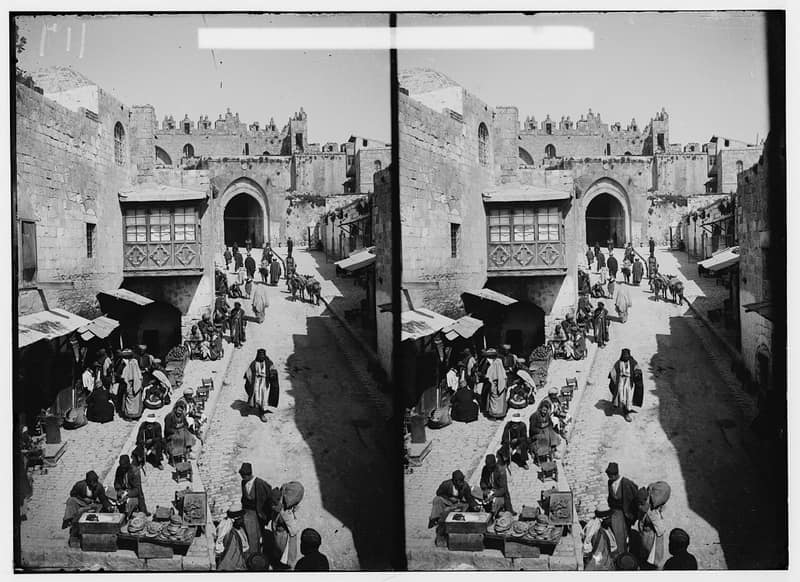
Few cities have been prayed over and fought over as long as Jerusalem. Settled since the Bronze Age on the hills between the Mediterranean and the Dead Sea, it grew from a Jebusite stronghold into the city of David and Solomon, was destroyed and rebuilt under Babylonians, Persians, Greeks and Romans, and crowned again in the seventh century with the Dome of the Rock. Within the walls raised in their present form by the Ottoman sultan Suleiman in the sixteenth century, the Old City — barely one square kilometre — holds the Al-Aqsa Mosque compound and the Dome of the Rock on al-Haram al-Sharif, the Church of the Holy Sepulchre, and the Western Wall, holy ground for Muslims, Christians and Jews alike. UNESCO inscribed the Old City and its walls as a World Heritage site in 1981, at Jordan’s proposal.
Palestinian Jerusalem lived in its quarters and markets: the Muslim, Christian and Armenian quarters of the Old City; the cloth and spice merchants of the vaulted suqs; ka’ak bread sold through the windows of street ovens around Damascus Gate; the presses, bookshops, schools and cafés of Salah al-Din Street and Jaffa Road that made the city, for centuries, the political and cultural capital of Palestine.
Since 1967 the city has been the conflict’s sharpest edge. Israel occupied East Jerusalem in June of that year, annexed some seventy square kilometres of surrounding West Bank land and declared the whole city its capital — an annexation made in breach of international law and never recognized by the international community. The Palestinians of the annexed areas were given the status of “permanent residents” rather than citizenship; according to B’Tselem, Israel has since revoked the residency of some 14,500 of them, expropriated more than a third of East Jerusalem’s land for Jewish-only neighborhoods, and cut the city off from the rest of the West Bank behind the separation barrier. In Sheikh Jarrah, just north of the Old City, Palestinian refugee families have for years fought eviction lawsuits brought by settler organizations — a struggle that in 2021 helped ignite protests across Palestine and beyond.
For Palestinians, al-Quds — “the Holy” — remains the compass. Refugees from Jaffa to Gaza named daughters and newspapers after it; its dome is stitched into embroidery and painted on camp walls from Jenin to Beirut. Its call to prayer still mixes with church bells over the Old City, and its people still marry, trade, bury their dead and hold on within its walls.
Sources
Cited works
4- whc.unesco.org(opens in a new tab)https://whc.unesco.org/en/list/148/
- britannica.com — Jerusalem(opens in a new tab)https://www.britannica.com/place/Jerusalem
- btselem.org — jerusalem(opens in a new tab)https://www.btselem.org/jerusalem
- ochaopt.org — statement humanitarian country team imminent eviction salem family sheikh jarrah east jerusalem(opens in a new tab)https://www.ochaopt.org/content/statement-humanitarian-country-team-imminent-eviction-salem-family-sheikh-jarrah-east-jerusalem
Cite this page
Every claim above carries its sources — citation is the point.
- Chicago
“Jerusalem.” Places, FALASTEEN.AI. Accessed 22 August 2026. https://falasteen.ai/places/jerusalem.- MLA
“Jerusalem.” Places, FALASTEEN.AI, 2026, https://falasteen.ai/places/jerusalem. Accessed 22 August 2026.- BibTeX
@misc{falasteen-jerusalem,
  title        = {Jerusalem},
  howpublished = {\url{https://falasteen.ai/places/jerusalem}},
  organization = {FALASTEEN.AI — A Living Archive for Palestine},
  year         = {2026},
  note         = {Accessed 2026-08-22}
}