Nazareth
الناصرة
Nazareth — al-Nasira, the childhood home of Jesus — is the city that survived 1948: ordered emptied, it was spared by a single officer's refusal, and grew into the largest Palestinian city in Israel and the cultural capital of the Palestinians of '48.
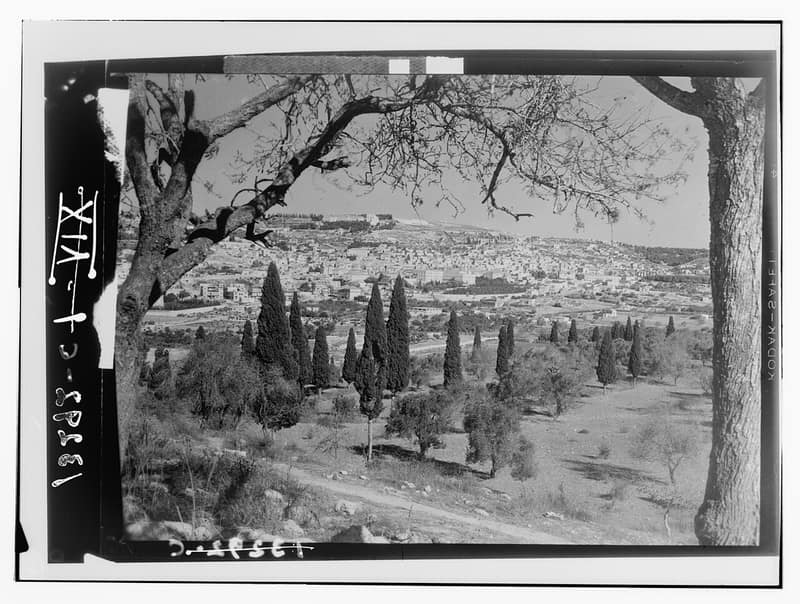
Nazareth was an unremarkable Galilean village — “Can anything good come out of Nazareth?” asks the Gospel of John — made immortal as the childhood home of Jesus. Pilgrims have come for centuries to the grotto venerated as the house of Mary, over which Byzantine, Crusader and Franciscan churches rose in turn; the present Basilica of the Annunciation, consecrated in 1969, is the largest church in the Middle East. Beneath its dome the town’s two faiths have long shared the lanes: the White Mosque stands a short walk from the basilica, and Mary’s Well still anchors the old center.
Under the Ottomans and the Mandate, Nazareth grew from village to market town — Christian and Muslim, its suq fragrant with spice mills and coffee, its stone houses stacked up the Galilean hillside. It was slated for the Arab state under the 1947 partition plan.
What happened in July 1948 made Nazareth the great exception of the Nakba. The city surrendered to Israeli forces on 16 July with virtually no resistance; the next day the commanding officer, Ben Dunkelman — a Canadian volunteer — received an order to expel its inhabitants, and refused. His superiors backed down, and Nazareth’s people stayed in their homes. The city then absorbed more than five thousand Palestinians displaced from surrounding villages that were destroyed, and in time became the largest Palestinian city in Israel — even as the development town of Nazareth Illit, now Nof HaGalil, was planted on the heights above it in the 1950s as part of the drive to “Judaize the Galilee.”
For Palestinians, Nazareth is the proof that remaining was possible — by one officer’s refusal and by the steadfastness of its own people. Today it is the cultural and political capital of the Palestinians of ‘48: its restored market and Elbabour spice mill, its churches and mosques, its theaters and newspapers speaking, in Arabic, for the community that was ordered to vanish and did not.
Sources
Cited works
2- haaretz.com — 0000017f dc33 d856 a37f fdf349bd0000(opens in a new tab)https://www.haaretz.com/jewish/2014-07-17/ty-article/.premium/this-day-officer-refuses-to-expel-arabs/0000017f-dc33-d856-a37f-fdf349bd0000
- hrw.org — israeli authorities and crimes apartheid and persecution(opens in a new tab)https://www.hrw.org/report/2021/04/27/threshold-crossed/israeli-authorities-and-crimes-apartheid-and-persecution
Cite this page
Every claim above carries its sources — citation is the point.
- Chicago
“Nazareth.” Places, FALASTEEN.AI. Accessed 22 August 2026. https://falasteen.ai/places/nazareth.- MLA
“Nazareth.” Places, FALASTEEN.AI, 2026, https://falasteen.ai/places/nazareth. Accessed 22 August 2026.- BibTeX
@misc{falasteen-nazareth,
  title        = {Nazareth},
  howpublished = {\url{https://falasteen.ai/places/nazareth}},
  organization = {FALASTEEN.AI — A Living Archive for Palestine},
  year         = {2026},
  note         = {Accessed 2026-08-22}
}