Jerusalem district · depopulated 1948 · 1 min read
Al-Qastal
القسطل
Al-Qastal was a tiny village on a commanding hill above the Jaffa–Jerusalem road. In April 1948 it became the pivot of the battle for Jerusalem: Palmach troops seized it during Operation Nachshon, and Abd al-Qadir al-Husayni, the best-known Palestinian commander of the war, was killed trying to win it back.
See Al-Qastal on the Atlas31.7969°N · 35.1442°E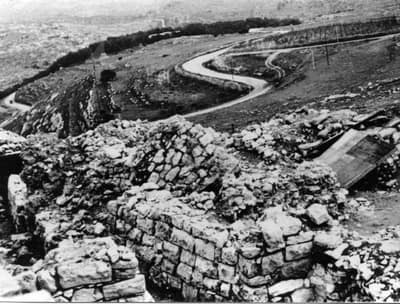
Al-Qastal crowned a high, rounded hill eight kilometers west of Jerusalem, overlooking the Jaffa–Jerusalem road where it begins its climb through the mountains. It took its name from a Crusader castle, Belveer, that once stood on the summit, and it was one of the smallest communities of the district: the 1945 British survey counted ninety residents, all Muslims, tending cereals and orchards on the slopes.
Its position made it decisive. In the spring of 1948 the Army of the Holy War used the height to attack convoys bound for besieged Jewish Jerusalem, and on 3 April, during Operation Nachshon, troops of the Palmach’s Harel Brigade took the village — most of its people had already fled the fighting. Abd al-Qadir al-Husayni, commander of the Jerusalem hills, led the counterattack, and in the foggy night of 7–8 April he was killed near the village. His fighters retook al-Qastal on 8 April and recovered his body, but his death broke the offensive: thousands left their positions to bury him at al-Aqsa, and on the night of 8–9 April the Palmach retook the nearly deserted hill, blew up its houses, and held it to the end of the war.
The hilltop ruins are now Israel’s Castel National Park, where preserved trenches and a monument commemorate the 1948 battles, and part of the town of Mevaseret Zion spreads over the village lands. For Palestinians, al-Qastal remains bound to the memory of al-Husayni, whose death — a day before Deir Yassin, in the same convulsed week — is often counted a turning point in the fall of Arab Jerusalem.
Sources
Cited works
3- palestineremembered.com — index(opens in a new tab)https://www.palestineremembered.com/Jerusalem/al-Qastal/index.html
- zochrot.org — en(opens in a new tab)https://www.zochrot.org/villages/village_details/49454/en
- palquest.org — al qastal(opens in a new tab)https://www.palquest.org/en/place/16868/al-qastal
Connected in the archive
31 connected records31 records elsewhere in the archive are linked to this one, each by a piece of evidence you can read below.
names this place — 4 records
One record names the other. A pointer for reading, not a claim that they belong to each other.
- Faisal al-Husseiniفيصل الحسيني
Evidence — Inferred from the text — read the evidence: Faisal al-Husseini was born in Baghdad on 17 July 1940, to a family at the centre of Palestinian national politics: his grandfather Musa Kazim al-Husseini headed the Jerusalem municipality from 1918 and led the Arab Executive Committee from 1920 until his death in 1934, and his father, Abd al-Qadir al-Husseini, commander of the Army of the Holy War, was killed at al-Qastal in April 1948.
- Qaluniyyaقالونيا
Evidence — Inferred from the text — read the evidence: The village sat just east of the battlefield of al-Qastal, astride the road that Arab forces were fighting to keep closed in the siege of Jewish Jerusalem.
- The Battle of al-Qastal
Evidence — Inferred from the text — read the evidence: In early April 1948, the hilltop village of al-Qastal, commanding the Tel Aviv–Jerusalem road, became the focus of the battle for the city's western approaches.
- The Husayni familyالحسيني
Evidence — Inferred from the text — read the evidence: …history; he died in Beirut in 1974. In 1948 it was Musa Kazim's son, Abd al-Qadir al-Husayni, who commanded the Holy War Army and was killed at the battle of al-Qastal on 8 April 1948, days before Deir Yassin.…
named in this record — 3 records
One record names the other. A pointer for reading, not a claim that they belong to each other.
- Abd al-Qadir al-Husayniعبد القادر الحسيني
Evidence — Inferred from the text — read the evidence: Abd al-Qadir al-Husayni, commander of the Jerusalem hills, led the counterattack, and in the foggy night of 7–8 April he was killed near the village.
- Deir Yassinدير ياسين
Evidence — Inferred from the text — read the evidence: For Palestinians, al-Qastal remains bound to the memory of al-Husayni, whose death — a day before Deir Yassin, in the same convulsed week — is often counted a turning point in the fall of Arab Jerusalem.
- Jerusalemالقدس
Evidence — Inferred from the text — read the evidence: Al-Qastal crowned a high, rounded hill eight kilometers west of Jerusalem, overlooking the Jaffa–Jerusalem road where it begins its climb through the mountains.
in the same district — 24 records
Filed near each other — the same Mandate district, or the same uncommon subject tags.
- 'Allarعَلاّر
Evidence — From a recorded field in this archive: Both recorded in the Jerusalem district.
- 'Artufعَرْتُوف
Evidence — From a recorded field in this archive: Both recorded in the Jerusalem district.
- 'Islinعِسْلِين
Evidence — From a recorded field in this archive: Both recorded in the Jerusalem district.
- Al-Malihaالمالِحَة
Evidence — From a recorded field in this archive: Both recorded in the Jerusalem district.
- Al-Qabuالقبو
Evidence — From a recorded field in this archive: Both recorded in the Jerusalem district.
- Al-Walajaالولجة
Evidence — From a recorded field in this archive: Both recorded in the Jerusalem district.
- and 18 more
Cite this page
Every claim above carries its sources — citation is the point.
- Chicago
“Al-Qastal.” Village Memory, FALASTEEN.AI. Accessed 22 August 2026. https://falasteen.ai/memory/qastal.- MLA
“Al-Qastal.” Village Memory, FALASTEEN.AI, 2026, https://falasteen.ai/memory/qastal. Accessed 22 August 2026.- BibTeX
@misc{falasteen-qastal,
  title        = {Al-Qastal},
  howpublished = {\url{https://falasteen.ai/memory/qastal}},
  organization = {FALASTEEN.AI — A Living Archive for Palestine},
  year         = {2026},
  note         = {Accessed 2026-08-22}
}