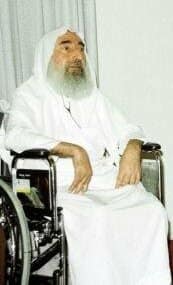
Sheikh Ahmed Yassin
أحمد إسماعيل ياسين
Founder and spiritual leader of Hamas, assassinated in Gaza in 2004
The quadriplegic refugee preacher from al-Jura who founded Hamas in December 1987 and was killed by Israeli helicopter missiles as he left dawn prayers in Gaza on 22 March 2004.
“The Israeli enemy leaves the Palestinian people only one choice: resistance, struggle, and martyrdom” — the sentence the Palestinian record preserves as Ahmed Yassin’s own summary of his politics. He was born in June 1936 in the village of al-Jura near al-Majdal, lost his father at five, and was driven with his family into the Gaza Strip in the Nakba of 1948, where they lived the refugee poverty of the camps; he left school for a year to work in a broad-bean restaurant to support the household. In the summer of 1952, at sixteen, he broke vertebrae in his neck while playing on the seashore, leaving him paralysed in all four limbs for the rest of his life. He finished secondary school in 1958, taught Arabic and Islamic education in UNRWA schools, preached in the mosques of Gaza, and in 1965 was jailed for a month by the Egyptian authorities on the charge of belonging to the Muslim Brotherhood.
After Israel occupied Gaza in June 1967 he preached resistance from the pulpit of the Abbas Mosque in Shati refugee camp and organized help for the families of prisoners and the dead. Chosen in 1968 to lead the Muslim Brotherhood in the Strip, he founded the Islamic Center (al-Mujamma’ al-Islami) in 1973 and helped found the Islamic University of Gaza in 1978. In April 1984 the Israeli authorities sentenced him to thirteen years for forming an armed group and possessing weapons; he was released in the May 1985 exchange between Israel and the PFLP–General Command. On 9 December 1987, as the First Intifada erupted, Yassin and a group of Islamic activists meeting at his house created the Movement of Islamic Resistance — Hamas — of which he was regarded ever after as the spiritual father.
The record runs in both directions and must be written whole. In May 1989 Israel arrested him and sentenced him to life plus fifteen years on nine indictments that included incitement to kill or kidnap Israeli soldiers and founding the movement’s military and security wings; contemporary reporting adds that the 1989 arrest concerned his ordering the killing of Palestinians suspected of collaboration. From 1994 onward Israelis buried their dead from Hamas suicide bombings that Israeli and American officials said were inspired and sanctioned by Yassin’s authority; the US State Department placed Hamas on its list of foreign terrorist organizations, and on the day of his death the Israeli army spokeswoman Ruth Yaron said, “Ahmed Yassin was the chief of a terror organization, who was aiming at Israeli civilians.” Within the Palestinian arena his relations with the Palestinian Authority were tense; Yasser Arafat twice placed him under house arrest after Hamas attacks. An attempt by the Izz al-Din al-Qassam Brigades to force his release through the kidnapping of the border policeman Nissim Toledano in December 1992 ended with Toledano found dead near Jerusalem.
Yassin was freed in October 1997, exchanged for the two Mossad agents captured in Amman after the failed poisoning of Khaled Mishal. After the second intifada began in September 2000 Israel moved to systematically assassinate the Hamas leadership: a first strike missed him on 6 September 2003, and at dawn on 22 March 2004, as the wheelchair-bound sheikh left a mosque in Gaza’s Sabra quarter after the dawn prayer, an Israeli Apache helicopter fired three missiles that killed him and seven companions and wounded two of his sons. Tens of thousands poured into the streets; the funeral prayer at the Omari Mosque overflowed into the city. The Palestinian prime minister Ahmed Qureia called the killing “a cowardly, criminal act against a prominent Palestinian leader who devoted all his life to the favor of the independence of his people,” and Arafat declared three days of official mourning.
Sources
Further reading
An external biography or archive holding more on this life than the entry above.
Connected in the archive
16 connected records16 records elsewhere in the archive are linked to this one, each by a piece of evidence you can read below.
born in — 1 record
- Al-Juraالجُورَة
Evidence — Inferred from the text — read the evidence: birthplace: "al-Jura, Palestine" → Al-Jura (Gaza) — 1 other village shares this name (Al-Jura, Jerusalem, Jerusalem); resolved to the only one with an archive record.
named in this record — 5 records
One record names the other. A pointer for reading, not a claim that they belong to each other.
- Intifada
Evidence — Inferred from the text — read the evidence: On 9 December 1987, as the First Intifada erupted, Yassin and a group of Islamic activists meeting at his house created the Movement of Islamic Resistance — Hamas — of which he was regarded ever after as the spiritual father.
- Izz al-Din al-Qassamعز الدين القسّام
Evidence — Inferred from the text — read the evidence: An attempt by the Izz al-Din al-Qassam Brigades to force his release through the kidnapping of the border policeman Nissim Toledano in December 1992 ended with Toledano found dead near Jerusalem.
- Jerusalemالقدس
Evidence — Inferred from the text — read the evidence: An attempt by the Izz al-Din al-Qassam Brigades to force his release through the kidnapping of the border policeman Nissim Toledano in December 1992 ended with Toledano found dead near Jerusalem.
- The First Intifada
Evidence — Inferred from the text — read the evidence: On 9 December 1987, as the First Intifada erupted, Yassin and a group of Islamic activists meeting at his house created the Movement of Islamic Resistance — Hamas — of which he was regarded ever after as the spiritual father.
- Yasser Arafatياسر عرفات
Evidence — Inferred from the text — read the evidence: …chief of a terror organization, who was aiming at Israeli civilians." Within the Palestinian arena his relations with the Palestinian Authority were tense; Yasser Arafat twice placed him under house arrest after Hamas attacks.…
names this person — 2 records
One record names the other. A pointer for reading, not a claim that they belong to each other.
- Abdel Aziz al-Rantisiعبد العزيز الرنتيسي
Evidence — Inferred from the text — read the evidence: On 9 December 1987 he was one of the seven Muslim Brotherhood leaders who met at the house of Sheikh Ahmed Yassin and decided to create the Movement of Islamic Resistance, Hamas.
- Fathi Shaqaqiفتحي الشقاقي
Evidence — Inferred from the text — read the evidence: Drawn first to Nasserism, he was thrown back on his beliefs by the defeat of 1967 and gravitated to the Muslim Brotherhood, which he joined after being introduced to Sheikh Ahmed Yassin.
on a related subject — 8 records
Filed near each other — the same Mandate district, or the same uncommon subject tags.
- Khalil al-Wazir (Abu Jihad)خليل الوزير (أبو جهاد)
Evidence — From a recorded field in this archive: Shared tags: "First Intifada", "assassination".
- Abu Ali Mustafaأبو علي مصطفى
Evidence — Inferred from the text — read the evidence: Shared tag: "assassination".
- Faisal al-Husseiniفيصل الحسيني
Evidence — Inferred from the text — read the evidence: Shared tag: "First Intifada".
- Ghassan Kanafaniغسان كنفاني
Evidence — Inferred from the text — read the evidence: Shared tag: "assassination".
- Hamas Contained: The Rise and Pacification of Palestinian Resistance
Evidence — Inferred from the text — read the evidence: Shared tag: "Hamas".
- Kamal Nasserكمال ناصر
Evidence — Inferred from the text — read the evidence: Shared tag: "assassination".
- and 2 more
Cite this page
Every claim above carries its sources — citation is the point.
- Chicago
“Sheikh Ahmed Yassin.” Figures, FALASTEEN.AI. Accessed 22 August 2026. https://falasteen.ai/figures/ahmed-yassin.- MLA
“Sheikh Ahmed Yassin.” Figures, FALASTEEN.AI, 2026, https://falasteen.ai/figures/ahmed-yassin. Accessed 22 August 2026.- BibTeX
@misc{falasteen-ahmed-yassin,
  title        = {Sheikh Ahmed Yassin},
  howpublished = {\url{https://falasteen.ai/figures/ahmed-yassin}},
  organization = {FALASTEEN.AI — A Living Archive for Palestine},
  year         = {2026},
  note         = {Accessed 2026-08-22}
}