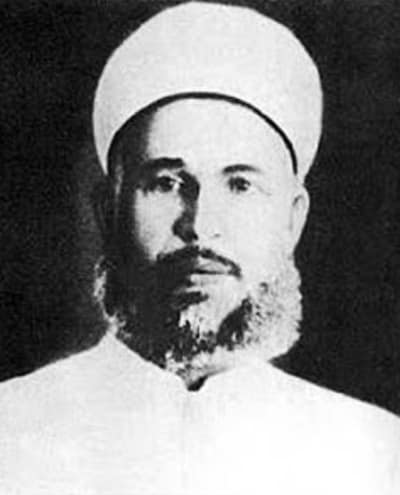
Izz al-Din al-Qassam
عز الدين القسّام
Preacher of Haifa's Istiqlal Mosque who organized the first armed revolt against British rule
The al-Azhar-educated preacher who ministered to Haifa's dispossessed peasants, declared armed revolt against British rule in November 1935, and whose death in battle at Ya'bad helped ignite the Great Rebellion of 1936–39.
Izz al-Din al-Qassam was born in 1882 in the town of Jabla, south of Latakia on the Syrian coast, where his father Abd al-Qadir ran the village Qur’an school. At fourteen he travelled to Cairo to attend the lectures given at al-Azhar Mosque by its most distinguished teachers, among them the reformer Shaykh Muhammad Abduh, and he was in Egypt during the aftermath of the Urabi rebellion against the British occupation. He returned to Jabla in 1903 with the Ahliyya diploma, succeeded his father in running the school, and became imam of the town’s Mansuri Mosque. After Italy attacked Libya in 1911 he called for aid to its people through demonstrations and volunteering, and in 1919–20 he was among the first to join the revolt against the French occupation of the Syrian coast, fighting in the mountains around the Citadel of Salah al-Din north of Latakia. The French authorities sentenced him to death.
In late 1920 he took refuge with his family in Haifa. He taught at the Burj secondary school run by the Muslim Society, gave religious lessons at the Istiqlal Mosque — becoming its imam and preacher — and founded a night school offering adult literacy classes. In July 1928 he was elected president of the Haifa branch of the Society of Muslim Youth, which he had helped to found, and in 1930 the Shari’a Court in Haifa appointed him a marriage registrar, work that took him through the villages of the Galilee. His congregation was above all the poor: the countryside people driven off lands that had passed into Jewish hands, who had migrated to Haifa to work in its port, industries and refinery and lived in the miserable suburbs east of the city.
Watching mass Jewish immigration grow in the early 1930s under British protection of the “Jewish National Home,” Qassam concluded that Britain was the root cause of the problem and that only armed struggle could restrain the Zionist project — on conditions he preached with rigour: sincerity of faith, abandonment of party and family loyalty, cooperation, sacrifice, secrecy, and strict organization and timing. He was reluctant to declare the revolt before his preparations were complete, but the flood of immigration, growing surveillance of his activities, and his fear of a pre-emptive move against him led him to declare jihad in Haifa on the night of 12 November 1935. With eleven companions he took to the forests near the village of Ya’bad in the Jenin district, and there, on 20 November, they fought a much larger British force for six hours. Qassam and four of his men were killed; the rest were wounded or captured.
Haifa declared a general strike in mourning on 21 November 1935, and thousands walked in the largest funeral procession the city had seen, burying him in the cemetery of Balad al-Shaykh. His death was to a large extent instrumental in igniting the Great Palestinian Rebellion of 1936–39, and his name has remained a source of inspiration for succeeding generations of Palestinian resistance — the military wing formed by Hamas in the late 1980s called itself the Izz al-Din al-Qassam Brigades.
Sources
Further reading
An external biography or archive holding more on this life than the entry above.
Connected in the archive
16 connected records16 records elsewhere in the archive are linked to this one, each by a piece of evidence you can read below.
names this person — 7 records
One record names the other. A pointer for reading, not a claim that they belong to each other.
- Abu Ali Mustafaأبو علي مصطفى
Evidence — Inferred from the text — read the evidence: Mustafa Ali al-Zabri was born on 14 May 1938 in Arraba, in the Jenin district, to Anisa and Ali al-Zabri, a farmer who had worked as a blacksmith on the railways and at the port of Haifa and who is believed to have joined Izz al-Din al-Qassam's band in the revolt of 1936.
- Farhan al-Saadiفرحان السعدي
Evidence — Inferred from the text — read the evidence: When he came out he went to Haifa, where he met Izz al-Din al-Qassam at the Istiqlal mosque and joined his movement.
- Jeninجنين
Evidence — Inferred from the text — read the evidence: …Under the Ottomans it was the market and seat of a district of villages known for their stubbornness, and in the 1930s that stubbornness became history: Izz al-Din al-Qassam, whose band opened the great revolt, was killed in the hills near Jenin in November 1935, and in 1938, after rebels briefly held the town, the British dynamited a quarter of its center in reprisal —…
- Nuh Ibrahimنوح إبراهيم
Evidence — Inferred from the text — read the evidence: He was a follower of Izz al-Din al-Qassam and was known by the name he was proudest of, tilmiz al-Qassam — the Student of Qassam.
- Sheikh Ahmed Yassinأحمد إسماعيل ياسين
Evidence — Inferred from the text — read the evidence: An attempt by the Izz al-Din al-Qassam Brigades to force his release through the kidnapping of the border policeman Nissim Toledano in December 1992 ended with Toledano found dead near Jerusalem.
- Songs of the 1936 Revolt
Evidence — Inferred from the text — read the evidence: He composed an elegy for Izz al-Din al-Qassam within days of his killing in November 1935 that was picked up and sung across Palestine; he composed for prisoners while inside Acre prison in 1937; he composed for peasants working vines and wheat.
- and 1 more
named in this record — 2 records
One record names the other. A pointer for reading, not a claim that they belong to each other.
- Balad al-Shaykhبلد الشيخ
Evidence — Inferred from the text — read the evidence: Haifa declared a general strike in mourning on 21 November 1935, and thousands walked in the largest funeral procession the city had seen, burying him in the cemetery of Balad al-Shaykh.
- Haifaحيفا
Evidence — Inferred from the text — read the evidence: In late 1920 he took refuge with his family in Haifa.
on a related subject — 7 records
Filed near each other — the same Mandate district, or the same uncommon subject tags.
- Abd al-Qadir al-Husayniعبد القادر الحسيني
Evidence — Inferred from the text — read the evidence: Shared tag: "Great Rebellion".
- Adalah — The Legal Center for Arab Minority Rights in Israel
Evidence — Inferred from the text — read the evidence: Shared tag: "Haifa".
- Elias Sanbarإلياس صنبر
Evidence — Inferred from the text — read the evidence: Shared tag: "Haifa".
- Leila Khaledليلى خالد
Evidence — Inferred from the text — read the evidence: Shared tag: "Haifa".
- Nakba and Survival: The Story of Palestinians Who Remained in Haifa and the Galilee, 1948–1956
Evidence — Inferred from the text — read the evidence: Shared tag: "Haifa".
- Sadhij Nassarساذج نصّار
Evidence — Inferred from the text — read the evidence: Shared tag: "Haifa".
- and 1 more
Cite this page
Every claim above carries its sources — citation is the point.
- Chicago
“Izz al-Din al-Qassam.” Figures, FALASTEEN.AI. Accessed 22 August 2026. https://falasteen.ai/figures/izz-ad-din-al-qassam.- MLA
“Izz al-Din al-Qassam.” Figures, FALASTEEN.AI, 2026, https://falasteen.ai/figures/izz-ad-din-al-qassam. Accessed 22 August 2026.- BibTeX
@misc{falasteen-izz-ad-din-al-qassam,
  title        = {Izz al-Din al-Qassam},
  howpublished = {\url{https://falasteen.ai/figures/izz-ad-din-al-qassam}},
  organization = {FALASTEEN.AI — A Living Archive for Palestine},
  year         = {2026},
  note         = {Accessed 2026-08-22}
}