Jenin
جنين
Jenin guarded the pass to the Jezreel plain for millennia, defied the British in the 1936 revolt, and held off Israel in June 1948; its refugee camp, born of the Nakba, fought the army for ten days in April 2002. The raids still come. The memory holds.
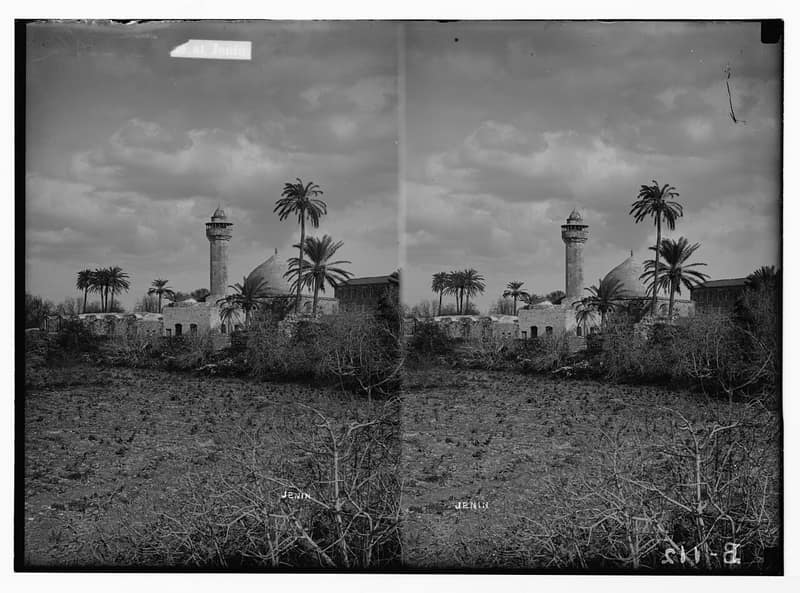
Jenin stands where the hills of the northern West Bank open onto Marj Ibn Amir, the Jezreel plain — a pass town since antiquity, plausibly the Ein Ganim of the Bible and the Grand Gerin of the Crusaders. Under the Ottomans it was the market and seat of a district of villages known for their stubbornness, and in the 1930s that stubbornness became history: Izz al-Din al-Qassam, whose band opened the great revolt, was killed in the hills near Jenin in November 1935, and in 1938, after rebels briefly held the town, the British dynamited a quarter of its center in reprisal — the rubble photographed by the American Colony’s cameras that same September.
In June 1948 the Iraqi army and local fighters defended Jenin in one of the war’s few clear Arab victories, and the town ended the fighting in what became the Jordanian-ruled West Bank. Refugees from the villages of Haifa, Nazareth and the Jezreel valley crowded in, and in 1953 UNRWA laid out Jenin camp on the town’s western edge — less than half a square kilometre that would become one of the most crowded and storied pieces of Palestine.
In April 2002, at the height of the second intifada, the Israeli army assaulted the camp in Operation Defensive Shield. Ten days of fighting killed 23 Israeli soldiers and at least 52 Palestinians — Human Rights Watch confirmed that at least 22 of the Palestinian dead were civilians — and army bulldozers flattened the camp’s Hawashin quarter, destroying some 140 buildings and leaving hundreds of families homeless. Early reports of a far larger massacre were not borne out by investigators, but Human Rights Watch documented unlawful killings and wanton destruction that it concluded amounted to war crimes.
The camp rebuilt, and made culture part of its defiance: the Freedom Theatre, founded in 2006 by Juliano Mer-Khamis, who was shot dead outside it in 2011, and the restored Cinema Jenin. The raids have never stopped — the large incursions of 2023, and from January 2025 the operation the army called Iron Wall, which emptied the camp and demolished whole blocks, drew protests from the United Nations. Jenin endures as it began the century: poor, crowded and unbowed — the town that memory made a stronghold.
Sources
Cited works
2- unrwa.org — jenin camp(opens in a new tab)https://www.unrwa.org/where-we-work/west-bank/jenin-camp
- palestineremembered.com — index(opens in a new tab)https://www.palestineremembered.com/Jenin/Jenin/index.html
Cite this page
Every claim above carries its sources — citation is the point.
- Chicago
“Jenin.” Places, FALASTEEN.AI. Accessed 22 August 2026. https://falasteen.ai/places/jenin.- MLA
“Jenin.” Places, FALASTEEN.AI, 2026, https://falasteen.ai/places/jenin. Accessed 22 August 2026.- BibTeX
@misc{falasteen-jenin,
  title        = {Jenin},
  howpublished = {\url{https://falasteen.ai/places/jenin}},
  organization = {FALASTEEN.AI — A Living Archive for Palestine},
  year         = {2026},
  note         = {Accessed 2026-08-22}
}