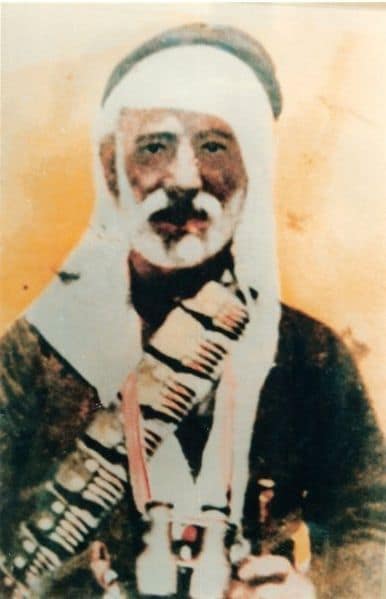
Farhan al-Saadi
فرحان السعدي
Qassamite commander, hanged at Acre
The old sheikh from a village west of Jenin who fired the opening shot of the 1936 revolt, and whom the British hanged at Acre in November 1937 while he was keeping the Ramadan fast. He was around eighty.
Farhan Ahmad Ibrahim al-Saadi was born around 1858 in al-Mazar, a village of the Jenin district that was depopulated in 1948. He learned to read in the village kuttab and at the elementary school in Jenin, memorised the Qur’an, and spent his youth in the study circles of the mosques, which is where the honorific attached itself: to everyone who knew him he was simply Shaykh Farhan. His grandfather taught him to ride and to shoot. He farmed, served in the Ottoman gendarmerie, fought in the First World War, and under the British served for a period as a corporal in the police of the Northern District.
He resigned from the police after the Buraq uprising of 1929 and formed a band of fighters in the Jenin district. The Mandate arrested him and held him for three years between Acre prison and Nur Shams. When he came out he went to Haifa, where he met Izz al-Din al-Qassam at the Istiqlal mosque and joined his movement. He was in the field on Qassam’s orders when the British surrounded the Ya’bad woods in November 1935 and killed him, and so survived his teacher — at an age when most men had long since stopped fighting.
In April 1936 al-Saadi opened fire on a Jewish convoy. Both of the Arabic sources this archive relies on say so in those words: WAFA has him and his companion Shaykh Atiyya Abu Ahmad attacking a Jewish convoy — هاجم الشيخ فرحان السعدي ورفيقه الشيخ عطية أبو أحمد قافلة يهودية — and Al Jazeera has him firing on a Jewish convoy on the road between Nablus and Tulkarm. That attack is generally taken as the opening of the Great Palestinian Rebellion of 1936–39; the Palestinian Museum dates it to 15 April, the Palestinian National Information Center to 17 April, and Al Jazeera’s account to 5 April. Within days the general strike had begun, and within weeks the British had declared a state of emergency. Over the following year and a half al-Saadi’s men fought a series of engagements between Jenin and the Carmel, among them an ambush on the lands of Fandaqumiya, between Nablus and Jenin, on 30 June 1936.
The British hunted him for eighteen months, and how the hunt ended is told two ways. In Al Jazeera’s account they besieged him in his own village, the mukhtar of al-Mazar interceded and asked him to surrender rather than see the houses demolished and the villagers killed, and he gave himself up with three companions on 22 November 1937 and was taken to Acre prison. WAFA records no surrender: it has the British authorities setting their informers and spies to track the Qassamites until they were able to seize Shaykh Farhan and three of his companions — بثت السلطات البريطانية عيونها وجواسيسها تتعقب القساميين حتى تمكنت من القبض على الشيخ فرحان وثلاثة آخرين من رفاقه. The trial at Acre lasted hours and heard no defence. Palestinian accounts differ on the charge — the Palestinian National Information Center records that he was tried for the killing of Lewis Andrews, the British district commissioner for Galilee assassinated that September, while Al Jazeera’s account records the formal charge as possession of a weapon, a capital offence under the emergency regulations. The record is unanimous on the outcome and not on the day. He was hanged in Acre prison, within days of his arrest, while keeping the Ramadan fast — but the Palestinian National Information Center gives the date as 22 November 1937 and Al Jazeera’s account as 27 November. Al Jazeera pairs its date with 14 Ramadan 1356 in the Hijri calendar, and that pairing does not reconcile: 1 Muharram 1356 fell on 14 March 1937, which puts 14 Ramadan around 18 November and 27 November at roughly 23 Ramadan. The archive prints the discrepancy rather than quietly choosing between the dates. Contemporary accounts put his age between seventy-five and eighty; the collection of the Palestinian publisher Mohamed Ali Eltaher, which holds a portrait of him, says eighty.
He is one of very few Palestinians of the Mandate period whose family has continued to appear in the casualty lists for ninety years: the al-Saadi family of Jenin has lost dozens of its members since 1990, and hundreds have passed through Israeli prisons. The old man who fired the first bullet is remembered in the north as the successor of Qassam.
Sources
- فرحان السعدي — الرواد، مركز المعلومات الوطني الفلسطيني (WAFA)
- الشيخ فرحان السعدي.. المقاوم الذي نجا من الاغتيال ولم ينج من الإعدام — الجزيرة نت, 27 November 2022
- Armed struggle in the 1936 Great Arab Revolt — The Palestinian Museum
- Palestine: 1937 — Sheikh Farhan Al-Saadi — Mohamed Ali Eltaher Collection
Further reading
An external biography or archive holding more on this life than the entry above.
Connected in the archive
21 connected records21 records elsewhere in the archive are linked to this one, each by a piece of evidence you can read below.
named in this record — 5 records
One record names the other. A pointer for reading, not a claim that they belong to each other.
- Acreعكا
Evidence — Inferred from the text — read the evidence: In Al Jazeera's account they besieged him in his own village, the mukhtar of al-Mazar interceded and asked him to surrender rather than see the houses demolished and the villagers killed, and he gave himself up with three companions on 22 November 1937 and was taken to Acre prison.
- Haifaحيفا
Evidence — Inferred from the text — read the evidence: When he came out he went to Haifa, where he met Izz al-Din al-Qassam at the Istiqlal mosque and joined his movement.
- Izz al-Din al-Qassamعز الدين القسّام
Evidence — Inferred from the text — read the evidence: When he came out he went to Haifa, where he met Izz al-Din al-Qassam at the Istiqlal mosque and joined his movement.
- Jeninجنين
Evidence — Inferred from the text — read the evidence: Farhan Ahmad Ibrahim al-Saadi was born around 1858 in al-Mazar, a village of the Jenin district that was depopulated in 1948. He learned to read in the village kuttab and at the elementary school in Jenin, memorised the Qur'an, and spent his youth in the study circles of the mosques, which is where the honorific attached itself: to everyone who knew him he was simply Shaykh Farhan.
- Mukhtar
Evidence — Inferred from the text — read the evidence: In Al Jazeera's account they besieged him in his own village, the mukhtar of al-Mazar interceded and asked him to surrender rather than see the houses demolished and the villagers killed, and he gave himself up with three companions on 22 November 1937 and was taken to Acre prison.
names this person — 3 records
One record names the other. A pointer for reading, not a claim that they belong to each other.
- Red Tuesday — the executions at Acre prison
Evidence — Inferred from the text — read the evidence: The Palestinian prisoners' movement traces its own roots to them: as the researcher Ra'fat Hamdouna argues in the movement's own historiography, its story is not limited to the post-1967 prisons but goes back to the Mandate — to Acre, to the men of 1930, to Farhan al-Saadi executed in 1937 and Yusuf Abu Durra in 1939.
- Red Tuesday and the Songs of the Prison
Evidence — Inferred from the text — read the evidence: In his history of the movement, the researcher Ra'fat Hamdouna argues that its roots are not limited to 1967 but go back to the British Mandate: to the men executed at Acre in 1930, to Farhan al-Saadi in 1937, to Yusuf Abu Durra in 1939.
- The Prison Songs
Evidence — Inferred from the text — read the evidence: The Palestinian prisoners' movement, which its own historians date not from 1967 but from the Mandate — from Acre, from the three men of 1930, from Farhan al-Saadi executed in 1937 and Yusuf Abu Durra after him — turned Israeli prisons into what its members call an academy, and the singing went with the rest of it.
on a related subject — 13 records
Filed near each other — the same Mandate district, or the same uncommon subject tags.
- Atta al-Zirعطا الزير
Evidence — From a recorded field in this archive: Shared tags: "Acre prison", "mandate".
- Fatima Ghazzalفاطمة غزال
Evidence — From a recorded field in this archive: Shared tags: "1936 revolt", "mandate".
- Fuad Hijaziفؤاد حجازي
Evidence — From a recorded field in this archive: Shared tags: "Acre prison", "mandate".
- Ibrahim Tuqanإبراهيم طوقان
Evidence — From a recorded field in this archive: Shared tags: "mandate", "1936 revolt".
- Muhammad Jamjoumمحمد جمجوم
Evidence — From a recorded field in this archive: Shared tags: "Acre prison", "mandate".
- Najati Sidqiنجاتي صدقي
Evidence — From a recorded field in this archive: Shared tags: "Acre prison", "mandate".
- and 7 more
Cite this page
Every claim above carries its sources — citation is the point.
- Chicago
“Farhan al-Saadi.” Figures, FALASTEEN.AI. Accessed 22 August 2026. https://falasteen.ai/figures/farhan-al-saadi.- MLA
“Farhan al-Saadi.” Figures, FALASTEEN.AI, 2026, https://falasteen.ai/figures/farhan-al-saadi. Accessed 22 August 2026.- BibTeX
@misc{falasteen-farhan-al-saadi,
  title        = {Farhan al-Saadi},
  howpublished = {\url{https://falasteen.ai/figures/farhan-al-saadi}},
  organization = {FALASTEEN.AI — A Living Archive for Palestine},
  year         = {2026},
  note         = {Accessed 2026-08-22}
}