Exhibition 2 of 8
Red Tuesday and the Songs of the Prison
Acre, 1930, and the movement that dates itself from the gallows
Three men hanged at Acre prison in June 1930, the funeral song that carried their names out of the yard, and the line Palestinian prisoners still draw from that morning to their own cells.
12 stops · walked in order
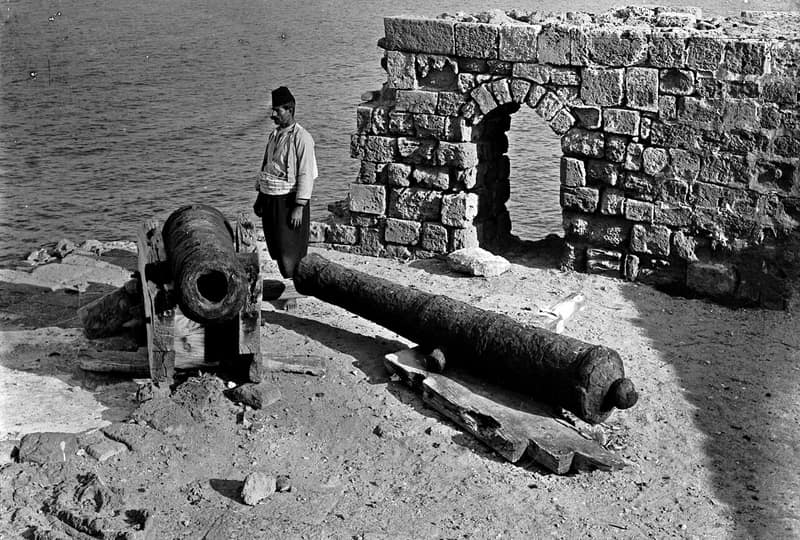
Cover image: Acre from the bay, c. 1900–1920. Matson Photo Service, Library of Congress (public domain), via Wikimedia Commons
On 17 June 1930 the British Mandate hanged three Palestinians at Acre prison for the events of the previous August. The Institute for Palestine Studies keeps the photograph of one of them, Fuad Hijazi of Safad, in its encyclopedia of the Palestine question, under a caption that states the fact without ornament: “The British Mandate sentenced three rebels to death on the 17th of June 1930. They were Mohammad Jamjoom, Atta al-Zir, and Fu’ad Hijazi.” Hijazi came from Safad; Jamjoum and al-Zir from Hebron. The Buraq uprising of August 1929 had produced hundreds of trials, and these were the three death sentences the Mandate carried out.
What followed is the reason this walk exists. The executions did not pass into silence — they passed into song. The funeral lament that begins min sijn ʿAkka, from Acre prison, names Jamjoum and Hijazi in its opening lines, so that anyone who sings it is compelled to say the names. It spread through Palestine and the Arab world, was made famous by Firqat al-ʿAshiqin, and is still sung at commemorations and inside the prisons a century later. The poet Ibrahim Tuqan wrote the elegy that gave the day the title Palestinians have used ever since: Red Tuesday.
The poets in this walk are not decoration on that history; they are inside it. Tuqan taught at An-Najah National School in Nablus and later worked at the Palestine Broadcasting Service, the first mass medium Palestinian poetry ever had. Abd al-Rahim Mahmoud studied under him at An-Najah, taught there in turn, joined the fighters in 1937, trained at the Iraqi Military Academy, and was killed in an attack at al-Shajara in July 1948 — an ending his best-known poem had described years before it happened. Forty years after Acre, Samih al-Qasim, writing as a Palestinian citizen of Israel under a different state and a different set of prisons, was still building verse out of the same arithmetic of confiscation and refusal.
The continuity is not a literary conceit; it is the prisoners’ movement’s own account of itself. In his history of the movement, the researcher Ra’fat Hamdouna argues that its roots are not limited to 1967 but go back to the British Mandate: to the men executed at Acre in 1930, to Farhan al-Saadi in 1937, to Yusuf Abu Durra in 1939. Abdul Qadir Idris of the Prisoners’ Committee of the Palestinian National and Islamic Forces describes what the movement then made of captivity — “transforming prison cells into scientific and cultural academies,” where hundreds of prisoners took degrees and published books behind the wire.
The walk ends where the argument lands. Administrative detention lets an Israeli military commander order imprisonment for six months at a time on classified evidence, renewable with no ceiling, so that the detainee cannot answer a charge because no charge is made. Addameer does the casework. Khalida Jarrar has been imprisoned five times, held through her father’s death and denied her daughter’s funeral, and moved in August 2024 into solitary confinement in a two-metre cell. The gallows at Acre were meant to end an uprising. The song is the evidence that they did not.
Sources
Drawn from 4 poems · 2 timeline events · 2 poets · 1 place · 1 glossary term · 1 research entry · 1 figure.
- The Buraq UprisingTimeline
- Red Tuesday — the executions at Acre prisonTimeline
- From Acre PrisonPoem
- AcrePlace
- Ibrahim TuqanPoet
- MawtiniPoem
- Abd al-Rahim MahmoudPoet
- The MartyrPoem
- Enemy of the SunPoem
- Administrative DetentionGlossary
- Addameer Prisoner Support and Human Rights AssociationResearch
- Khalida JarrarFigure
- 01
The Buraq UprisingTimeline
1929
August 1929, and the hundreds of trials that followed it. Everything in this walk begins in these courtrooms.
A year-long dispute over access to al-Buraq — the Western Wall — erupted in August 1929 into violence that spread from Jerusalem to Hebron and Safed. The Shaw Commission counted 133 Jews and 116 Arabs killed; many of the Arab casualties, it found, were caused by rifle fire from the police and military.
Open this record↑ StartStop 2 ↓ - 02
Red Tuesday — the executions at Acre prisonTimeline
1930
17 June 1930: Fuad Hijazi, Muhammad Jamjoum and Atta al-Zir are hanged at Acre. The Institute for Palestine Studies keeps the record of the sentence.
On 17 June 1930 the British Mandate hanged Fuad Hijazi, Muhammad Jamjoum and Atta al-Zir at Acre prison for the events of August 1929. The day entered Palestinian memory through the songs sung for them — above all the funeral song from Acre prison that is still sung a century later.
- 03
From Acre PrisonPoem
Traditional — sung by Firqat al-ʿAshiqin
The lament that went out with the funerals and never stopped being sung. Its opening lines are the names themselves — which is why singing it is an act of remembering.
The funeral song for Fuad Hijazi, Muhammad Jamjoum and Atta al-Zir, hanged by the British at Acre prison on 17 June 1930. It went out with their funerals and never stopped being sung — in the camps, at commemorations, and inside the prisons.
- 04
AcrePlace
Western Galilee coast
The prison was inside a citadel that had stopped Napoleon. Stand in the city the gallows stood in.
Acre — Akka — is the walled city that broke Napoleon: a Phoenician port, the Crusaders' last capital, and an Ottoman citadel-town whose Old City is a UNESCO World Heritage site. Most of its people were expelled in 1948; among its exiled children was Ghassan Kanafani.
- 05
Ibrahim TuqanPoet
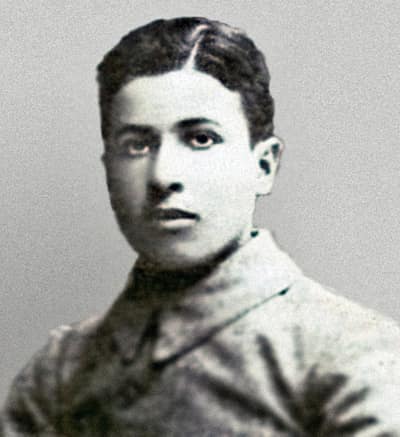
1905–1941
The Nablus poet who gave the day its name. His elegy for the three men is the reason it is called Red Tuesday and not simply 17 June.
Poet of the 1936 revolt and author of 'Mawtini,' the verse that served as Palestine's unofficial anthem and became Iraq's national anthem in 2004.
- 06
MawtiniPoem
Ibrahim Tuqan
The other thing Tuqan wrote: the verse that served as Palestine's unofficial anthem, and that Iraq adopted as its own in 2004.
The verse that became Palestine's unofficial anthem — sung at demonstrations and funerals for ninety years, and adopted as the national anthem of Iraq in 2004.
- 07
1913–1948
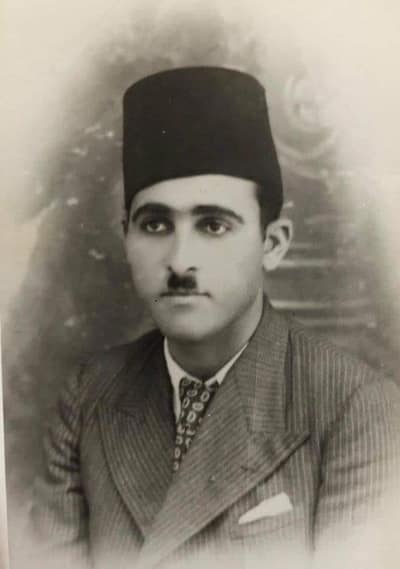
Tuqan taught at An-Najah in Nablus; Mahmoud studied there, then taught there. The political poetry of the Mandate runs down a single corridor.
The 'martyr poet' — a schoolteacher who wrote of carrying his soul in his palm and was killed in battle at al-Shajara in July 1948.
- 08
The MartyrPoem
Abd al-Rahim Mahmoud
Written in his twenties, describing an ending he went and met at al-Shajara in July 1948. Read it knowing that.
Written by a schoolteacher in his twenties who was killed in battle eleven years later — the poem that earned Abd al-Rahim Mahmoud the name 'the martyr poet.'
- 09
Enemy of the SunPoem
Samih al-Qasim
Samih al-Qasim, 1970 — “feed my youth to prison cells.” The prison had by then changed hands, and the refusal had not changed at all.
Al-Qasim's defiant refrain — 'I shall not compromise... I shall resist' — traveled far beyond Palestine: a handwritten copy was found among George Jackson's prison books.
- 10
Administrative DetentionGlossary
legal
What replaced the Mandate's emergency courts: imprisonment without charge, on secret evidence, renewable without limit.
Imprisonment without charge or trial, ordered by military commanders on the basis of secret evidence and renewable in six-month increments without limit; Israel uses it extensively against Palestinians in the occupied West Bank.
- 11
Addameer Prisoner Support and Human Rights AssociationResearch
Addameer
The Palestinian organisation whose name means conscience, and which does the casework the walk has been describing.
Addameer supports Palestinian political prisoners held by Israeli authorities and campaigns against administrative detention and torture.
- 12
Khalida JarrarFigure
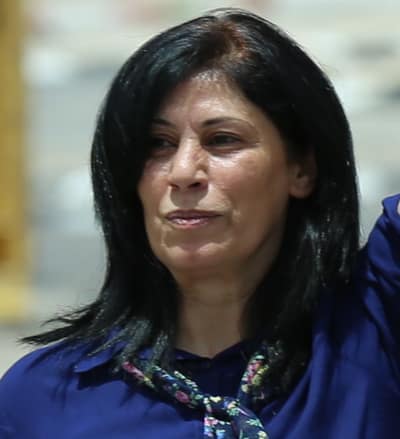
1963–
End with the living end of the line: five imprisonments, years of administrative detention, and a two-metre cell in al-Ramle.
The Nablus-born parliamentarian and Addameer director, arrested five times and held for years in administrative detention and solitary confinement — denied even her daughter's funeral — who emerged from each imprisonment restating the same demand: freedom from colonial domination.
Open this record↑ Stop 11End of the walk
End of the walk
You have passed 12 stops across 7 rooms of the archive. Every one of them is a full record with its own sources — the exhibition supplied only the order.
Exit through the archive
Cite this page
Every claim above carries its sources — citation is the point.
- Chicago
“Red Tuesday and the Songs of the Prison.” Exhibitions, FALASTEEN.AI. Accessed 22 August 2026. https://falasteen.ai/exhibitions/red-tuesday-and-the-songs-of-the-prison.- MLA
“Red Tuesday and the Songs of the Prison.” Exhibitions, FALASTEEN.AI, 2026, https://falasteen.ai/exhibitions/red-tuesday-and-the-songs-of-the-prison. Accessed 22 August 2026.- BibTeX
@misc{falasteen-red-tuesday-and-the-songs-of-the-prison,
  title        = {Red Tuesday and the Songs of the Prison},
  howpublished = {\url{https://falasteen.ai/exhibitions/red-tuesday-and-the-songs-of-the-prison}},
  organization = {FALASTEEN.AI — A Living Archive for Palestine},
  year         = {2026},
  note         = {Accessed 2026-08-22}
}