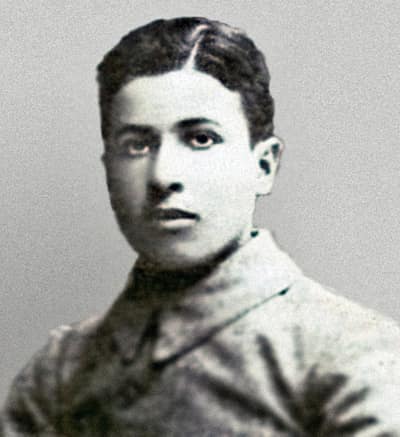
Ibrahim Tuqan
إبراهيم طوقان
1905–1941
Nablus
Poet of the 1936 revolt and author of 'Mawtini,' the verse that served as Palestine's unofficial anthem and became Iraq's national anthem in 2004.
Ibrahim Tuqan was born in Nablus in 1905 into the prominent Tuqan family, which had governed the city in the eighteenth and nineteenth centuries. He was educated at al-Rashadiyya al-Gharbiyya in Nablus and St George’s School in Jerusalem, and took a degree in literature at the American University of Beirut, where he studied from 1923 to 1929. He taught Arabic literature at An-Najah National School in Nablus and later at AUB, and served as sub-director of the Arabic programme section of the Palestine Broadcasting Service — the Mandate radio station, and the first mass medium Palestinian poetry ever had.
He is the elder brother of Fadwa Tuqan, and her first teacher: he tutored her at home at a time when her formal schooling had been cut short, and her career as the leading Palestinian woman poet of the century begins in that arrangement.
Tuqan’s own poetry belongs to the years of British rule and Zionist land purchase, and much of it is political and satirical — attacks on land brokers, on factionalism among Palestinian leaders, and on the Mandate itself. His best-known work, “Mawtini,” was written in 1934, set to music by Mohammed Flayfel, and became the de facto Palestinian anthem until an official one was adopted in 1996; in 2004 it was adopted as the national anthem of Iraq. He married Samia Abd al-Hadi in 1937 and had two children. He died in Jerusalem on 2 May 1941, aged thirty-five, of a peptic ulcer — seven years before the catastrophe his poetry had spent a decade warning about.
Sources
Read more
Explore selected poems, essays, and biographical material on the linked source.
Explore Ibrahim TuqanConnected in the archive
21 connected records21 records elsewhere in the archive are linked to this one, each by a piece of evidence you can read below.
born in — 1 record
- Nablusنابلس
Evidence — From a recorded field in this archive: birthplace: "Nablus" → Nablus (Nablus Governorate, northern West Bank)
written by them — 2 records
- Mawtini
Evidence — From a recorded field in this archive: poetSlug: "ibrahim-tuqan" → Ibrahim Tuqan
- Red Tuesday
Evidence — From a recorded field in this archive: poetSlug: "ibrahim-tuqan" → Ibrahim Tuqan
names this person — 11 records
One record names the other. A pointer for reading, not a claim that they belong to each other.
- Red Tuesday and the Songs of the Prison
Evidence — From a recorded field in this archive: The Nablus poet who gave the day its name. His elegy for the three men is the reason it is called Red Tuesday and not simply 17 June.
- A Mountainous Journey: A Poet's Autobiography
Evidence — Inferred from the text — read the evidence: It is the story of a girl in a prominent Nablus family whose education was obstructed until she left school altogether, and who was rescued from that by her brother — the poet Ibrahim Tuqan — who taught her at home.
- Abd al-Rahim Mahmoudعبد الرحيم محمود
Evidence — Inferred from the text — read the evidence: He studied at the National Najah School in Nablus, where Ibrahim Tuqan taught, and afterwards taught Arabic at the same school — a line of descent that runs through most of the political poetry of Mandate Palestine.
- Atta al-Zirعطا الزير
Evidence — Inferred from the text — read the evidence: Ibrahim Tuqan gave him the third and last of the three hours — the hour of the patient man and the great heart, the one who meets death in gladness — and swore in it by al-Zir's small children weeping for the lion.
- From Acre Prison
Evidence — Inferred from the text — read the evidence: The mourning was national; the poet Ibrahim Tuqan named the day Red Tuesday.
- Fuad Hijaziفؤاد حجازي
Evidence — Inferred from the text — read the evidence: He has no grave that Palestinians can visit; the archive's account of the executions is at Red Tuesday, 1930, and the elegy Ibrahim Tuqan built around his hour is at Red Tuesday.
- and 5 more
named in this record — 1 record
One record names the other. A pointer for reading, not a claim that they belong to each other.
- Jerusalemالقدس
Evidence — Inferred from the text — read the evidence: He was educated at al-Rashadiyya al-Gharbiyya in Nablus and St George's School in Jerusalem, and took a degree in literature at the American University of Beirut, where he studied from 1923 to 1929.
on a related subject — 6 records
Filed near each other — the same Mandate district, or the same uncommon subject tags.
- Farhan al-Saadiفرحان السعدي
Evidence — From a recorded field in this archive: Shared tags: "mandate", "1936 revolt".
- Fatima Ghazzalفاطمة غزال
Evidence — From a recorded field in this archive: Shared tags: "mandate", "1936 revolt".
- Songs of the 1936 Revolt
Evidence — From a recorded field in this archive: Shared tags: "mandate", "1936 revolt".
- Yusuf Abu Durraيوسف أبو درة
Evidence — From a recorded field in this archive: Shared tags: "mandate", "1936 revolt".
- The Prison Songs
Evidence — Inferred from the text — read the evidence: Shared tag: "mandate".
- Wild Thorns
Evidence — Inferred from the text — read the evidence: Shared tag: "Nablus".
Cite this page
Every claim above carries its sources — citation is the point.
- Chicago
“Ibrahim Tuqan.” Poetry, FALASTEEN.AI. Accessed 22 August 2026. https://falasteen.ai/poetry/ibrahim-tuqan.- MLA
“Ibrahim Tuqan.” Poetry, FALASTEEN.AI, 2026, https://falasteen.ai/poetry/ibrahim-tuqan. Accessed 22 August 2026.- BibTeX
@misc{falasteen-ibrahim-tuqan,
  title        = {Ibrahim Tuqan},
  howpublished = {\url{https://falasteen.ai/poetry/ibrahim-tuqan}},
  organization = {FALASTEEN.AI — A Living Archive for Palestine},
  year         = {2026},
  note         = {Accessed 2026-08-22}
}