Nablus
نابلس
Nablus — Roman Flavia Neapolis, nestled between Mount Gerizim and Mount Ebal — is the northern West Bank's proud commercial heart, famed for its Old City, its olive-oil soap and its knafeh, and shadowed by Balata, the West Bank's most populous refugee camp.
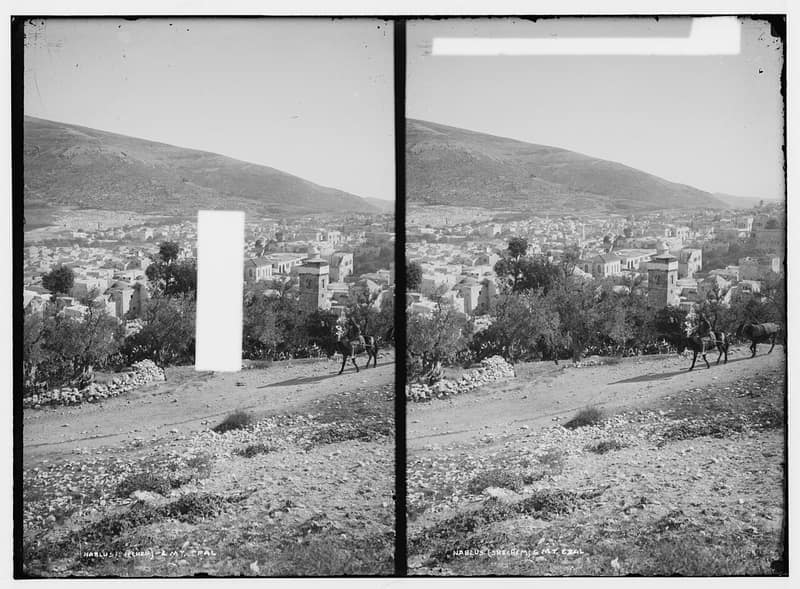
Nablus began as a Roman city. Founded in 72 CE as Flavia Neapolis — the “new city” — in the pass between Mount Gerizim and Mount Ebal, it stood beside the far older Canaanite Shechem, whose ruins lie at Tell Balata to the east. Watered by abundant springs, it drew empires and pilgrims: Jacob’s Well and Joseph’s Tomb lie within its orbit, and the small Samaritan community, whose ancestors have kept Passover on Mount Gerizim for millennia, still makes its home there. Conquered by the Arabs in 636 — its modern name an Arabic wearing-down of Neapolis — it passed through Crusader, Mamluk and Ottoman hands.
The Old City is a dense casbah of Mamluk and Ottoman stone: khan and suq, the Great Mosque raised on a Byzantine basilica, domed Turkish baths. Two products made its name across the Levant. The first is soap — Nabulsi soap, boiled from olive oil in great copper vats and stacked to dry in vaulted towers, an industry centuries old. The second is knafeh: the cheese pastry in syrup that Nablus claims as its own invention, served hot from wide brass trays in the Old City’s sweet shops.
Its modern reputation is fiercer. A center of opposition to British rule and Zionism during the Mandate, the city earned the name Jabal al-Nar, the Mountain of Fire; under Jordanian rule after 1948, its eastern edge filled with the tents and then the concrete lanes of Balata camp, established in 1950 for some five thousand refugees and today the most populous refugee camp in the West Bank. Occupied in 1967, Nablus was a stronghold of both intifadas; Israeli incursions in 2002 left parts of the Old City in ruins. Under the Palestinian Authority it remains the commercial capital of the northern West Bank — and one of its most frequently raided cities.
Nablus endures in the senses: the smell of olive-oil soap curing in the dark, the orange glow of knafeh under crushed pistachio, the close stone cool of the casbah. A city that empires founded and refugees remade, it keeps its pride — and its receipts — in equal measure.
Sources
Cited works
2- britannica.com — Nablus(opens in a new tab)https://www.britannica.com/place/Nablus
- unrwa.org — balata camp(opens in a new tab)https://www.unrwa.org/where-we-work/west-bank/balata-camp
Cite this page
Every claim above carries its sources — citation is the point.
- Chicago
“Nablus.” Places, FALASTEEN.AI. Accessed 22 August 2026. https://falasteen.ai/places/nablus.- MLA
“Nablus.” Places, FALASTEEN.AI, 2026, https://falasteen.ai/places/nablus. Accessed 22 August 2026.- BibTeX
@misc{falasteen-nablus,
  title        = {Nablus},
  howpublished = {\url{https://falasteen.ai/places/nablus}},
  organization = {FALASTEEN.AI — A Living Archive for Palestine},
  year         = {2026},
  note         = {Accessed 2026-08-22}
}