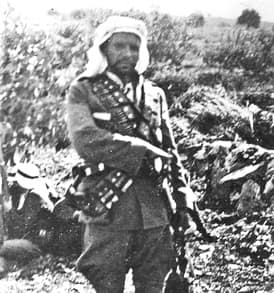
Yusuf Abu Durra
يوسف أبو درة
Commander of the 1936–39 revolt
A railway worker from a village near Jenin who escaped the cordon at Ya'bad where Qassam was killed, became one of the five commanders of the Great Revolt, stormed Atlit prison to free its inmates — and was handed to the British by the Arab Legion and hanged.
Yusuf Sa’id Abu Durra was born in 1900 in Silat al-Harithiya, a village in the district of Jenin, and took his first schooling there. He worked the land for a time and then, like thousands of Palestinian villagers in those years, went to Haifa for wages — in his case on the railway. It was in Haifa that he met Izz al-Din al-Qassam, joined his circle, and was with him in the woods of Ya’bad in November 1935 when the British closed a cordon around the group and killed him. Seeing that resistance was hopeless, Abu Durra slipped through the ring and disappeared for a while.
When the Great Palestinian Rebellion began in 1936 he joined it under Shaykh Atiyya Ahmad Awad, commander of the Jenin sector. With his men he attacked colonies and British and Zionist strongpoints in the country between Jenin and Haifa, blew bridges and laid ambushes. When Shaykh Atiyya was killed at the battle of al-Yamun, Abu Durra took over the fight and won it, inherited the sector, and by the autumn of 1937 had extended his command from Jenin into the Nazareth subdistrict and the Haifa region. He became one of five men leading the revolt in Palestine, and signed his communiqués with a formula of his own — he who relies upon God, Yusuf Sa’id Abu Durra.
Two things about him survive better than the battles. The first is that he stormed the fortified prison at Atlit and freed the prisoners inside it — an operation with almost no parallel in the revolt. The second is a communiqué. After the battle of Umm al-Zinat in the Carmel on 28 November 1938, where a few dozen of his fighters faced more than a thousand British soldiers supported by thirteen aircraft, a rumour spread that he had been killed. He issued a statement describing the engagement and ending: I declare that there is no truth whatever to the rumour that I, Yusuf Sa’id Abu Durra, have come to any harm. I am, praise God, still in health, and I pledge to God and the Prophet to continue the struggle to the end. Two weeks earlier, in the rebel leadership’s reply of 3 December 1938 to the British colonial secretary’s statement on the Woodhead report, he had put his name to a sentence that reads now like an epitaph for the whole revolt: the fighters will go on fighting the forces of tyrannical authority to the death, without retreat, until the Arab nation in Palestine obtains its rights entire and undiminished. The translations here are the archive’s own, from the Arabic text in the Palestinian Encyclopedia.
The revolt stopped in September 1939. Abu Durra withdrew to Damascus and then towards Transjordan, where a patrol of the Arab Legion arrested him on the road. He was held for a period at Karak, and General John Bagot Glubb handed him over to the British Mandate authorities, who sentenced him to death. The Palestinian Encyclopedia, working from Mustafa Murad al-Dabbagh’s Biladuna Filastin and Akram Zu’aytir’s collection of national-movement documents, records that the sentence was carried out in Jerusalem on 30 September 1939; other accounts date the hanging to February 1940 and have his body returned to Silat al-Harithiya for burial. The manner of his end is not in dispute: the man who had escaped every British cordon for four years was delivered to them by an Arab army.
Sources
Further reading
An external biography or archive holding more on this life than the entry above.
Connected in the archive
19 connected records19 records elsewhere in the archive are linked to this one, each by a piece of evidence you can read below.
named in this record — 6 records
One record names the other. A pointer for reading, not a claim that they belong to each other.
- Haifaحيفا
Evidence — Inferred from the text — read the evidence: He worked the land for a time and then, like thousands of Palestinian villagers in those years, went to Haifa for wages — in his case on the railway.
- Izz al-Din al-Qassamعز الدين القسّام
Evidence — Inferred from the text — read the evidence: It was in Haifa that he met Izz al-Din al-Qassam, joined his circle, and was with him in the woods of Ya'bad in November 1935 when the British closed a cordon around the group and killed him.
- Jeninجنين
Evidence — Inferred from the text — read the evidence: Yusuf Sa'id Abu Durra was born in 1900 in Silat al-Harithiya, a village in the district of Jenin, and took his first schooling there.
- Jerusalemالقدس
Evidence — Inferred from the text — read the evidence: The Palestinian Encyclopedia, working from Mustafa Murad al-Dabbagh's Biladuna Filastin and Akram Zu'aytir's collection of national-movement documents, records that the sentence was carried out in Jerusalem on 30 September 1939; other accounts date the hanging to February 1940 and have his body returned to Silat al-Harithiya for burial.
- The Great Arab Revolt
Evidence — Inferred from the text — read the evidence: A railway worker from a village near Jenin who escaped the cordon at Ya'bad where Qassam was killed, became one of the five commanders of the Great Revolt, stormed Atlit prison to free its inmates — and was handed to the British by the Arab Legion and hanged.
- Umm az-Zinatأم الزينات
Evidence — Inferred from the text — read the evidence: After the battle of Umm al-Zinat in the Carmel on 28 November 1938, where a few dozen of his fighters faced more than a thousand British soldiers supported by thirteen aircraft, a rumour spread that he had been killed.
names this person — 3 records
One record names the other. A pointer for reading, not a claim that they belong to each other.
- Red Tuesday — the executions at Acre prison
Evidence — Inferred from the text — read the evidence: The Palestinian prisoners' movement traces its own roots to them: as the researcher Ra'fat Hamdouna argues in the movement's own historiography, its story is not limited to the post-1967 prisons but goes back to the Mandate — to Acre, to the men of 1930, to Farhan al-Saadi executed in 1937 and Yusuf Abu Durra in 1939.
- Red Tuesday and the Songs of the Prison
Evidence — Inferred from the text — read the evidence: In his history of the movement, the researcher Ra'fat Hamdouna argues that its roots are not limited to 1967 but go back to the British Mandate: to the men executed at Acre in 1930, to Farhan al-Saadi in 1937, to Yusuf Abu Durra in 1939.
- The Prison Songs
Evidence — Inferred from the text — read the evidence: The Palestinian prisoners' movement, which its own historians date not from 1967 but from the Mandate — from Acre, from the three men of 1930, from Farhan al-Saadi executed in 1937 and Yusuf Abu Durra after him — turned Israeli prisons into what its members call an academy, and the singing went with the rest of it.
on a related subject — 10 records
Filed near each other — the same Mandate district, or the same uncommon subject tags.
- Farhan al-Saadiفرحان السعدي
Evidence — From a recorded field in this archive: Shared tags: "1936 revolt", "Qassam", "Jenin", "mandate".
- Fatima Ghazzalفاطمة غزال
Evidence — From a recorded field in this archive: Shared tags: "1936 revolt", "mandate".
- Ibrahim Tuqanإبراهيم طوقان
Evidence — From a recorded field in this archive: Shared tags: "mandate", "1936 revolt".
- Nuh Ibrahimنوح إبراهيم
Evidence — From a recorded field in this archive: Shared tags: "1936 revolt", "Haifa", "Qassam".
- Sadhij Nassarساذج نصّار
Evidence — From a recorded field in this archive: Shared tags: "Haifa", "mandate".
- Songs of the 1936 Revolt
Evidence — From a recorded field in this archive: Shared tags: "1936 revolt", "mandate".
- and 4 more
Cite this page
Every claim above carries its sources — citation is the point.
- Chicago
“Yusuf Abu Durra.” Figures, FALASTEEN.AI. Accessed 22 August 2026. https://falasteen.ai/figures/yusuf-abu-durra.- MLA
“Yusuf Abu Durra.” Figures, FALASTEEN.AI, 2026, https://falasteen.ai/figures/yusuf-abu-durra. Accessed 22 August 2026.- BibTeX
@misc{falasteen-yusuf-abu-durra,
  title        = {Yusuf Abu Durra},
  howpublished = {\url{https://falasteen.ai/figures/yusuf-abu-durra}},
  organization = {FALASTEEN.AI — A Living Archive for Palestine},
  year         = {2026},
  note         = {Accessed 2026-08-22}
}