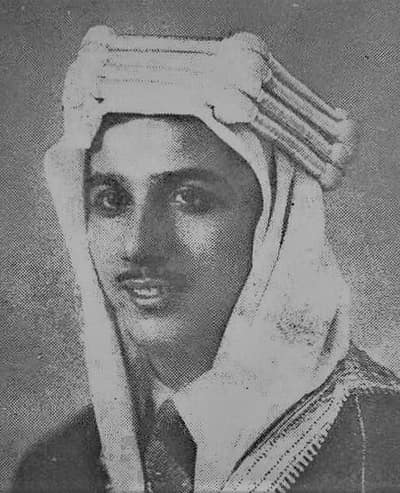
Nuh Ibrahim
نوح إبراهيم
Zajal poet of the 1936 revolt
The printing-press worker from Haifa who wrote in the language people actually spoke, and whose lament for the three men hanged at Acre in 1930 became the most-sung Palestinian song of the century. The British censor banned his collected work by name.
Nuh Ibrahim was born in Haifa in 1913, in the Wadi al-Nisnas quarter. His family lived on very little; his father was killed when he was a child. He left school in the fifth grade to work at a printing press — the Palestinian Museum’s account has him finishing vocational school in Jerusalem at sixteen and then returning to Haifa to the press of a tobacco factory — and it was there, among type and paper, that he became a poet. He never wrote fusha, the elevated literary Arabic in which Palestinian poetry was published and reviewed. He composed only zajal: colloquial verse, half-recited and half-sung, made to be performed rather than printed. There is no definitive text of a Nuh Ibrahim poem, because each existed in the moment it was performed, with lines added and dropped as he went.
He was a follower of Izz al-Din al-Qassam and was known by the name he was proudest of, tilmiz al-Qassam — the Student of Qassam. When Qassam was killed by British forces in the Ya’bad woods in November 1935, Ibrahim composed an elegy for him that was taken up and sung across Palestine. In 1937 the British swept up fighters across the country and sent Ibrahim to Acre prison for five months. He used the time to write for the other prisoners and recite to them. The song that came out of it, addressed to a British district officer — Your Honour Mr Bailey, representative of the Northern District, your rule is too harsh when it should have been just — became the anthem of political prisoners, men and women, for the rest of the Mandate.
His fame reached the point where the Mandate’s press censor issued a warning against him by name, prohibiting the printing or publication, openly or in secret, of the book of his collected poems that had been printed outside Palestine. Very few poets in any language have had their complete works banned as a police matter.
The work of his that outlived everything else was written years before the revolt, for the three men the British hanged at Acre on 17 June 1930: Fuad Hijazi, Muhammad Jamjoum and Atta al-Zir. Its opening — from Acre prison a funeral went out — carries their names in the verse itself, so that anyone who sings it performs an act of remembering. It travelled as folk song, was recorded in the 1980s by the ensemble Firqat al-ʿAshiqin, and is still sung at prisoners’ vigils and commemorations. Ibrahim Tuqan, the most celebrated poet in Palestine at the time, wrote his own elegy for the same three men and gave the day its name, Red Tuesday; but it is not Tuqan’s classical lines Palestinians know by heart. It is the printer’s. The archive holds the song at From Acre Prison.
He had been working in Bahrain when the revolt began, and left his job to come home and fight. His career as a poet lasted four years. On 18 October 1938 he was killed with three other fighters in an unequal engagement with the British army on the heights of Jabal al-Sani’a, near the village of Tamra in the Galilee: Muhammad Khader Qiblawi, aged twenty-three; Izz al-Din Khalayla of Majd al-Kurum; and a Syrian fighter known as Abu Ra’ad. Nuh Ibrahim was twenty-five. His biographer in the Jerusalem Quarterly calls him shahed wa shahid — witness and martyr.
Sources
- Samih Shabeeb, “Poetry of Rebellion: The Life, Verse and Death of Nuh Ibrahim during the 1936-39 Revolt,” Jerusalem Quarterly 25 (Winter 2006), pp. 65–78 — Institute for Palestine Studies
- From Acre prison, with love: the life and times of Nuh Ibrahim, poet of the 1936 Revolt — The Palestinian Museum
- الثلاثاء الحمراء: تسعون عاما على إعدام جمجوم والزير وحجازي — WAFA (Palestinian News and Information Agency), 16 June 2020
Further reading
An external biography or archive holding more on this life than the entry above.
Connected in the archive
18 connected records18 records elsewhere in the archive are linked to this one, each by a piece of evidence you can read below.
born in — 1 record
- Haifaحيفا
Evidence — From a recorded field in this archive: birthplace: "Haifa, Palestine" → Haifa (Haifa Bay, northern coast)
named in this record — 8 records
One record names the other. A pointer for reading, not a claim that they belong to each other.
- Acreعكا
Evidence — Inferred from the text — read the evidence: In 1937 the British swept up fighters across the country and sent Ibrahim to Acre prison for five months.
- Atta al-Zirعطا الزير
Evidence — Inferred from the text — read the evidence: The work of his that outlived everything else was written years before the revolt, for the three men the British hanged at Acre on 17 June 1930: Fuad Hijazi, Muhammad Jamjoum and Atta al-Zir.
- Fuad Hijaziفؤاد حجازي
Evidence — Inferred from the text — read the evidence: The work of his that outlived everything else was written years before the revolt, for the three men the British hanged at Acre on 17 June 1930: Fuad Hijazi, Muhammad Jamjoum and Atta al-Zir.
- Ibrahim Tuqanإبراهيم طوقان
Evidence — Inferred from the text — read the evidence: Ibrahim Tuqan, the most celebrated poet in Palestine at the time, wrote his own elegy for the same three men and gave the day its name, Red Tuesday; but it is not Tuqan's classical lines Palestinians know by heart.
- Izz al-Din al-Qassamعز الدين القسّام
Evidence — Inferred from the text — read the evidence: He was a follower of Izz al-Din al-Qassam and was known by the name he was proudest of, tilmiz al-Qassam — the Student of Qassam.
- Jerusalemالقدس
Evidence — Inferred from the text — read the evidence: He left school in the fifth grade to work at a printing press — the Palestinian Museum's account has him finishing vocational school in Jerusalem at sixteen and then returning to Haifa to the press of a tobacco factory — and it was there, among type and paper, that he became a poet.
- and 2 more
names this person — 3 records
One record names the other. A pointer for reading, not a claim that they belong to each other.
- Red Tuesday
Evidence — Inferred from the text — read the evidence: The verses that travelled were those of Nuh Ibrahim, a printer's apprentice from Haifa's Wadi al-Nisnas who composed only zajal — colloquial folk verse, half-recited and half-sung — and whose lament for the same three men became the song from Acre prison that has never stopped being performed.
- Songs of the 1936 Revolt
Evidence — Inferred from the text — read the evidence: Its master was Nuh Ibrahim, a printing-press worker from Haifa's Wadi al-Nisnas who called himself the Student of Qassam.
- The Prison Songs
Evidence — Inferred from the text — read the evidence: It was written by Nuh Ibrahim, a printing-press worker from Haifa who composed only in colloquial zajal, and it is the most widely known Palestinian song of the twentieth century.
on a related subject — 6 records
Filed near each other — the same Mandate district, or the same uncommon subject tags.
- Farhan al-Saadiفرحان السعدي
Evidence — From a recorded field in this archive: Shared tags: "1936 revolt", "Qassam", "Acre prison".
- Yusuf Abu Durraيوسف أبو درة
Evidence — From a recorded field in this archive: Shared tags: "1936 revolt", "Haifa", "Qassam".
- Adalah — The Legal Center for Arab Minority Rights in Israel
Evidence — Inferred from the text — read the evidence: Shared tag: "Haifa".
- Nakba and Survival: The Story of Palestinians Who Remained in Haifa and the Galilee, 1948–1956
Evidence — Inferred from the text — read the evidence: Shared tag: "Haifa".
- The Martyr's Testament
Evidence — Inferred from the text — read the evidence: Shared tag: "Acre prison".
- The Secret Life of Saeed: The Pessoptimist
Evidence — Inferred from the text — read the evidence: Shared tag: "Haifa".
Cite this page
Every claim above carries its sources — citation is the point.
- Chicago
“Nuh Ibrahim.” Figures, FALASTEEN.AI. Accessed 22 August 2026. https://falasteen.ai/figures/nuh-ibrahim.- MLA
“Nuh Ibrahim.” Figures, FALASTEEN.AI, 2026, https://falasteen.ai/figures/nuh-ibrahim. Accessed 22 August 2026.- BibTeX
@misc{falasteen-nuh-ibrahim,
  title        = {Nuh Ibrahim},
  howpublished = {\url{https://falasteen.ai/figures/nuh-ibrahim}},
  organization = {FALASTEEN.AI — A Living Archive for Palestine},
  year         = {2026},
  note         = {Accessed 2026-08-22}
}