Haifa
حيفا
Haifa grew under the Mandate into Palestine's great industrial port, a mixed Arab-Jewish city climbing Mount Carmel — until April 1948 emptied most of its Palestinian neighborhoods by sea. Kanafani's Returning to Haifa made it the literature's city of return.
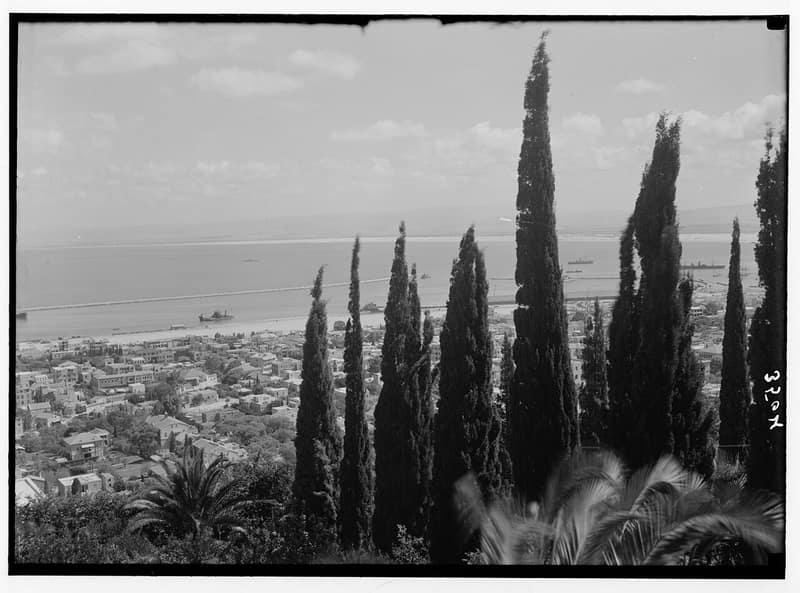
Haifa is a comparative newcomer among Palestine’s coastal cities. A small town for most of its history — mentioned in the Talmud, called Sykaminos by Eusebius and Caiphas by the Crusaders, long overshadowed by Acre across the bay — it was transformed from the late Ottoman period and above all under the British Mandate into the country’s industrial heart: a deep-water port opened in 1933, an oil refinery, a railhead, and worker neighborhoods climbing the slopes of Mount Carmel above the curve of the bay.
By the 1940s it was Palestine’s most conspicuously mixed city. Palestinian Arabs — Muslims and Christians together a large share of the population — lived in Wadi Salib, Wadi Nisnas, al-Abbas and Halisa, worked the port and the refinery, published newspapers, and organized some of the country’s strongest labor unions, while Jewish Haifa spread through the Hadar and up the Carmel.
That world ended in three days. On 21 April 1948 the Haganah launched its operation against the Arab city, which surrendered on 22 April; in the chaos and under mortar fire, tens of thousands of Palestinians fled toward the port and were taken by boat to Acre and to Lebanon. Of more than fifty thousand Arabs who had lived in Haifa before the war, only about three thousand remained. Their houses passed to the state under absentee property laws; Wadi Salib, the old Arab quarter beneath the Hadar, was left to crumble and was partly demolished.
Ghassan Kanafani, exiled from Acre as a boy, made Haifa the setting of his 1969 novella Returning to Haifa, in which a Palestinian couple cross the lines after 1967 to stand again in the house they fled in 1948 — and to reckon with who now lives in it. Today Palestinian citizens of Israel sustain churches, mosques, markets and festivals in Wadi Nisnas and the surviving quarters; in the national imagination, Haifa remains the city of the return that has not yet happened.
Sources
Cited works
2- britannica.com — Haifa(opens in a new tab)https://www.britannica.com/place/Haifa
- palestineremembered.com — index(opens in a new tab)https://www.palestineremembered.com/Haifa/Haifa/index.html
Cite this page
Every claim above carries its sources — citation is the point.
- Chicago
“Haifa.” Places, FALASTEEN.AI. Accessed 22 August 2026. https://falasteen.ai/places/haifa.- MLA
“Haifa.” Places, FALASTEEN.AI, 2026, https://falasteen.ai/places/haifa. Accessed 22 August 2026.- BibTeX
@misc{falasteen-haifa,
  title        = {Haifa},
  howpublished = {\url{https://falasteen.ai/places/haifa}},
  organization = {FALASTEEN.AI — A Living Archive for Palestine},
  year         = {2026},
  note         = {Accessed 2026-08-22}
}