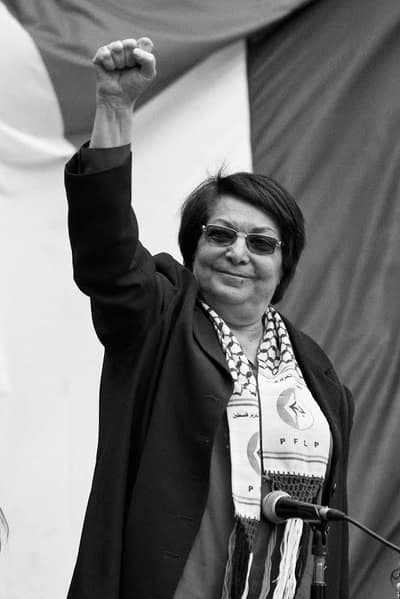
Leila Khaled
ليلى خالد
PFLP political bureau member and hijacker of 1969 and 1970
Driven from Haifa at four, she hijacked two airliners for the PFLP in 1969 and 1970 and has sat on the front's political bureau since 2005.
Leila Khaled was born in Haifa on 9 April 1944, one of twelve children of Ali Khaled and Jamila Lattuf. She was barely four when the family was forced out after the city fell to Zionist forces in April 1948; they settled in Tyre, in southern Lebanon, and she was schooled there and at the Sidon Girls School. She joined the Arab Nationalist Movement in 1959 and enrolled at the American University of Beirut in 1963, where she was elected to the committee of the General Union of Palestinian Students; she had to leave after a year because her family could not pay the fees, and taught English in government schools in Kuwait from 1963 to 1969. She joined the Popular Front for the Liberation of Palestine as soon as it was founded in December 1967.
Between 1969 and 1972 Khaled took part in the front’s foreign operations, organised by Wadi Haddad. On 29 August 1969 she and Salim Isawi hijacked a TWA airliner; they were held in Syria for six weeks and released. On 6 September 1970, during the wave of hijackings that precipitated the war between the Palestinian factions and the Jordanian army, she was one of two people who attempted to hijack an El Al flight; her comrade Patrick Argüello, a Nicaraguan-American, was shot dead on board by Israeli security guards, and Khaled was detained for a month in Britain after the pilot landed in London. She became, and remains, the most photographed face of the Palestinian armed movement of that decade. Her account of those years, My People Shall Live: Autobiography of a Revolutionary, written with George Hajjar, appeared in 1975.
From 1973 to 1977 she worked with the resistance in Lebanon, as a PFLP official and on the secretariat of the General Union of Palestinian Women, to which she had been elected in 1974, helping the displaced and the wounded after Israeli attacks on the camps. In 1978 she helped found the House of the Children of Resilience for the orphans of Tal al-Za’atar camp, which still exists. She studied in Moscow and Rostov between 1978 and 1980, cut the studies short when the PLO recalled its students, and during the Israeli invasion of 1982 worked through the women’s union to shelter the displaced. She became a member of the Palestine National Council at its fourteenth session in Damascus in 1979.
In 1986 she was elected first secretary of the Palestine Women Organization, the PFLP’s general framework for women’s work, and edited its magazine The Woman’s Voice. She was elected to the front’s central committee at its fifth national conference in 1993 and to its political bureau in 2005. She moved with her family to Amman in 1992 and lives there. The United States designated the PFLP a Foreign Terrorist Organization on 8 October 1997.
Selected contributions
- My People Shall Live: Autobiography of a Revolutionary (with George Hajjar, 1975)
- First secretary of the Palestine Women Organization (1986)
- Member of the PFLP central committee (1993–) and political bureau (2005–)
Sources
Further reading
An external biography or archive holding more on this life than the entry above.
Connected in the archive
14 connected records14 records elsewhere in the archive are linked to this one, each by a piece of evidence you can read below.
born in — 1 record
- Haifaحيفا
Evidence — From a recorded field in this archive: birthplace: "Haifa, Palestine" → Haifa (Haifa Bay, northern coast)
names this person — 1 record
One record names the other. A pointer for reading, not a claim that they belong to each other.
- The Women of the Movement
Evidence — From a recorded field in this archive: Driven out of Haifa at four; two hijackings for the PFLP in 1969 and 1970; on the front's political bureau since 2005. The most photographed and least read woman in this walk.
on a related subject — 12 records
Filed near each other — the same Mandate district, or the same uncommon subject tags.
- Wadie Haddadوديع حداد
Evidence — From a recorded field in this archive: Shared tags: "PFLP", "hijackings".
- Adalah — The Legal Center for Arab Minority Rights in Israel
Evidence — Inferred from the text — read the evidence: Shared tag: "Haifa".
- Handala
Evidence — Inferred from the text — read the evidence: Shared tag: "refugees".
- Izz al-Din al-Qassamعز الدين القسّام
Evidence — Inferred from the text — read the evidence: Shared tag: "Haifa".
- Keys of Return
Evidence — Inferred from the text — read the evidence: Shared tag: "refugees".
- Nakba and Survival: The Story of Palestinians Who Remained in Haifa and the Galilee, 1948–1956
Evidence — Inferred from the text — read the evidence: Shared tag: "Haifa".
- and 6 more
Cite this page
Every claim above carries its sources — citation is the point.
- Chicago
“Leila Khaled.” Figures, FALASTEEN.AI. Accessed 22 August 2026. https://falasteen.ai/figures/leila-khaled.- MLA
“Leila Khaled.” Figures, FALASTEEN.AI, 2026, https://falasteen.ai/figures/leila-khaled. Accessed 22 August 2026.- BibTeX
@misc{falasteen-leila-khaled,
  title        = {Leila Khaled},
  howpublished = {\url{https://falasteen.ai/figures/leila-khaled}},
  organization = {FALASTEEN.AI — A Living Archive for Palestine},
  year         = {2026},
  note         = {Accessed 2026-08-22}
}