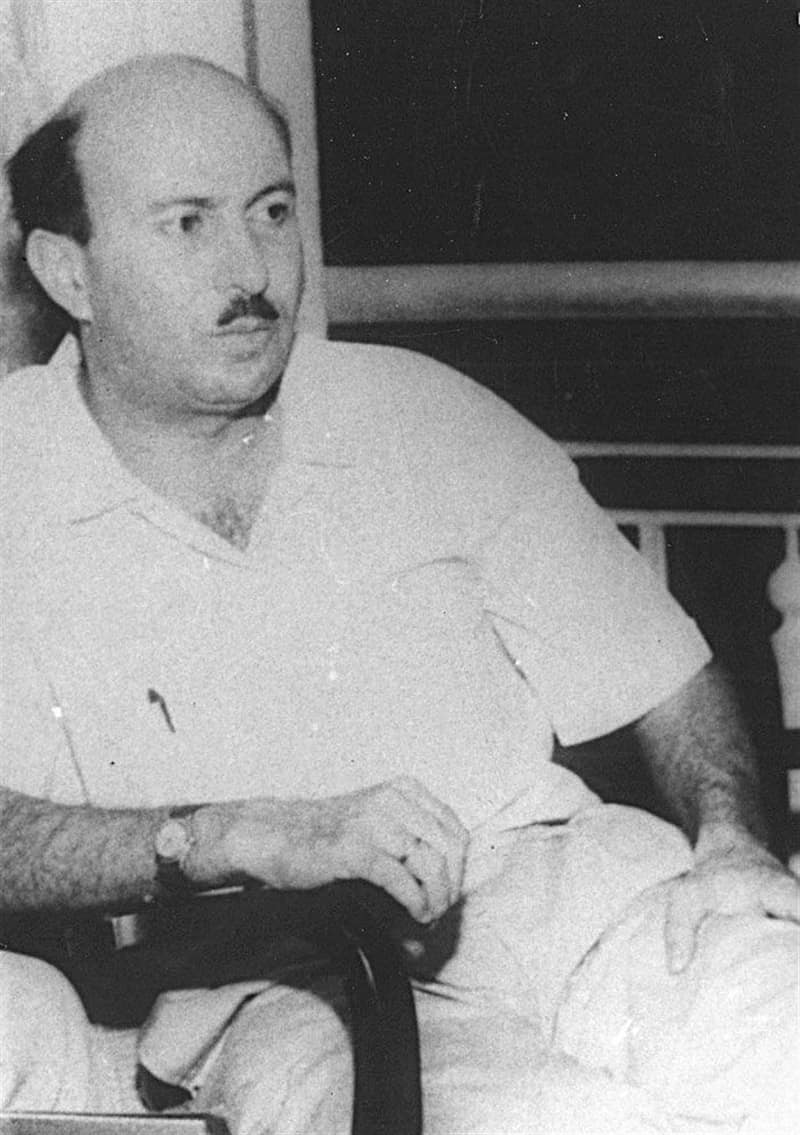
Wadie Haddad
وديع حداد
Physician and head of the PFLP's external operations branch
Physician, co-founder of the Arab Nationalist Movement and the PFLP, and the architect of its aircraft hijackings — expelled by his own front, killed by poison in 1978.
Wadi (Wadie) Haddad was born in Safad in 1927. His father taught Arabic at a secondary school in Haifa, and Haddad was schooled there — a strong mathematician and a runner. The Nakba drove the family out; they took refuge in Beirut, where Haddad entered the American University of Beirut to study medicine and met George Habash. The two became lifelong friends, took leading roles in the student society al-Urwa al-Wuthqa, and in 1952 opened a free clinic together in Amman for refugees and the poor. Haddad was among the founders of the Arab Nationalist Movement announced by Habash in Amman in December 1956, and of the Popular Front for the Liberation of Palestine in December 1967.
Within the PFLP he was given two portfolios: finance, and external military operations. From 23 July 1968 the branch he chaired began a campaign under the slogan “pursue the enemy everywhere,” starting with the hijacking of an El Al flight from Rome to Lydda airport, which was forced to land in Algiers and whose passengers were released only after Israel freed Palestinian prisoners. Between 6 and 9 September 1970 the branch hijacked three Western airliners to a desert strip near Zarqa in Jordan that it named “Revolution Airport,” evacuated the passengers and crew, and blew the aircraft up on 12 September — the immediate trigger for the war between the Jordanian army and the Palestinian factions. Haddad also built the branch’s alliances with the Japanese Red Army, the Baader-Meinhof Group and the Red Brigades; on 30 May 1972 three Japanese Red Army members trained by his branch opened fire in the arrivals hall at Lydda airport, killing twenty-six people, most of them Christian pilgrims from Puerto Rico.
The front’s own leadership had by then turned against the method. Habash stated publicly in Beirut on 14 March 1972 that the PFLP executive committee had resolved on 5 November 1970 to stop hijacking aircraft. Haddad refused to comply. When he organised the hijacking of an Air France flight to Entebbe in June 1976, the PFLP expelled him along with every member of the external operations branch; he continued under the name Popular Front for the Liberation of Palestine – External Operations.
Haddad fell ill in late 1977, was moved to Algeria in January 1978 and then to the Charité hospital in East Berlin, where he died on 28 March 1978, aged fifty-one. The death was first reported as leukaemia. Israeli accounts later stated that the Mossad had killed him with a slow-acting poison introduced into Belgian chocolates delivered to him — the version now carried by the Palestinian national information centre and by Habash’s own biographers, who record the loss as one of the two that marked Habash most, the other being the killing of Ghassan Kanafani.
Selected contributions
- Co-founder of the Arab Nationalist Movement (1956) and of the PFLP (1967)
- Head of the PFLP’s external operations branch (1968–1976)
Sources
Further reading
An external biography or archive holding more on this life than the entry above.
Connected in the archive
12 connected records12 records elsewhere in the archive are linked to this one, each by a piece of evidence you can read below.
born in — 1 record
- Safedصفد
Evidence — From a recorded field in this archive: birthplace: "Safad, Palestine" → Safed (Upper Galilee)
named in this record — 5 records
One record names the other. A pointer for reading, not a claim that they belong to each other.
- George Habashجورج حبش
Evidence — Inferred from the text — read the evidence: The Nakba drove the family out; they took refuge in Beirut, where Haddad entered the American University of Beirut to study medicine and met George Habash.
- Ghassan Kanafaniغسان كنفاني
Evidence — Inferred from the text — read the evidence: Israeli accounts later stated that the Mossad had killed him with a slow-acting poison introduced into Belgian chocolates delivered to him — the version now carried by the Palestinian national information centre and by Habash's own biographers, who record the loss as one of the two that marked Habash most, the other being the killing of Ghassan Kanafani.
- Ghassan Kanafaniغسان كنفاني
Evidence — Inferred from the text — read the evidence: Israeli accounts later stated that the Mossad had killed him with a slow-acting poison introduced into Belgian chocolates delivered to him — the version now carried by the Palestinian national information centre and by Habash's own biographers, who record the loss as one of the two that marked Habash most, the other being the killing of Ghassan Kanafani.
- Haifaحيفا
Evidence — Inferred from the text — read the evidence: Wadi (Wadie) Haddad was born in Safad in 1927. His father taught Arabic at a secondary school in Haifa, and Haddad was schooled there — a strong mathematician and a runner.
- Lyddaاللد
Evidence — Inferred from the text — read the evidence: From 23 July 1968 the branch he chaired began a campaign under the slogan "pursue the enemy everywhere," starting with the hijacking of an El Al flight from Rome to Lydda airport, which was forced to land in Algiers and whose passengers were released only after Israel freed Palestinian prisoners.
on a related subject — 6 records
Filed near each other — the same Mandate district, or the same uncommon subject tags.
- Abdel Aziz al-Rantisiعبد العزيز الرنتيسي
Evidence — From a recorded field in this archive: Shared tags: "medicine", "assassination".
- Abu Ali Mustafaأبو علي مصطفى
Evidence — From a recorded field in this archive: Shared tags: "PFLP", "assassination".
- Leila Khaledليلى خالد
Evidence — From a recorded field in this archive: Shared tags: "PFLP", "hijackings".
- Fathi Shaqaqiفتحي الشقاقي
Evidence — Inferred from the text — read the evidence: Shared tag: "assassination".
- Fuad Hijaziفؤاد حجازي
Evidence — Inferred from the text — read the evidence: Shared tag: "Safad".
- Sheikh Ahmed Yassinأحمد إسماعيل ياسين
Evidence — Inferred from the text — read the evidence: Shared tag: "assassination".
Cite this page
Every claim above carries its sources — citation is the point.
- Chicago
“Wadie Haddad.” Figures, FALASTEEN.AI. Accessed 22 August 2026. https://falasteen.ai/figures/wadie-haddad.- MLA
“Wadie Haddad.” Figures, FALASTEEN.AI, 2026, https://falasteen.ai/figures/wadie-haddad. Accessed 22 August 2026.- BibTeX
@misc{falasteen-wadie-haddad,
  title        = {Wadie Haddad},
  howpublished = {\url{https://falasteen.ai/figures/wadie-haddad}},
  organization = {FALASTEEN.AI — A Living Archive for Palestine},
  year         = {2026},
  note         = {Accessed 2026-08-22}
}