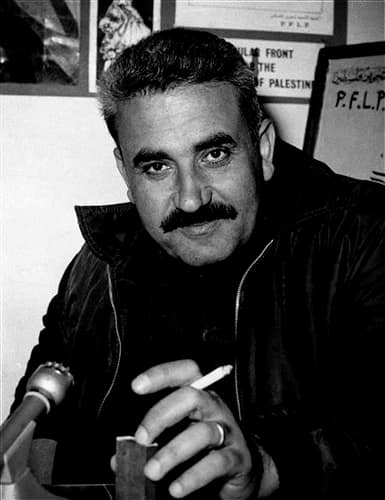
George Habash
جورج حبش
Physician, founder of the Arab Nationalist Movement and the PFLP
The physician from Lydda, expelled with his town in 1948, who founded the Arab Nationalist Movement and then the Popular Front for the Liberation of Palestine.
George Habash was born in Lydda on 1 August 1925 into a Greek Orthodox family that owned farmland and shops; his father, Nicholas Habash, was a well-known merchant, and his mother was Tuhfa. He went to school in Lydda, then to the National Orthodox College in Jaffa, and matriculated at Terra Sancta College in Jerusalem. In 1944 he entered the medical school of the American University of Beirut, where the historian Constantine Zurayk became the decisive influence on his politics; Habash was elected general secretary of the student society al-Urwa al-Wuthqa for 1949–50.
The turning point was 1948. Habash broke off his studies and returned to Lydda in June to work as an assistant to the surgeon treating the town’s wounded. Lydda and neighbouring Ramla fell on 11 July; some sixty thousand people were driven out at gunpoint and marched east. Habash, his parents and his siblings were among them, and he treated the old, the women and the children who collapsed on the road. He went back to Beirut that October, qualified as a doctor in 1951, and in 1952 opened a free clinic in Amman with his closest friend, Wadi Haddad, for refugees and the poor. Pursued by Jordanian security, he went underground for two years and moved to Damascus in 1954.
In December 1956, at a congress in Amman, Habash announced the founding of the Arab Nationalist Movement, with Wadi Haddad, Salih Shibl, Hamid Jabburi, Ahmad al-Khatib and Hani al-Hindi. Its ideology was secular and unionist and its slogan was “Unity, Liberation, Revenge.” It spread across Jordan, Syria, the Gulf, Yemen and North Africa. After the Ba’thist takeover in Syria and the failed Nasserist coup of 1963 Habash was sentenced to death in absentia; he moved secretly to Beirut in 1964. The defeat of June 1967 sent him back to first principles: he turned towards Marxism-Leninism and in December 1967 founded the Popular Front for the Liberation of Palestine, whose declared aim was the liberation of Palestine through armed struggle. He saw no contradiction in this. In a formulation his biographers still quote, he described a harmony between “my Arab nationalism, my being Christian, my Islamic culture and my progressive Marxism.”
Arrested by the Syrian authorities in 1968, he spent ten months in the Shaykh Hasan prison reading Marx, Lenin, Ho Chi Minh and Mao, and was broken out by Wadi Haddad. The front’s external operations branch, which Haddad ran, hijacked civil airliners from 1968 under the slogan “pursue the enemy everywhere,” culminating in the three aircraft blown up at Dawson’s Field in Jordan in September 1970 and the confrontation with the Jordanian army that followed. Habash stated in Beirut on 14 March 1972 that the front’s executive committee had decided on 5 November 1970 to end hijackings; Haddad refused, and after the Entebbe hijacking of June 1976 the PFLP leadership expelled him and the whole external branch. Habash meanwhile lost Ghassan Kanafani to a Mossad car bomb in 1972 and Haddad to poison in 1978, and twice escaped Israeli attempts to seize aircraft he was booked on, in 1973 and 1986.
He opposed the Madrid conference of 1991 and the Oslo Accord of 1993, arguing that they secured neither the refugees’ right of return nor a sovereign state, and he tied his own return to Palestine to the return of the refugees. He suffered a heart attack in 1972 and a brain haemorrhage in 1980, resigned as PFLP secretary-general in 2000, and died in Amman on 26 January 2008. The United States designated the PFLP a Foreign Terrorist Organization on 8 October 1997. His memoir, Les Révolutionnaires ne meurent jamais, appeared in French in 2008 and in Arabic the following year.
Selected contributions
- Founder of the Arab Nationalist Movement (Amman, December 1956)
- Founder and secretary-general of the Popular Front for the Liberation of Palestine (1967–2000)
- Les Révolutionnaires ne meurent jamais (2008)
Sources
Further reading
An external biography or archive holding more on this life than the entry above.
Connected in the archive
17 connected records17 records elsewhere in the archive are linked to this one, each by a piece of evidence you can read below.
born in — 1 record
- Lyddaاللد
Evidence — From a recorded field in this archive: birthplace: "Lydda, Palestine" → Lydda (Central Palestine)
named in this record — 4 records
One record names the other. A pointer for reading, not a claim that they belong to each other.
- Ghassan Kanafaniغسان كنفاني
Evidence — Inferred from the text — read the evidence: Habash meanwhile lost Ghassan Kanafani to a Mossad car bomb in 1972 and Haddad to poison in 1978, and twice escaped Israeli attempts to seize aircraft he was booked on, in 1973 and 1986.
- Ghassan Kanafaniغسان كنفاني
Evidence — Inferred from the text — read the evidence: Habash meanwhile lost Ghassan Kanafani to a Mossad car bomb in 1972 and Haddad to poison in 1978, and twice escaped Israeli attempts to seize aircraft he was booked on, in 1973 and 1986.
- Jaffaيافا
Evidence — Inferred from the text — read the evidence: He went to school in Lydda, then to the National Orthodox College in Jaffa, and matriculated at Terra Sancta College in Jerusalem.
- Jerusalemالقدس
Evidence — Inferred from the text — read the evidence: He went to school in Lydda, then to the National Orthodox College in Jaffa, and matriculated at Terra Sancta College in Jerusalem.
names this person — 2 records
One record names the other. A pointer for reading, not a claim that they belong to each other.
- Abu Ali Mustafaأبو علي مصطفى
Evidence — Inferred from the text — read the evidence: He was jailed again in 1966. After the June 1967 defeat he reached George Habash and Wadi Haddad, took part in founding the Popular Front for the Liberation of Palestine in December 1967, and headed its central field command in Ramallah.
- Wadie Haddadوديع حداد
Evidence — Inferred from the text — read the evidence: The Nakba drove the family out; they took refuge in Beirut, where Haddad entered the American University of Beirut to study medicine and met George Habash.
on a related subject — 10 records
Filed near each other — the same Mandate district, or the same uncommon subject tags.
- Ismail Shammoutإسماعيل شموط
Evidence — From a recorded field in this archive: Shared tags: "Lydda", "Nakba".
- Abdel Aziz al-Rantisiعبد العزيز الرنتيسي
Evidence — Inferred from the text — read the evidence: Shared tag: "medicine".
- Adel Mannaعادل مناع
Evidence — Inferred from the text — read the evidence: Shared tag: "Nakba".
- Ghassan Kanafani: A Conversation Between the Sword and the Neck
Evidence — Inferred from the text — read the evidence: Shared tag: "PFLP".
- Mustafa Barghoutiمصطفى البرغوثي
Evidence — Inferred from the text — read the evidence: Shared tag: "medicine".
- Nakba and Survival: The Story of Palestinians Who Remained in Haifa and the Galilee, 1948–1956
Evidence — Inferred from the text — read the evidence: Shared tag: "Nakba".
- and 4 more
Cite this page
Every claim above carries its sources — citation is the point.
- Chicago
“George Habash.” Figures, FALASTEEN.AI. Accessed 22 August 2026. https://falasteen.ai/figures/george-habash.- MLA
“George Habash.” Figures, FALASTEEN.AI, 2026, https://falasteen.ai/figures/george-habash. Accessed 22 August 2026.- BibTeX
@misc{falasteen-george-habash,
  title        = {George Habash},
  howpublished = {\url{https://falasteen.ai/figures/george-habash}},
  organization = {FALASTEEN.AI — A Living Archive for Palestine},
  year         = {2026},
  note         = {Accessed 2026-08-22}
}