Jaffa
يافا
Jaffa — Yafa, the Bride of the Sea — was Palestine's gateway and its orange capital until 1948, when most of its seventy thousand people were driven out by land and sea. A Palestinian community endures in Ajami, and the city's name still opens every account of the Nakba.
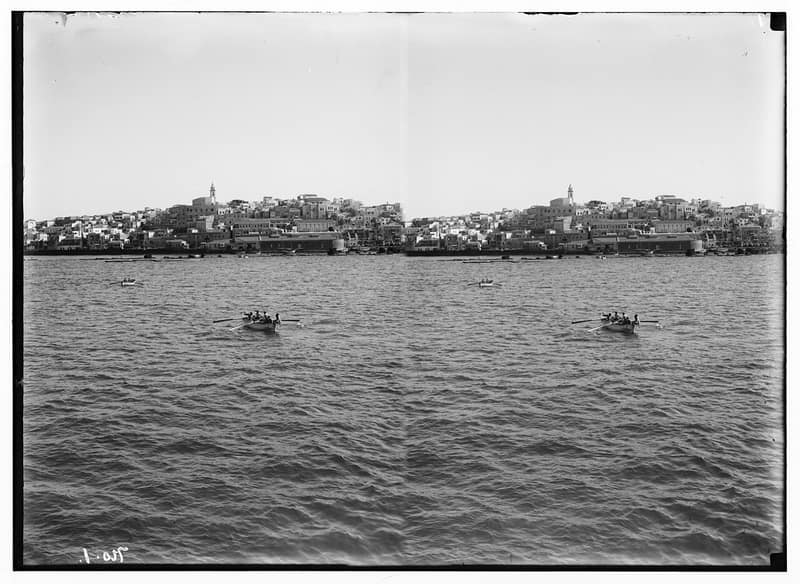
Jaffa is one of the oldest working harbors in the world. A Canaanite town — the Yapu of Egyptian records from the fifteenth century BCE — it served, in the Bible’s telling, as the landing port for the cedars of Lebanon bound for Solomon’s Temple, and as the port from which Jonah set sail. Greeks, Romans and Crusaders all prized it; Saladin and Richard the Lionheart closed the Third Crusade with the Battle of Jaffa in 1192. The Ottomans revived it from the late seventeenth century, and by the nineteenth it was Palestine’s second city and its gateway: pilgrims for Jerusalem landed at its wharves, consulates opened, newspapers rolled off its presses, and above all there were oranges — the Shamouti, shipped worldwide as the “Jaffa orange” until the fruit itself became a byword for Palestine.
On the eve of 1948 Jaffa was the largest Arab city in Palestine, with some seventy thousand Palestinian Muslims and Christians. Its cultural life matched its wealth: the newspaper Filastin, founded in 1909, schools and cinemas, the fishermen and stevedores of the port, the grand villas of Ajami and al-Manshiyya rising behind the sea wall. The limestone clock tower the Ottomans raised in the square in 1903 still stands over all of it.
The end came in weeks. Designated an Arab exclave under the 1947 UN partition plan, Jaffa was besieged after the plan’s announcement; on 26 April 1948 the Irgun launched its assault, and on 13 May the city surrendered. The great majority of its people fled — tens of thousands by sea, toward Gaza, Egypt and Lebanon. Roughly four thousand remained, and were concentrated in the Ajami quarter under military rule that lasted until 1966. In 1950 Jaffa was merged into Tel Aviv–Yafo; much of its old city and its markets were demolished in the years that followed.
Today a Palestinian community holds on in Ajami and al-Jabaliyya, fighting eviction and gentrification as the old town is repackaged for tourists. In Palestinian memory Jaffa stands for the lost cosmopolitan city: its oranges, its sea, its presses. Refugees carried its name into the camps of Gaza and Lebanon, where grandmothers still begin the story with the bayarat — the groves — and end it with the boats.
Sources
Cited works
2- britannica.com — Jaffa(opens in a new tab)https://www.britannica.com/place/Jaffa
- palestineremembered.com — index(opens in a new tab)https://www.palestineremembered.com/Jaffa/Jaffa/index.html
Cite this page
Every claim above carries its sources — citation is the point.
- Chicago
“Jaffa.” Places, FALASTEEN.AI. Accessed 22 August 2026. https://falasteen.ai/places/jaffa.- MLA
“Jaffa.” Places, FALASTEEN.AI, 2026, https://falasteen.ai/places/jaffa. Accessed 22 August 2026.- BibTeX
@misc{falasteen-jaffa,
  title        = {Jaffa},
  howpublished = {\url{https://falasteen.ai/places/jaffa}},
  organization = {FALASTEEN.AI — A Living Archive for Palestine},
  year         = {2026},
  note         = {Accessed 2026-08-22}
}