Safed
صفد
Safed — Safad, the city on the hill — was a Galilee town of mystics, weavers and rebels until May 1948, when nearly all of its roughly ten thousand Palestinians fled or were driven out as the town fell. Its stone Arab quarter survives as an artists' colony, and its refugees carry Safad with them still.
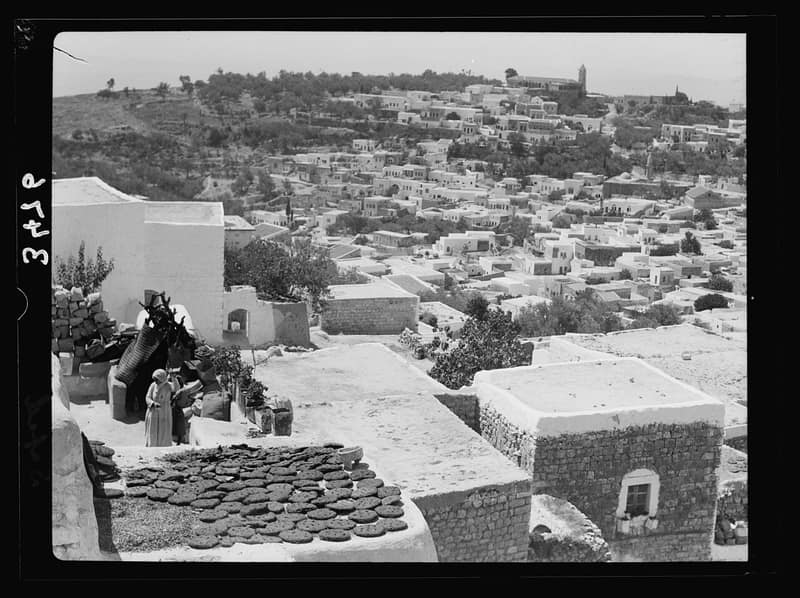
Safed crowns a hilltop some 850 metres above the Upper Galilee, the highest town in the country. It steps clearly into the record under the Crusaders, whose Templar castle the Mamluk sultan Baybars stormed in 1266; under the Mamluks Safed became a provincial capital, and under the Ottomans the seat of the Safad Sanjak. After 1492, Jews expelled from Spain settled among its Arab majority, and in the sixteenth century the town flowered into the world capital of Jewish mysticism — the Kabbalah of Isaac Luria, Joseph Karo’s code of law, the Sabbath hymn Lekhah Dodi. The earthquake of 1837 levelled much of it; the town that rose again was an Arab market center of wool weavers and olive presses beneath the ruined citadel.
On the eve of 1948 Safed held roughly ten to twelve thousand Palestinian Muslims and Christians alongside a small, long-rooted Jewish community of under two thousand. Its market drew the villages of the eastern Galilee, its workshops turned out the woolen cloth for which Safad was known, and the Scottish mission’s hospital and schools served the whole hill country. It was in Safed that Fayez Sayegh — raised in Tiberias, later one of the Palestinian cause’s foremost legal scholars — went to secondary school in the 1930s.
The end came in two days. As the British pulled out, Palmach forces took Safed on 10–11 May 1948 in Operation Yiftach, shelling its Arab quarters; nearly the entire Palestinian population fled east, toward Lebanon and Syria, and was never allowed back — only a handful of the old and infirm remained. The emptied stone quarter was settled with new immigrants, and from 1949 the old Arab town was recast as an artists’ colony: the galleries of today’s Artists’ Quarter occupy the houses of the departed.
Safed’s refugees scattered to Ein al-Hilweh and the other camps of Lebanon and Syria, and their grandchildren still answer to the surname Safadi. The citadel hill is a public park; the town below trades on a mystique built in part on emptied stones. In the annals of the Nakba, Safed stands for the speed of 1948 — a town of some ten thousand emptied in forty-eight hours, and remembered ever since.
Sources
Cited works
2- britannica.com — Safed(opens in a new tab)https://www.britannica.com/place/Safed
- palestineremembered.com — index(opens in a new tab)https://www.palestineremembered.com/Safed/Safed/index.html
Cite this page
Every claim above carries its sources — citation is the point.
- Chicago
“Safed.” Places, FALASTEEN.AI. Accessed 22 August 2026. https://falasteen.ai/places/safed.- MLA
“Safed.” Places, FALASTEEN.AI, 2026, https://falasteen.ai/places/safed. Accessed 22 August 2026.- BibTeX
@misc{falasteen-safed,
  title        = {Safed},
  howpublished = {\url{https://falasteen.ai/places/safed}},
  organization = {FALASTEEN.AI — A Living Archive for Palestine},
  year         = {2026},
  note         = {Accessed 2026-08-22}
}