Keys of Return
مفتاح العودة
The house keys carried out of Palestine in 1948, passed down through refugee generations as deeds to homes and to memory.
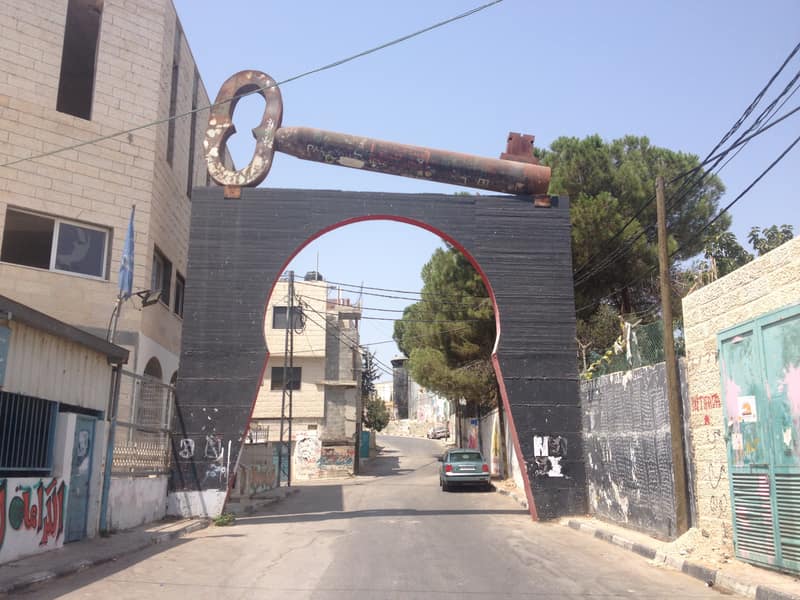
When more than 700,000 Palestinians were expelled or fled their homes in 1948, many locked their doors and took the key, expecting to return in days or weeks. The keys — heavy iron keys of village houses and city apartments alike — were never used again, but they were never thrown away.
Passed from grandparents to grandchildren, the keys became a portable inheritance: a material claim to a house, a village, and a history that maps and records sought to erase. In refugee camps across Lebanon, Jordan, Syria, Gaza, and the West Bank, the old key hangs on walls beside photographs of the lost home.
In recent decades, the key has grown into a monumental public symbol. Giant keys stand at the entrances of refugee camps, including the Aida camp in Bethlehem, where a several-meter key rises over the gate inscribed “Not for Sale.” Each 15 May, on Nakba Day, the key is carried in demonstrations as the emblem of the right of return affirmed in UN General Assembly Resolution 194.
Connected in the archive
21 connected records21 records elsewhere in the archive are linked to this one, each by a piece of evidence you can read below.
named in this record — 5 records
One record names the other. A pointer for reading, not a claim that they belong to each other.
- Bethlehemبيت لحم
Evidence — Inferred from the text — read the evidence: Giant keys stand at the entrances of refugee camps, including the Aida camp in Bethlehem, where a several-meter key rises over the gate inscribed "Not for Sale." Each 15 May, on Nakba Day, the key is carried in demonstrations as the emblem of the right of return affirmed in UN General Assembly Resolution 194.
- Nakba
Evidence — Inferred from the text — read the evidence: Giant keys stand at the entrances of refugee camps, including the Aida camp in Bethlehem, where a several-meter key rises over the gate inscribed "Not for Sale." Each 15 May, on Nakba Day, the key is carried in demonstrations as the emblem of the right of return affirmed in UN General Assembly Resolution 194.
- Nakba Day
Evidence — Inferred from the text — read the evidence: Giant keys stand at the entrances of refugee camps, including the Aida camp in Bethlehem, where a several-meter key rises over the gate inscribed "Not for Sale." Each 15 May, on Nakba Day, the key is carried in demonstrations as the emblem of the right of return affirmed in UN General Assembly Resolution 194.
- The Nakba
Evidence — Inferred from the text — read the evidence: Giant keys stand at the entrances of refugee camps, including the Aida camp in Bethlehem, where a several-meter key rises over the gate inscribed "Not for Sale." Each 15 May, on Nakba Day, the key is carried in demonstrations as the emblem of the right of return affirmed in UN General Assembly Resolution 194.
- UN General Assembly Resolution 194
Evidence — Inferred from the text — read the evidence: Giant keys stand at the entrances of refugee camps, including the Aida camp in Bethlehem, where a several-meter key rises over the gate inscribed "Not for Sale." Each 15 May, on Nakba Day, the key is carried in demonstrations as the emblem of the right of return affirmed in UN General Assembly Resolution 194.
on a related subject — 16 records
Filed near each other — the same Mandate district, or the same uncommon subject tags.
- BADIL Resource Center for Palestinian Residency and Refugee Rights
Evidence — From a recorded field in this archive: Shared tags: "refugees", "right of return".
- A History of Modern Palestine: One Land, Two Peoples
Evidence — Inferred from the text — read the evidence: Shared tag: "nakba".
- All That Remains: The Palestinian Villages Occupied and Depopulated by Israel in 1948
Evidence — Inferred from the text — read the evidence: Shared tag: "nakba".
- Gate of the Sun
Evidence — Inferred from the text — read the evidence: Shared tag: "nakba".
- Handala
Evidence — Inferred from the text — read the evidence: Shared tag: "refugees".
- Leila Khaledليلى خالد
Evidence — Inferred from the text — read the evidence: Shared tag: "refugees".
- and 10 more
Cite this page
Every claim above carries its sources — citation is the point.
- Chicago
“Keys of Return.” Culture, FALASTEEN.AI. Accessed 22 August 2026. https://falasteen.ai/culture/keys-of-return.- MLA
“Keys of Return.” Culture, FALASTEEN.AI, 2026, https://falasteen.ai/culture/keys-of-return. Accessed 22 August 2026.- BibTeX
@misc{falasteen-keys-of-return,
  title        = {Keys of Return},
  howpublished = {\url{https://falasteen.ai/culture/keys-of-return}},
  organization = {FALASTEEN.AI — A Living Archive for Palestine},
  year         = {2026},
  note         = {Accessed 2026-08-22}
}