The Jaffa Orange
برتقال يافا
The Shamouti orange, bred by Palestinian growers near Jaffa in the mid-nineteenth century — Palestine's great export, and after 1948 a brand without its farmers.
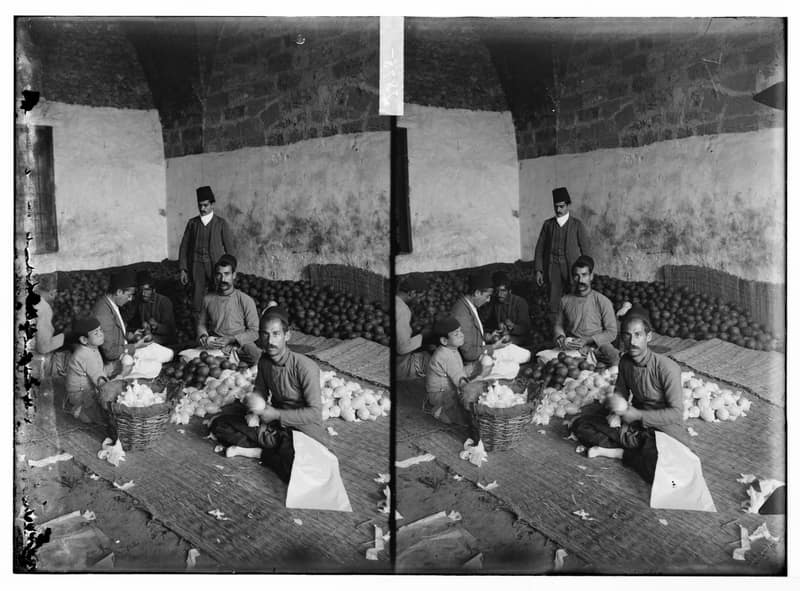
The Jaffa orange is a cultivar, not a place-name: the shamouti, a nearly seedless sweet orange with a thick, loose skin, which appeared as a mutation on a baladi tree in the groves outside Jaffa in the middle of the nineteenth century and was propagated by Arab growers by grafting. Its tough peel made it travel, and travelling was the point. British consular reports mention it going to Europe in the 1850s; steamships shortened the passage from weeks to days. Exports rose from around 200,000 oranges in 1845 to some 38 million by 1870 — the year the name “Jaffa” was first used as a marketing label, by the German Templer colony.
Citrus reshaped the coastal plain. The groves demanded wells, pumps, packing houses, crates, camel and cart transport and thousands of seasonal pickers and packers, and because a new grove yields nothing for years, ownership concentrated among Palestinian merchants and notables of Jaffa rather than smallholders. A European account of 1872 put the annual value of Jaffa’s fruit at £10,000; by 1902 the main export markets were England, Turkey, Egypt and Austria-Hungary. Under the British Mandate the industry became the country’s leading export: by 1939 Arab- and Jewish-owned groves together covered some 30,000 hectares and employed more than 100,000 people.
That shared boom was also a contest. By the end of 1928 Zionist buyers had acquired half of the region’s orange land — 30,000 of 60,000 dunams — and land prices in fruiting groves had tripled since before the war. In 1933 Jewish-owned production overtook Arab-owned production for the first time; during the Second World War, with export markets closed, the order reversed again. The Hope Simpson enquiry of 1930 recorded the orange as “introduced by the Arabs before the commencement of Jewish settlement” while crediting its later perfection to Jewish science — a formula that would outlive the Mandate.
In April and May 1948 Jaffa was emptied of the overwhelming majority of its roughly 70,000 Arab inhabitants, and the villages of its hinterland with it. The groves remained; the growers did not. They passed to the new state and its custodianship of “absentee” property, and the Jaffa label was exported afterwards as an Israeli product, presented as the achievement of a pioneering movement in which no Palestinian had ever worked. Today almost no commercial citrus grows around Jaffa itself. The orange survives in Palestinian memory as a specific loss: in the crate labels collected by families in exile, in Ghassan Kanafani’s The Land of Sad Oranges, and in the deeds still held for groves whose owners have never been allowed back to them.
Sources
Connected in the archive
20 connected records20 records elsewhere in the archive are linked to this one, each by a piece of evidence you can read below.
named in this record — 3 records
One record names the other. A pointer for reading, not a claim that they belong to each other.
- Ghassan Kanafaniغسان كنفاني
Evidence — Inferred from the text — read the evidence: The orange survives in Palestinian memory as a specific loss: in the crate labels collected by families in exile, in Ghassan Kanafani's The Land of Sad Oranges, and in the deeds still held for groves whose owners have never been allowed back to them.
- Ghassan Kanafaniغسان كنفاني
Evidence — Inferred from the text — read the evidence: The orange survives in Palestinian memory as a specific loss: in the crate labels collected by families in exile, in Ghassan Kanafani's The Land of Sad Oranges, and in the deeds still held for groves whose owners have never been allowed back to them.
- Jaffaيافا
Evidence — Inferred from the text — read the evidence: The Jaffa orange is a cultivar, not a place-name: the shamouti, a nearly seedless sweet orange with a thick, loose skin, which appeared as a mutation on a baladi tree in the groves outside Jaffa in the middle of the nineteenth century and was propagated by Arab growers by grafting.
on a related subject — 17 records
Filed near each other — the same Mandate district, or the same uncommon subject tags.
- Adel Mannaعادل مناع
Evidence — Inferred from the text — read the evidence: Shared tag: "Nakba".
- Aref al-Arefعارف العارف
Evidence — Inferred from the text — read the evidence: Shared tag: "Nakba".
- George Habashجورج حبش
Evidence — Inferred from the text — read the evidence: Shared tag: "Nakba".
- Ibrahim Abu-Lughodإبراهيم أبو لغد
Evidence — Inferred from the text — read the evidence: Shared tag: "Jaffa".
- Ismail Shammoutإسماعيل شموط
Evidence — Inferred from the text — read the evidence: Shared tag: "Nakba".
- Khalil al-Wazir (Abu Jihad)خليل الوزير (أبو جهاد)
Evidence — Inferred from the text — read the evidence: Shared tag: "Nakba".
- and 11 more
Cite this page
Every claim above carries its sources — citation is the point.
- Chicago
“The Jaffa Orange.” Culture, FALASTEEN.AI. Accessed 22 August 2026. https://falasteen.ai/culture/jaffa-orange.- MLA
“The Jaffa Orange.” Culture, FALASTEEN.AI, 2026, https://falasteen.ai/culture/jaffa-orange. Accessed 22 August 2026.- BibTeX
@misc{falasteen-jaffa-orange,
  title        = {The Jaffa Orange},
  howpublished = {\url{https://falasteen.ai/culture/jaffa-orange}},
  organization = {FALASTEEN.AI — A Living Archive for Palestine},
  year         = {2026},
  note         = {Accessed 2026-08-22}
}