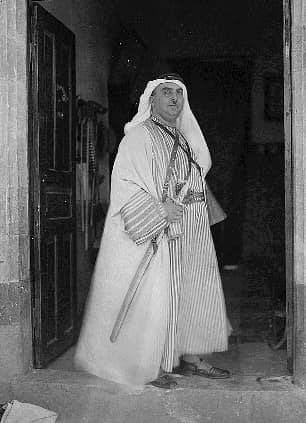
Aref al-Aref
عارف العارف
Historian of the Nakba
Ottoman officer, Siberian prisoner of war, Mandate district officer, mayor of Jerusalem — and the man who spent the years after 1948 interviewing survivors across the Arab world to write the six-volume Arabic history of the catastrophe he had watched happen.
Aref al-Aref was born in Jerusalem in 1892, went to the Ma’muniyya school there, and in 1909 continued his education in Istanbul, graduating from the arts faculty of Istanbul University in 1914 while working nights as an editor at the newspaper Tanin to pay for it. He was already writing about the danger before the First World War: in January 1913 the Jaffa paper Filastin carried a piece signed “A. Aref” on the sale of the village of Abu Shusha, warning that if things continued in that manner the Zionists would take the country village by village and town by town.
The war took him to the Caucasus as an Ottoman officer and then to a Russian prison camp in Siberia, where he spent three years, learned Russian and German, translated Ernst Haeckel into Arabic, and produced with a Syrian fellow prisoner a satirical Arabic weekly called Naqat Allah — God’s Camel — that ran to some fifty issues in 1916 and 1917. He escaped in September 1918 and reached Jerusalem by way of the Far East in February 1919, after ten years away.
He then had two careers at once. He edited Southern Syria, the first nationalist newspaper published in Jerusalem under British occupation, until the Mandate banned it repeatedly; he spoke alongside Haj Amin al-Husseini at the Nabi Musa rally of April 1920, was sentenced in absentia to ten years, fled to Damascus and Transjordan, and returned under amnesty on condition that he abandon both politics and journalism. So he became a civil servant: district officer in Jenin, Nablus, Baysan and Jaffa; secretary-general to Prince Abdullah in Transjordan; district officer of Bir al-Saba’ for ten years from 1929, then of Gaza, then of Ramallah, and finally deputy to the British commissioner of the Jerusalem district — the post he held on 15 May 1948. He was mayor of Jerusalem from 1949, by appointment and then by election, until 1955, and resigned as a Jordanian minister rather than accept the Baghdad Pact.
What makes him matter to this archive is what he did afterwards. He had watched the Nakba from inside the administration and recorded it day by day, and he then went out and collected an unequalled body of testimony — from officials, from fighters, from ordinary people, in Palestine and in every Arab capital he could reach. Out of it came a six-volume history of the war for Palestine, published between 1956 and 1961, which remains one of the foundational Arabic works on 1948. He is called the dean of Palestinian historians, and the reason is method: he wrote about the districts he had governed, the events he had been present at, and the people he had known, and he went looking for the survivors while they were still alive to be asked.
He served as director of the Palestine Archaeological Museum in Jerusalem from 1963, chaired the Wounded Veterans League there, and was a trustee of the Family Revival Society in al-Bireh chaired by Samiha Khalil. He died in Ramallah in 1973 after a stroke and is buried there. In 1990 the PLO awarded him the Jerusalem Medal for Culture, Arts and Literature.
Sources
Further reading
An external biography or archive holding more on this life than the entry above.
Connected in the archive
20 connected records20 records elsewhere in the archive are linked to this one, each by a piece of evidence you can read below.
born in — 1 record
- Jerusalemالقدس
Evidence — From a recorded field in this archive: birthplace: "Jerusalem, Palestine" → Jerusalem (Jerusalem Governorate)
named in this record — 5 records
One record names the other. A pointer for reading, not a claim that they belong to each other.
- al-Birehالبيرة
Evidence — Inferred from the text — read the evidence: He served as director of the Palestine Archaeological Museum in Jerusalem from 1963, chaired the Wounded Veterans League there, and was a trustee of the Family Revival Society in al-Bireh chaired by Samiha Khalil.
- Bir al-Sabaبئر السبع
Evidence — Inferred from the text — read the evidence: So he became a civil servant: district officer in Jenin, Nablus, Baysan and Jaffa; secretary-general to Prince Abdullah in Transjordan; district officer of Bir al-Saba' for ten years from 1929, then of Gaza, then of Ramallah, and finally deputy to the British commissioner of the Jerusalem district — the post he held on 15 May 1948.
- Jeninجنين
Evidence — Inferred from the text — read the evidence: So he became a civil servant: district officer in Jenin, Nablus, Baysan and Jaffa; secretary-general to Prince Abdullah in Transjordan; district officer of Bir al-Saba' for ten years from 1929, then of Gaza, then of Ramallah, and finally deputy to the British commissioner of the Jerusalem district — the post he held on 15 May 1948.
- Ramallahرام الله
Evidence — Inferred from the text — read the evidence: So he became a civil servant: district officer in Jenin, Nablus, Baysan and Jaffa; secretary-general to Prince Abdullah in Transjordan; district officer of Bir al-Saba' for ten years from 1929, then of Gaza, then of Ramallah, and finally deputy to the British commissioner of the Jerusalem district — the post he held on 15 May 1948.
- Samiha Khalilسميحة خليل
Evidence — Inferred from the text — read the evidence: He served as director of the Palestine Archaeological Museum in Jerusalem from 1963, chaired the Wounded Veterans League there, and was a trustee of the Family Revival Society in al-Bireh chaired by Samiha Khalil.
names this person — 2 records
One record names the other. A pointer for reading, not a claim that they belong to each other.
- 'Iraq al-Manshiyyaعِراق المَنْشِيَّة
Evidence — Inferred from the text — read the evidence: The Palestinian historian Aref al-Aref writes that the village was the target of continuous attacks during the second truce, and notably on 22 August.
- Al-Damunالدامون
Evidence — Inferred from the text — read the evidence: After the first Israeli successes of Operation Dekel, units of the Sheva' Brigade moved west and captured al-Damun in the operation's second stage, on 15–16 July 1948 — the Palestinian historian Aref al-Aref dates its fall earlier, to May, after the capture of Acre.
on a related subject — 12 records
Filed near each other — the same Mandate district, or the same uncommon subject tags.
- Khalil Beidasخليل بيدس
Evidence — From a recorded field in this archive: Shared tags: "Nakba", "Jerusalem".
- Najati Sidqiنجاتي صدقي
Evidence — From a recorded field in this archive: Shared tags: "Jerusalem", "mandate".
- Rashid Khalidiرشيد خالدي
Evidence — From a recorded field in this archive: Shared tags: "Nakba", "historiography".
- The Husayni familyالحسيني
Evidence — From a recorded field in this archive: Shared tags: "Jerusalem", "mandate".
- The Nashashibi familyالنشاشيبي
Evidence — From a recorded field in this archive: Shared tags: "Jerusalem", "mandate".
- Armenian Ceramics of Jerusalem
Evidence — Inferred from the text — read the evidence: Shared tag: "Jerusalem".
- and 6 more
Cite this page
Every claim above carries its sources — citation is the point.
- Chicago
“Aref al-Aref.” Figures, FALASTEEN.AI. Accessed 22 August 2026. https://falasteen.ai/figures/aref-al-aref.- MLA
“Aref al-Aref.” Figures, FALASTEEN.AI, 2026, https://falasteen.ai/figures/aref-al-aref. Accessed 22 August 2026.- BibTeX
@misc{falasteen-aref-al-aref,
  title        = {Aref al-Aref},
  howpublished = {\url{https://falasteen.ai/figures/aref-al-aref}},
  organization = {FALASTEEN.AI — A Living Archive for Palestine},
  year         = {2026},
  note         = {Accessed 2026-08-22}
}