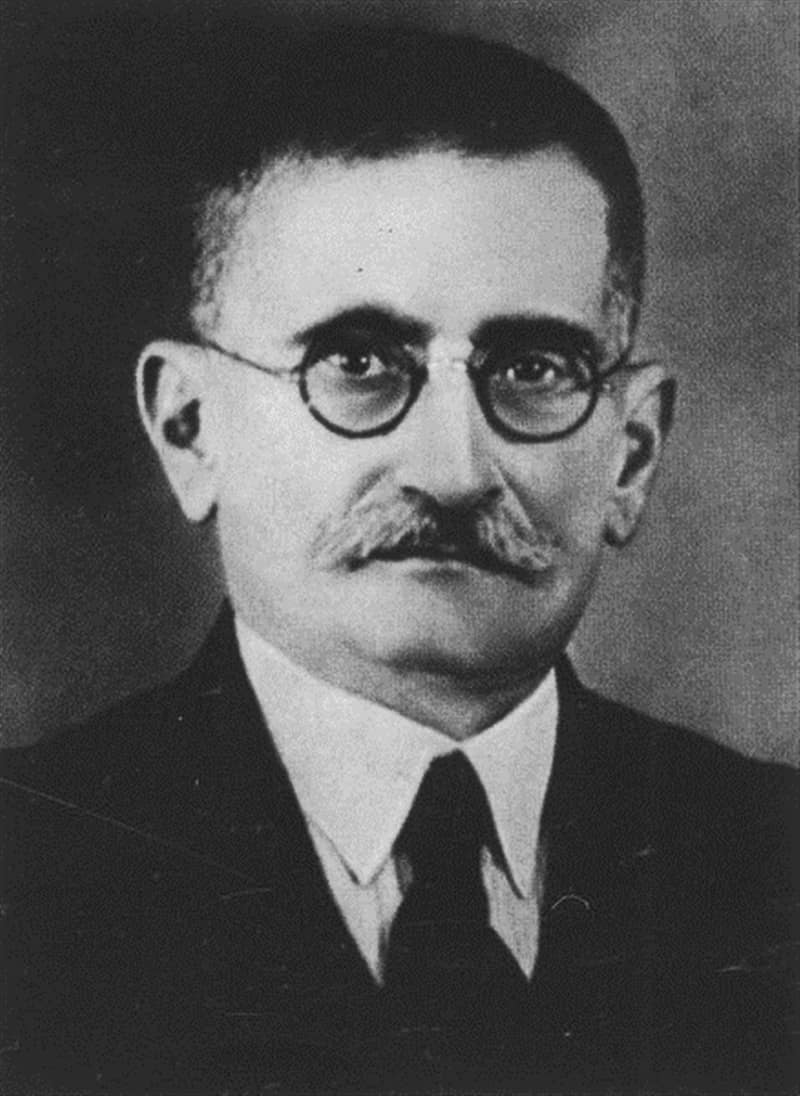
Khalil Beidas
خليل بيدس
Novelist, translator and editor of al-Nafa'is
The Nazareth schoolmaster who brought Pushkin and Tolstoy into Arabic, founded the magazine that carried a generation of Palestinian writing, was sentenced to death by the Ottomans and to fifteen years by the British — and lost his library and his manuscripts in 1948.
Khalil Beidas was born in Nazareth in 1875 to Ibrahim and Warda Beidas. He was schooled at the Greek Orthodox school in the town and then spent six years at the Russian Teachers’ College there — the institution that determined everything that followed. He became headmaster of the Russian elementary school in Homs, then taught at Russian schools in Baskinta, Suq al-Gharb and Jdaidet Marja’uyun in Lebanon, and in 1908 was transferred to the Orthodox School in Haifa.
That was the year the Ottoman constitution was restored, and Beidas used the opening to start a weekly magazine, al-Nafa’is, which in 1909 became the fortnightly al-Nafa’is al-Asriyya. He moved it to Jerusalem in 1911. It closed at the outbreak of the First World War, resumed in 1919, and finally shut in 1923. In its fifteen years it circulated across the Arab world and beyond it, and most of the significant literary figures of Palestine and the Arab East published in its pages. He is regarded as a pioneer of translation from Russian into Arabic — Pushkin’s The Captain’s Daughter appeared in his version in Beirut in 1898, Tolstoy in 1909 — and as the writer who pushed the Palestinian novel toward the ordinary lives of ordinary people. He left some forty-four books written or translated.
He was also, from early on, a political writer on the danger he saw coming. In articles in al-Ahram and al-Muqattam he warned about Zionist immigration and called on the Ottoman state to deal justly with the Arabs of Palestine. When the Arab Revolt broke out in June 1916 the Ottoman authorities sentenced him to death; he took refuge in the Orthodox Patriarchate in Jerusalem, which sheltered him and saved him from the gallows. Four years later the British arrested him after a Jerusalem demonstration at which he spoke against the Balfour Declaration and sentenced him to fifteen years. In Acre prison he wrote a short book describing the imperial prison system and the treatment of nationalist prisoners inside it — one of the earliest works of Palestinian prison literature, written in the same fortress where the Mandate would hang Fuad Hijazi, Muhammad Jamjoum and Atta al-Zir a decade later. He was released under the general pardon issued by the High Commissioner Herbert Samuel, and taught Arabic at St George’s School in Jerusalem until he retired in 1945.
He had assembled a valuable library of manuscripts and printed books. In 1948, when Zionist militias took his quarter of Jerusalem, he was forced out of his house and walked to the village of Silwan. He was seventy-three. Everything in the library was lost. From Silwan he went to Amman and then to Beirut, where he died on 9 February 1949 and was buried. The PLO awarded him the Jerusalem Medal for Culture, Arts and Literature in January 1990.
Sources
Further reading
An external biography or archive holding more on this life than the entry above.
Connected in the archive
20 connected records20 records elsewhere in the archive are linked to this one, each by a piece of evidence you can read below.
born in — 1 record
- Nazarethالناصرة
Evidence — From a recorded field in this archive: birthplace: "Nazareth, Palestine" → Nazareth (Lower Galilee)
named in this record — 7 records
One record names the other. A pointer for reading, not a claim that they belong to each other.
- Acreعكا
Evidence — Inferred from the text — read the evidence: In Acre prison he wrote a short book describing the imperial prison system and the treatment of nationalist prisoners inside it — one of the earliest works of Palestinian prison literature, written in the same fortress where the Mandate would hang Fuad Hijazi, Muhammad Jamjoum and Atta al-Zir a decade later.
- Atta al-Zirعطا الزير
Evidence — Inferred from the text — read the evidence: In Acre prison he wrote a short book describing the imperial prison system and the treatment of nationalist prisoners inside it — one of the earliest works of Palestinian prison literature, written in the same fortress where the Mandate would hang Fuad Hijazi, Muhammad Jamjoum and Atta al-Zir a decade later.
- Fuad Hijaziفؤاد حجازي
Evidence — Inferred from the text — read the evidence: In Acre prison he wrote a short book describing the imperial prison system and the treatment of nationalist prisoners inside it — one of the earliest works of Palestinian prison literature, written in the same fortress where the Mandate would hang Fuad Hijazi, Muhammad Jamjoum and Atta al-Zir a decade later.
- Haifaحيفا
Evidence — Inferred from the text — read the evidence: He became headmaster of the Russian elementary school in Homs, then taught at Russian schools in Baskinta, Suq al-Gharb and Jdaidet Marja'uyun in Lebanon, and in 1908 was transferred to the Orthodox School in Haifa.
- Jerusalemالقدس
Evidence — Inferred from the text — read the evidence: He moved it to Jerusalem in 1911.
- Muhammad Jamjoumمحمد جمجوم
Evidence — Inferred from the text — read the evidence: In Acre prison he wrote a short book describing the imperial prison system and the treatment of nationalist prisoners inside it — one of the earliest works of Palestinian prison literature, written in the same fortress where the Mandate would hang Fuad Hijazi, Muhammad Jamjoum and Atta al-Zir a decade later.
- and 1 more
on a related subject — 12 records
Filed near each other — the same Mandate district, or the same uncommon subject tags.
- Aref al-Arefعارف العارف
Evidence — From a recorded field in this archive: Shared tags: "Nakba", "Jerusalem".
- Najati Sidqiنجاتي صدقي
Evidence — From a recorded field in this archive: Shared tags: "translation", "Jerusalem", "Acre prison".
- Armenian Ceramics of Jerusalem
Evidence — Inferred from the text — read the evidence: Shared tag: "Jerusalem".
- Elia Suleimanإيليا سليمان
Evidence — Inferred from the text — read the evidence: Shared tag: "Nazareth".
- Karimeh Abbudكريمة عبود
Evidence — Inferred from the text — read the evidence: Shared tag: "Nazareth".
- Nakba and Survival: The Story of Palestinians Who Remained in Haifa and the Galilee, 1948–1956
Evidence — Inferred from the text — read the evidence: Shared tag: "Nakba".
- and 6 more
Cite this page
Every claim above carries its sources — citation is the point.
- Chicago
“Khalil Beidas.” Figures, FALASTEEN.AI. Accessed 22 August 2026. https://falasteen.ai/figures/khalil-beidas.- MLA
“Khalil Beidas.” Figures, FALASTEEN.AI, 2026, https://falasteen.ai/figures/khalil-beidas. Accessed 22 August 2026.- BibTeX
@misc{falasteen-khalil-beidas,
  title        = {Khalil Beidas},
  howpublished = {\url{https://falasteen.ai/figures/khalil-beidas}},
  organization = {FALASTEEN.AI — A Living Archive for Palestine},
  year         = {2026},
  note         = {Accessed 2026-08-22}
}