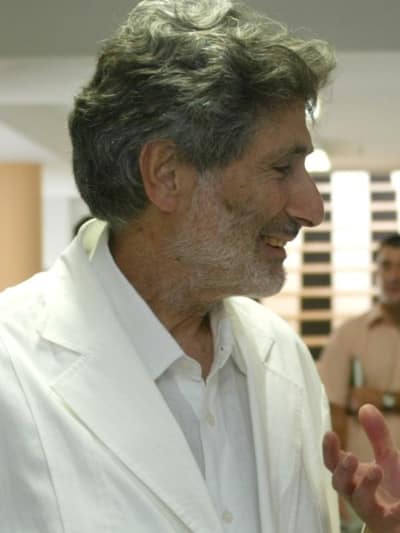
Edward W. Said
إدوارد سعيد
Literary critic and public intellectual
The Jerusalem-born critic whose Orientalism remade the study of empire, and who spent three decades arguing that Palestinians were owed what he called permission to narrate.
Edward Wadie Said was born on 1 November 1935 in the Talbiyya quarter of Jerusalem, to Wadih Said and Hilda Moussa. His father had moved to Cairo in 1929 and built a stationery business there, so Said’s schooling was divided between the two cities: Gezira Preparatory School in Cairo, a year at St. George’s School in Jerusalem in 1947, and then Victoria College in Cairo after most of the family left Jerusalem in 1948. Expelled from Victoria College in 1951, he was sent to Northfield Mount Hermon School in Massachusetts, graduating in 1953. He completed his undergraduate degree at Princeton in 1957 and took an MA (1960) and a PhD in English literature (1964) at Harvard. In 1963, a year before finishing his doctorate, he joined the English and Comparative Literature faculty at Columbia University, where he remained until his death.
Orientalism, published in 1978, argued that Western scholarship on the East had produced not knowledge of it but a system of representation bound to imperial power — and in doing so helped bring into being the field now called postcolonial studies. Said wrote roughly thirty books, translated into more than thirty-five languages, among them The Question of Palestine and Culture and Imperialism. He insisted that the intellectual’s task was to speak, in his phrase, truth to power, and that criticism could not be conducted from inside a position of power without ceasing to be criticism.
His Palestinian politics ran alongside the scholarship rather than beneath it. He translated Yasser Arafat’s 1974 speech for the United Nations, and met Mahmoud Darwish and Shafiq al-Hout for the first time that year. In 1977 the thirteenth Palestine National Council elected him as an independent intellectual; he attended the nineteenth PNC in Algiers in 1988 and fully endorsed the Declaration of Independence. Five years later he broke publicly and sharply with the Oslo agreement, and the rupture with the PLO leadership was never repaired. He also served as music critic for The Nation, and with Daniel Barenboim co-founded the West-Eastern Divan Orchestra, recruiting young Palestinian musicians for it.
Said died in New York on 24 September 2003 after a long illness and was buried in Broumana, Lebanon. In 2004 the Edward Said National Conservatory of Music was established in Ramallah and other Palestinian cities, and Ramallah named a street for him.
Selected works
- Orientalism (1978)
- The Question of Palestine (1979)
- Culture and Imperialism (1993)
- Out of Place: A Memoir (1999)
Sources
Further reading
An external biography or archive holding more on this life than the entry above.
Connected in the archive
17 connected records17 records elsewhere in the archive are linked to this one, each by a piece of evidence you can read below.
named in this record — 6 records
One record names the other. A pointer for reading, not a claim that they belong to each other.
- Jerusalemالقدس
Evidence — Inferred from the text — read the evidence: Edward Wadie Said was born on 1 November 1935 in the Talbiyya quarter of Jerusalem, to Wadih Said and Hilda Moussa.
- Mahmoud Darwishمحمود درويش
Evidence — Inferred from the text — read the evidence: He translated Yasser Arafat's 1974 speech for the United Nations, and met Mahmoud Darwish and Shafiq al-Hout for the first time that year.
- Orientalism
Evidence — Inferred from the text — read the evidence: Orientalism, published in 1978, argued that Western scholarship on the East had produced not knowledge of it but a system of representation bound to imperial power — and in doing so helped bring into being the field now called postcolonial studies.
- Ramallahرام الله
Evidence — Inferred from the text — read the evidence: In 2004 the Edward Said National Conservatory of Music was established in Ramallah and other Palestinian cities, and Ramallah named a street for him.
- The Question of Palestine
Evidence — Inferred from the text — read the evidence: Said wrote roughly thirty books, translated into more than thirty-five languages, among them The Question of Palestine and Culture and Imperialism.
- Yasser Arafatياسر عرفات
Evidence — Inferred from the text — read the evidence: He translated Yasser Arafat's 1974 speech for the United Nations, and met Mahmoud Darwish and Shafiq al-Hout for the first time that year.
names this person — 2 records
One record names the other. A pointer for reading, not a claim that they belong to each other.
- After the Last Sky: Palestinian Lives
Evidence — Inferred from the text — read the evidence: Edward W. Said (1935–2003) was a Jerusalem-born literary scholar at Columbia University and the leading Palestinian voice in Western public life.
- I Saw Ramallah
Evidence — Inferred from the text — read the evidence: - English translation by Ahdaf Soueif; foreword by Edward W. Said
on a related subject — 9 records
Filed near each other — the same Mandate district, or the same uncommon subject tags.
- Kamal Boullataكمال بلاطة
Evidence — From a recorded field in this archive: Shared tags: "Jerusalem", "exile".
- A Long Walk from Gaza
Evidence — Inferred from the text — read the evidence: Shared tag: "exile".
- Armenian Ceramics of Jerusalem
Evidence — Inferred from the text — read the evidence: Shared tag: "Jerusalem".
- Edward Said on Oslo: The Morning After
Evidence — Inferred from the text — read the evidence: Shared tag: "criticism".
- Edward Said: The Question of Palestine
Evidence — Inferred from the text — read the evidence: Shared tag: "exile".
- Men in the Sun
Evidence — Inferred from the text — read the evidence: Shared tag: "exile".
- and 3 more
Cite this page
Every claim above carries its sources — citation is the point.
- Chicago
“Edward W. Said.” Figures, FALASTEEN.AI. Accessed 22 August 2026. https://falasteen.ai/figures/edward-said.- MLA
“Edward W. Said.” Figures, FALASTEEN.AI, 2026, https://falasteen.ai/figures/edward-said. Accessed 22 August 2026.- BibTeX
@misc{falasteen-edward-said,
  title        = {Edward W. Said},
  howpublished = {\url{https://falasteen.ai/figures/edward-said}},
  organization = {FALASTEEN.AI — A Living Archive for Palestine},
  year         = {2026},
  note         = {Accessed 2026-08-22}
}