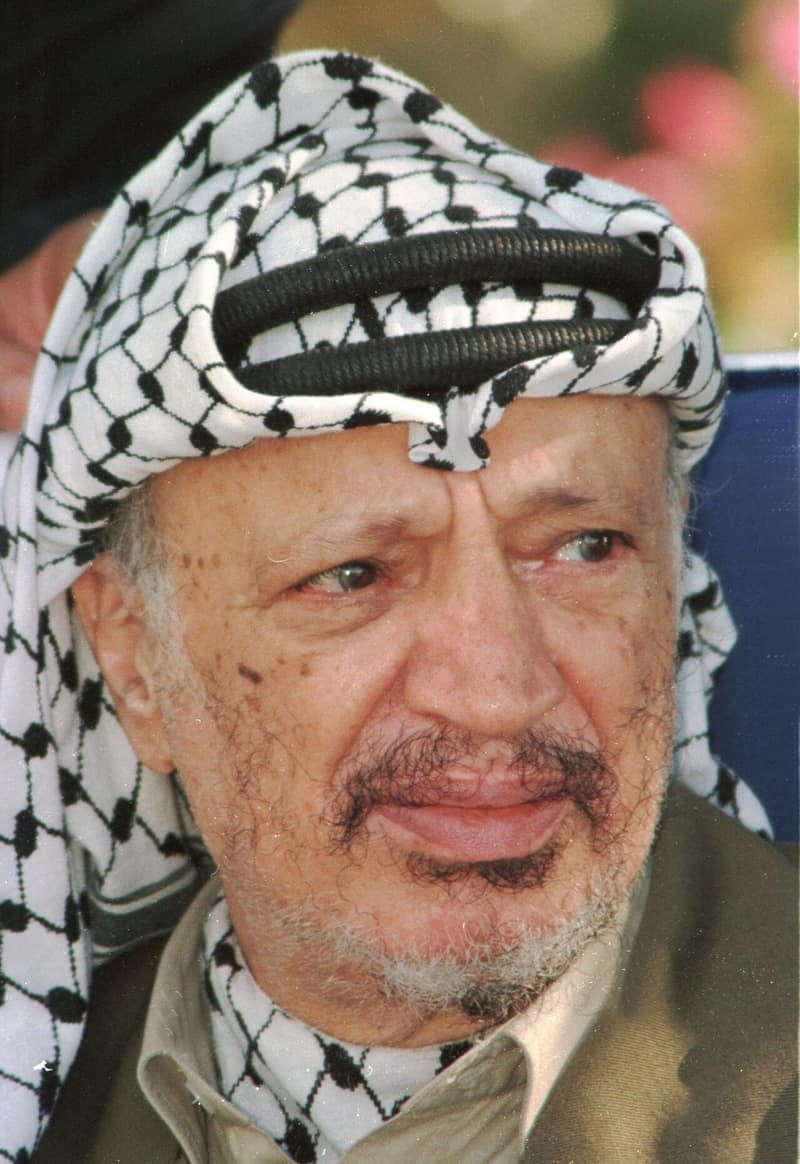
Yasser Arafat
ياسر عرفات
Founder of Fatah, chairman of the PLO, president of the State of Palestine
Founder of Fatah and chairman of the PLO for thirty-five years, who told the UN in 1974 that he came bearing an olive branch and a freedom fighter's gun.
He was born Muhammad Abd al-Ra’uf al-Qudwa al-Husseini and known as Yasser Arafat and Abu Ammar. His exact birthplace is disputed, but he was probably born in Cairo on 24 August 1929, to a father from Gaza who traded in Egypt and a mother, Zahwa Khalil Abu al-Su’ud, from Jerusalem. His mother died when he was four and he was sent to live with an uncle in Jerusalem for four years before returning to Cairo. In 1946, still at school, he met Hajj Amin al-Husseini; after the partition resolution of November 1947 he worked with a group under the Arab Higher Committee collecting weapons left in the western desert for Abd al-Qadir al-Husseini’s Army of the Holy War, and in his first university year he volunteered with that army in Gaza. He read civil engineering at Fuad I University in Cairo, helped found the Palestinian Students League in 1951 with Salah Khalaf and others, and was its president from 1952 until he graduated in 1956.
In Kuwait, in the autumn of 1957, he and Khalil al-Wazir formed the nucleus of the first Palestinian guerrilla movement. On 10 October 1959 he took part in a meeting in a Kuwait flat that founded Harakat al-tahrir al-watani al-Filastini — known by its reversed acronym, Fatah. Its argument reversed the Arab nationalist slogan of the day: not “Arab unity is the road to the liberation of Palestine” but “the liberation of Palestine is the road to Arab unity,” with Palestinians relying on themselves. The movement’s magazine Filastinuna – nida’ al-hayat first carried the name in Beirut in October 1959. Arafat and the Fatah leadership were wary of the PLO created under Arab auspices in 1964, and pressed to start armed action without waiting: on the night of 31 December 1964 Fatah’s al-Asifa blew up an Israeli water installation at the Aylabun tunnel, and one of the fighters, Ahmad Musa Salameh, was killed. Palestinians have dated their modern revolution from 1 January 1965 ever since.
After the defeat of June 1967 Arafat infiltrated the West Bank to build cells. On 21 March 1968 Palestinian fighters, with Jordanian army support, met an Israeli assault on al-Karama in the Jordan Valley and inflicted heavy losses; the battle turned the resistance into a mass movement. In February 1969 the fifth Palestine National Council elected him chairman of the PLO Executive Committee, a post he held until his death. After the fighting in Jordan of September 1970 he moved to Lebanon. On 13 November 1974, weeks after the Arab states recognised the PLO as the sole legitimate representative of the Palestinian people, he addressed the UN General Assembly: “The difference between the revolutionary and the terrorist lies in the reason for which each fights,” he said, and closed, “Today I have come bearing an olive branch and a freedom-fighter’s gun. Do not let the olive branch fall from my hand. I repeat: do not let the olive branch fall from my hand.” Nine days later the Assembly recognised the Palestinian right to self-determination and gave the PLO observer status.
Under his leadership the PLO’s programme changed step by step: from the liberation of all of Palestine to acceptance in 1974 of liberating part of it; from a single democratic state to acceptance in 1977 of a state on land vacated by the occupation; from armed struggle as the only path to acceptance in November 1988 of negotiations. He led the resistance through the Israeli invasion and the eighty-eight-day siege of Beirut in 1982 and left for Tunis that August. At Algiers on 15 November 1988 the Palestine National Council proclaimed the State of Palestine; at Geneva on 14 December Arafat told a press conference, under heavy American pressure, “we totally and absolutely renounce all forms of terrorism, including individual, group and state terrorism,” and accepted Resolutions 242 and 338. The PLO Central Council elected him President of the State of Palestine in April 1989.
He signed the Oslo Accords, returned to Palestine in 1994 and headed the Palestinian Authority. The Second Intifada from September 2000 brought the Israeli campaign against him to its height: from December 2001 his Ramallah headquarters were besieged on Ariel Sharon’s orders, with George W. Bush openly calling for his removal. He fell ill under siege in October 2004, was flown to the Percy military hospital at Clamart near Paris, and died there on 11 November 2004. A hundred thousand people met his body at Ramallah, where he was buried in the muqata’a. His remains were exhumed in 2012 to test for polonium; Swiss experts found poisoning probable, Russian and French experts did not.
Selected contributions
- Co-founder of Fatah (Kuwait, 1959)
- Chairman of the PLO Executive Committee (1969–2004)
- Speech to the UN General Assembly, 13 November 1974
- President of the State of Palestine (1989–2004)
Sources
- Yasir Arafat — Interactive Encyclopedia of the Palestine Question
- Speech of Yasir Arafat at the UN General Assembly, 13 November 1974 — PalQuest
- Press conference statement of Yasir Arafat clarifying his speech before the UN General Assembly, 14 December 1988 — PalQuest
- The Palestinian National Liberation Movement – Fatah (I) — PalQuest
Further reading
An external biography or archive holding more on this life than the entry above.
Connected in the archive
30 connected records30 records elsewhere in the archive are linked to this one, each by a piece of evidence you can read below.
names this person — 18 records
One record names the other. A pointer for reading, not a claim that they belong to each other.
- Arafat's Olive Branch at the United Nations
Evidence — Inferred from the text — read the evidence: On 13 November 1974, Yasser Arafat, chairman of the PLO's Executive Committee, addressed the General Assembly in New York.
- Edward W. Saidإدوارد سعيد
Evidence — Inferred from the text — read the evidence: He translated Yasser Arafat's 1974 speech for the United Nations, and met Mahmoud Darwish and Shafiq al-Hout for the first time that year.
- Founding of the PLO
Evidence — Inferred from the text — read the evidence: Yasser Arafat became chairman in 1969, and the PLO was reconstituted as an umbrella for the armed and political factions of the Palestinian national movement.
- Here We Will Stay
Evidence — Inferred from the text — read the evidence: Ziyad (1929–1994) was himself a fixture of that steadfastness: a poet of protest, he served as mayor of Nazareth and as a member of the Knesset, and died in a car crash in the Jordan Valley on his way back from welcoming Yasser Arafat's return from exile.
- Intissar al-Wazir (Umm Jihad)انتصار الوزير (أم جهاد)
Evidence — Inferred from the text — read the evidence: The Yasser Arafat Museum's account of the launch of her memoir Rifqat 'Umr states that she was finally able to return to Palestine in July 1994, after thirty-two years in exile; the Dictionary of the Israeli-Palestinian Conflict entry reproduced by Encyclopedia.com puts it in 1995, after thirty years.
- Keffiyeh
Evidence — Inferred from the text — read the evidence: It gained global iconic status through Yasser Arafat, who draped it so its folds echoed the map of historic Palestine.
- and 12 more
named in this record — 4 records
One record names the other. A pointer for reading, not a claim that they belong to each other.
- Jerusalemالقدس
Evidence — Inferred from the text — read the evidence: His exact birthplace is disputed, but he was probably born in Cairo on 24 August 1929, to a father from Gaza who traded in Egypt and a mother, Zahwa Khalil Abu al-Su'ud, from Jerusalem.
- Oslo Accords
Evidence — Inferred from the text — read the evidence: He signed the Oslo Accords, returned to Palestine in 1994 and headed the Palestinian Authority.
- The Oslo Accords
Evidence — Inferred from the text — read the evidence: He signed the Oslo Accords, returned to Palestine in 1994 and headed the Palestinian Authority.
- The Second Intifada
Evidence — Inferred from the text — read the evidence: The Second Intifada from September 2000 brought the Israeli campaign against him to its height: from December 2001 his Ramallah headquarters were besieged on Ariel Sharon's orders, with George W.
on a related subject — 8 records
Filed near each other — the same Mandate district, or the same uncommon subject tags.
- Armed Struggle and the Search for State: The Palestinian National Movement, 1949–1993
Evidence — From a recorded field in this archive: Shared tags: "PLO", "Oslo".
- Diana Buttu on Negotiations and Media Framing
Evidence — From a recorded field in this archive: Shared tags: "PLO", "Oslo".
- Edward Said on Oslo: The Morning After
Evidence — From a recorded field in this archive: Shared tags: "PLO", "Oslo".
- Mahmoud Hamshariمحمود الهمشري
Evidence — From a recorded field in this archive: Shared tags: "PLO", "Fatah".
- Salah Khalaf (Abu Iyad)صلاح خلف (أبو إياد)
Evidence — From a recorded field in this archive: Shared tags: "Fatah", "PLO".
- Diana Buttuديانا بطو
Evidence — Inferred from the text — read the evidence: Shared tag: "Oslo".
- and 2 more
Cite this page
Every claim above carries its sources — citation is the point.
- Chicago
“Yasser Arafat.” Figures, FALASTEEN.AI. Accessed 22 August 2026. https://falasteen.ai/figures/yasser-arafat.- MLA
“Yasser Arafat.” Figures, FALASTEEN.AI, 2026, https://falasteen.ai/figures/yasser-arafat. Accessed 22 August 2026.- BibTeX
@misc{falasteen-yasser-arafat,
  title        = {Yasser Arafat},
  howpublished = {\url{https://falasteen.ai/figures/yasser-arafat}},
  organization = {FALASTEEN.AI — A Living Archive for Palestine},
  year         = {2026},
  note         = {Accessed 2026-08-22}
}