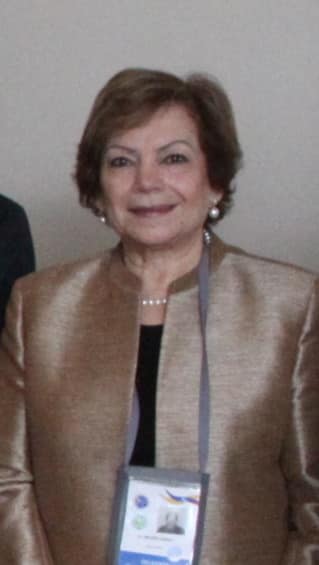
Intissar al-Wazir (Umm Jihad)
انتصار الوزير (أم جهاد)
First woman member of Fatah and the Palestinian Authority's first minister of social affairs
The Gaza City militant who became Fatah's first woman member in 1959, built the PLO's institutions for the families of martyrs and prisoners, survived her husband Khalil al-Wazir's assassination beside her in Tunis, and returned from decades of exile as minister of social affairs.
Intissar al-Wazir was born in Gaza City in 1941, and in 1959 became the first woman member of Fatah — the movement in which she met Khalil al-Wazir, whom she married two years later. From 1963 to 1965 the couple lived in Algiers, where Khalil al-Wazir ran Fatah’s first bureau abroad. An ardent militant for the place of women in the Palestinian resistance, she was one of the founders of the General Union of Palestinian Women; her memoir records her taking part in the union’s first congress, which the union’s own record of that congress dates to Jerusalem, 15 to 20 July 1965, and she served as the union’s secretary-general from 1980 to 1985. In the 1960s she helped found the PLO’s social service institutions — the Social Affairs Committee, the Martyrs’ Families Organization, and the Committee for Prisoners and the Injured — the apparatus that sustained the families of the movement’s dead and imprisoned, which she would direct for decades.
She became a member of the Palestine National Council in 1974, took a history degree from the University of Damascus in 1978, and joined Fatah’s Revolutionary Council in 1981. In April 1988, after six years in Tunis, an Israeli commando assassinated her husband — by then the PLO’s second figure and the architect of support for the First Intifada — in front of her at their home. That same year she was elected to the PLO Executive Committee, and in August 1989, at Fatah’s fifth congress in Tunis, she joined the movement’s Central Committee.
The date of her return home is not agreed. The Yasser Arafat Museum’s account of the launch of her memoir Rifqat ‘Umr states that she was finally able to return to Palestine in July 1994, after thirty-two years in exile; the Dictionary of the Israeli-Palestinian Conflict entry reproduced by Encyclopedia.com puts it in 1995, after thirty years. What is not in dispute is what followed: she was appointed the Palestinian Authority’s first minister of social affairs, and in January 1996 was elected to the Palestinian Legislative Council as a deputy for Gaza City. She still held the portfolio in 2003: the presidential decree constituting the cabinet formed under Mahmoud Abbas that April, published by the Palestinian National Information Center, lists her third among the ministers — السيدة/ انتصار الوزير وزير الشؤون الاجتماعية. Her nom de guerre, Umm Jihad — mother of the struggle — is the name by which Palestinians know her: one of the last women of the founding generation, unyielding in her insistence that the occupation, not the occupied, bore responsibility for the condition of her people.
Sources
- Wazir, Intisar Al- (Umm Jihad; 1941–) — Dictionary of the Israeli-Palestinian Conflict, via Encyclopedia.com
- رفقة عمر: مذكرات انتصار الوزير (أم جهاد) — her own memoir, Arab Center for Research and Policy Studies (2022)
- المناضلة انتصار الوزير (أم جهاد) تطلق كتابها “رفقة عمر” — Yasser Arafat Museum, on the memoir and her return to Palestine in July 1994
- المؤتمر الأول للاتحاد العام للمرأة الفلسطينية، القدس، 15/7/1965 – 20/7/1965 — the union’s own record of its first congress and founding constitution (PDF)
- مرسوم رئاسي رقم (7) لسنة 2003م بتشكيل مجلس الوزراء — the decree constituting the sixth Palestinian government, Palestinian National Information Center (WAFA)
Further reading
An external biography or archive holding more on this life than the entry above.
Connected in the archive
13 connected records13 records elsewhere in the archive are linked to this one, each by a piece of evidence you can read below.
born in — 1 record
- Gaza Cityغزة
Evidence — From a recorded field in this archive: birthplace: "Gaza City, Gaza" → Gaza City (Gaza Strip)
named in this record — 3 records
One record names the other. A pointer for reading, not a claim that they belong to each other.
- Jerusalemالقدس
Evidence — Inferred from the text — read the evidence: An ardent militant for the place of women in the Palestinian resistance, she was one of the founders of the General Union of Palestinian Women; her memoir records her taking part in the union's first congress, which the union's own record of that congress dates to Jerusalem, 15 to 20 July 1965, and she served as the union's secretary-general from 1980 to 1985.
- The First Intifada
Evidence — Inferred from the text — read the evidence: She became a member of the Palestine National Council in 1974, took a history degree from the University of Damascus in 1978, and joined Fatah's Revolutionary Council in 1981. In April 1988, after six years in Tunis, an Israeli commando assassinated her husband — by then the PLO's second figure and the architect of support for the First Intifada — in front of her at their home.
- Yasser Arafatياسر عرفات
Evidence — Inferred from the text — read the evidence: The Yasser Arafat Museum's account of the launch of her memoir Rifqat 'Umr states that she was finally able to return to Palestine in July 1994, after thirty-two years in exile; the Dictionary of the Israeli-Palestinian Conflict entry reproduced by Encyclopedia.com puts it in 1995, after thirty years.
names this person — 2 records
One record names the other. A pointer for reading, not a claim that they belong to each other.
- The Women of the Movement
Evidence — From a recorded field in this archive: Fatah's first woman member, in 1959. She built the PLO's institutions for the families of prisoners and the dead, and watched her husband assassinated beside her in Tunis.
- Khalil al-Wazir (Abu Jihad)خليل الوزير (أبو جهاد)
Evidence — Inferred from the text — read the evidence: His wife and cousin, Intissar al-Wazir (Umm Jihad), later became the Palestinian Authority's first minister of social affairs.
on a related subject — 7 records
Filed near each other — the same Mandate district, or the same uncommon subject tags.
- Marwan Barghoutiمروان البرغوثي
Evidence — From a recorded field in this archive: Shared tags: "Fatah", "PLC".
- Salah Khalaf (Abu Iyad)صلاح خلف (أبو إياد)
Evidence — From a recorded field in this archive: Shared tags: "Fatah", "Tunis".
- Faisal al-Husseiniفيصل الحسيني
Evidence — Inferred from the text — read the evidence: Shared tag: "Fatah".
- Issam Abdul Hadiعصام عبد الهادي
Evidence — Inferred from the text — read the evidence: Shared tag: "General Union of Palestinian Women".
- Khalida Jarrarخالدة جرار
Evidence — Inferred from the text — read the evidence: Shared tag: "PLC".
- Mahmoud Hamshariمحمود الهمشري
Evidence — Inferred from the text — read the evidence: Shared tag: "Fatah".
- and 1 more
Cite this page
Every claim above carries its sources — citation is the point.
- Chicago
“Intissar al-Wazir (Umm Jihad).” Figures, FALASTEEN.AI. Accessed 22 August 2026. https://falasteen.ai/figures/intissar-al-wazir.- MLA
“Intissar al-Wazir (Umm Jihad).” Figures, FALASTEEN.AI, 2026, https://falasteen.ai/figures/intissar-al-wazir. Accessed 22 August 2026.- BibTeX
@misc{falasteen-intissar-al-wazir,
  title        = {Intissar al-Wazir (Umm Jihad)},
  howpublished = {\url{https://falasteen.ai/figures/intissar-al-wazir}},
  organization = {FALASTEEN.AI — A Living Archive for Palestine},
  year         = {2026},
  note         = {Accessed 2026-08-22}
}