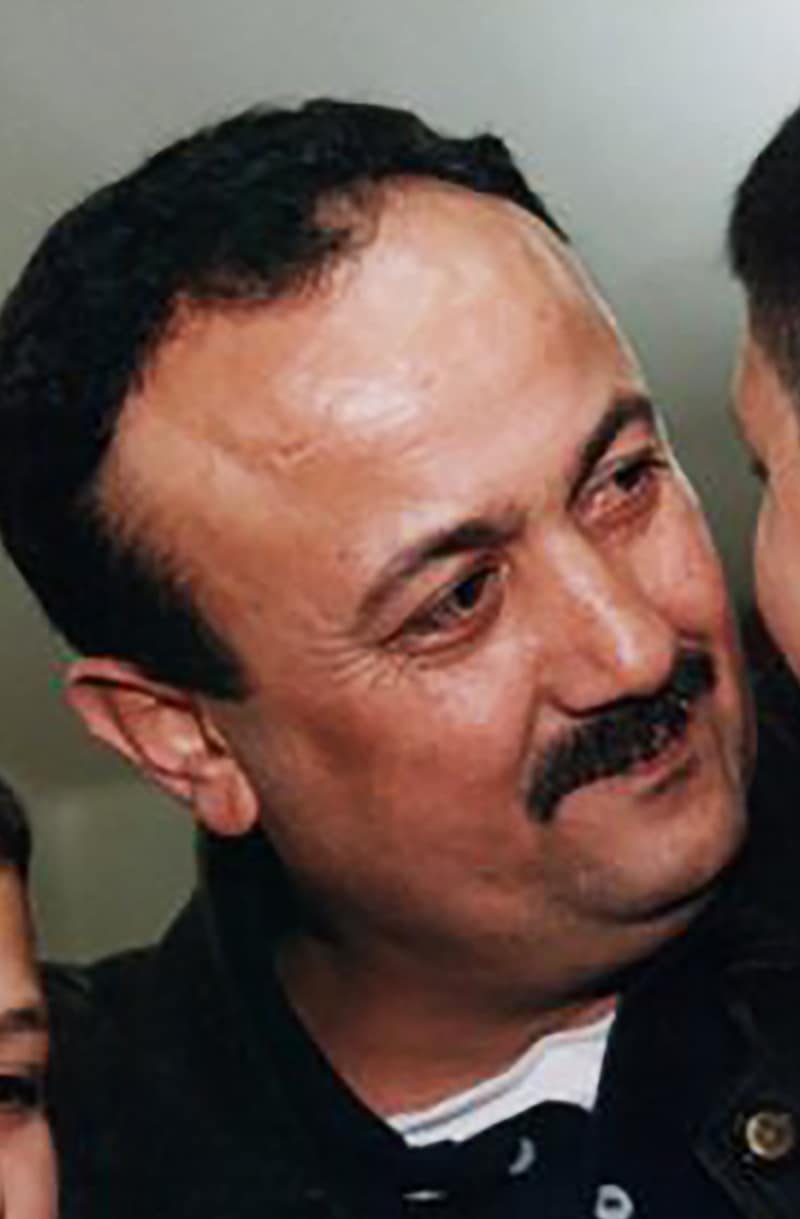
Marwan Barghouti
مروان البرغوثي
General secretary of Fatah in the West Bank, imprisoned in Israel since 2002
The Fatah leader from Kobar, imprisoned since 2002 under five life sentences after an Inter-Parliamentary Union-appointed observer concluded that breaches of international law made a fair trial impossible and that guilt had not been established — an observer's conclusion, not a court acquittal.
“Israel has established a dual legal regime, a form of judicial apartheid, that provides virtual impunity for Israelis who commit crimes against Palestinians, while criminalizing Palestinian presence and resistance,” Marwan Barghouti wrote in The New York Times in 2017, as he led a thousand Palestinian prisoners on hunger strike. “Israel’s courts are a charade of justice, clearly instruments of colonial, military occupation.” He was born on 6 June 1959 in the village of Kobar near Ramallah, one of seven children of a manual labourer, and had just turned eight when the occupation of the West Bank began. He joined Fatah in his mid-teens, was arrested at eighteen — he later described being beaten and sexually humiliated under interrogation — and spent four and a half years in prison. Released in 1983, he studied history and political science at Birzeit University and rose as a student leader in the years before the First Intifada, until Israel deported him to Jordan in May 1987, months before it began. He returned in 1993 under the Oslo Accords, and in 1994 became secretary-general of Fatah in the West Bank.
During the Second Intifada he was a major leader of the uprising — a man who, as a Fatah colleague put it, led demonstrations in a T-shirt and trousers and was seen as close to his people. Israel accuses him of having established the al-Aqsa Martyrs Brigades and of directing attacks; he has always denied controlling the Brigades. Tracked through a wiretap, he was arrested in 2002, refused to mount a defence — disputing the court’s legitimacy — and in 2004 was convicted of planning attacks that killed five people and sentenced to five consecutive life sentences. An observer appointed by the Inter-Parliamentary Union concluded that breaches of international law made it impossible to say he had received a fair trial and that guilt had therefore not been established. His own recorded positions cut across the caricature: in his last television interview, to Channel 4 News in 2006, he said, “Nobody can justify killing civilians, women and children anywhere in this world… They should be outside of the game, in Palestine or in Israel,” while maintaining that “the Palestinian people have the full right to resist the Israeli occupation.” He urged Hamas toward elections rather than armed struggle, and helped draft the 2006 National Conciliation Document of the Prisoners with leaders of Hamas, Islamic Jihad and the PFLP.
In prison he learned fluent Hebrew and English, taught university classes, endured a three-year stretch of solitary confinement, and earned a Cairo University doctorate in 2010 with a thesis on Palestinian democracy smuggled out one page at a time by his lawyer. Opinion polls have long made him the most popular Palestinian politician; Palestinians often call him the “Palestinian Mandela,” and in 2021 he co-led the Freedom electoral list with Nasser Kidwa before Mahmoud Abbas cancelled the elections. Hamas sought his release in the 2011 exchange and again in the negotiations of October 2025; Israel refused each time — reporting placed the veto with the prime minister’s office and the far-right minister Itamar Ben Gvir, who in August 2025 was filmed threatening Barghouti in his cell, footage condemned by the UN human rights chief Volker Türk. Since October 2023 his family and fellow prisoners report confiscated books, rationed food, and, in September 2025, a beating by eight guards that broke four ribs and left him unconscious. Former Israeli intelligence chiefs Ami Ayalon and Efraim Halevy are among those who have called for his release; Halevy told Israeli public radio in February 2025 that Barghouti “is popular with his people, he has a clear position, he speaks Hebrew well and can negotiate, all of which qualifies him to lead a new path.”
The distinction in the trial record matters. An observer appointed by the Inter-Parliamentary Union concluded that breaches of international law made a fair trial impossible and that guilt had not been established. That was the observer’s finding, not an acquittal by a court; the Israeli parliamentary authorities maintain that Barghouti was lawfully convicted in a fair trial. In a decision adopted on 19 April 2026, the Inter-Parliamentary Union again called for his immediate release.
Sources
Further reading
An external biography or archive holding more on this life than the entry above.
Connected in the archive
16 connected records16 records elsewhere in the archive are linked to this one, each by a piece of evidence you can read below.
named in this record — 5 records
One record names the other. A pointer for reading, not a claim that they belong to each other.
- Oslo Accords
Evidence — Inferred from the text — read the evidence: He returned in 1993 under the Oslo Accords, and in 1994 became secretary-general of Fatah in the West Bank.
- Ramallahرام الله
Evidence — Inferred from the text — read the evidence: "Israel's courts are a charade of justice, clearly instruments of colonial, military occupation." He was born on 6 June 1959 in the village of Kobar near Ramallah, one of seven children of a manual labourer, and had just turned eight when the occupation of the West Bank began.
- The First Intifada
Evidence — Inferred from the text — read the evidence: Released in 1983, he studied history and political science at Birzeit University and rose as a student leader in the years before the First Intifada, until Israel deported him to Jordan in May 1987, months before it began.
- The Oslo Accords
Evidence — Inferred from the text — read the evidence: He returned in 1993 under the Oslo Accords, and in 1994 became secretary-general of Fatah in the West Bank.
- The Second Intifada
Evidence — Inferred from the text — read the evidence: During the Second Intifada he was a major leader of the uprising — a man who, as a Fatah colleague put it, led demonstrations in a T-shirt and trousers and was seen as close to his people.
on a related subject — 11 records
Filed near each other — the same Mandate district, or the same uncommon subject tags.
- Intissar al-Wazir (Umm Jihad)انتصار الوزير (أم جهاد)
Evidence — From a recorded field in this archive: Shared tags: "Fatah", "PLC".
- Khalida Jarrarخالدة جرار
Evidence — From a recorded field in this archive: Shared tags: "prisoners", "PLC".
- Abu Ali Mustafaأبو علي مصطفى
Evidence — Inferred from the text — read the evidence: Shared tag: "Second Intifada".
- Faisal al-Husseiniفيصل الحسيني
Evidence — Inferred from the text — read the evidence: Shared tag: "Fatah".
- Fuad Hijaziفؤاد حجازي
Evidence — Inferred from the text — read the evidence: Shared tag: "prisoners".
- Ibrahim Abu-Lughodإبراهيم أبو لغد
Evidence — Inferred from the text — read the evidence: Shared tag: "Birzeit".
- and 5 more
Cite this page
Every claim above carries its sources — citation is the point.
- Chicago
“Marwan Barghouti.” Figures, FALASTEEN.AI. Accessed 22 August 2026. https://falasteen.ai/figures/marwan-barghouti.- MLA
“Marwan Barghouti.” Figures, FALASTEEN.AI, 2026, https://falasteen.ai/figures/marwan-barghouti. Accessed 22 August 2026.- BibTeX
@misc{falasteen-marwan-barghouti,
  title        = {Marwan Barghouti},
  howpublished = {\url{https://falasteen.ai/figures/marwan-barghouti}},
  organization = {FALASTEEN.AI — A Living Archive for Palestine},
  year         = {2026},
  note         = {Accessed 2026-08-22}
}