Gaza City
غزة
Gaza City is among the oldest cities on earth — Philistine stronghold, Mamluk and Ottoman provincial center, home of the Great Omari Mosque. Besieged since 2007, it has since October 2023 been subjected to destruction on a scale that has shattered its ancient fabric.
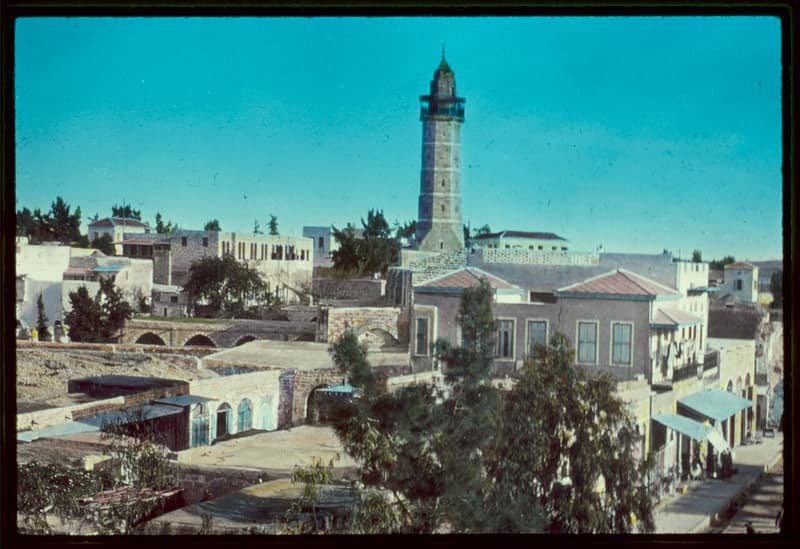
Gaza has been a city for as long as there have been cities. Guarding the coastal road between Egypt and Asia, it was prized by the pharaohs, held by the Philistines, besieged by Alexander the Great in 332 BCE, and ruled in turn by Romans, Byzantines, Arabs, Crusaders, Mamluks and Ottomans. Its Great Omari Mosque, the oldest and largest mosque in Gaza, rose in Mamluk times over a Byzantine church; around it grew the old quarters — al-Daraj, al-Zaytun, al-Shujaiyya — the vaulted Qissariya gold market, the Pasha’s Palace, and bathhouses that served the city for centuries.
Modern Gaza’s character was sealed by 1948. The war compressed hundreds of thousands of refugees from across southern Palestine into the narrow strip that took the city’s name; under Egyptian administration, then Israeli occupation from 1967, Gaza City became the crowded heart of a captive territory — its camps, universities, markets and fishing harbor sustaining one of the densest populations on earth. Israel withdrew its soldiers and settlers in 2005, but after Hamas took control in 2007 Israel, with Egypt, closed the crossings: a land, air and sea blockade that by the early 2020s had driven unemployment to nearly half the workforce and left some eighty percent of Gaza’s people dependent on humanitarian aid, through repeated wars in 2008–09, 2012, 2014 and 2021.
Since October 2023, Gaza City has endured a military assault without precedent in its long history. The great majority of its population has been displaced, whole quarters have been reduced to rubble, and tens of thousands across the Strip have been killed. UNESCO’s satellite-verified assessment has recorded damage to more than one hundred and sixty cultural sites in Gaza, among them the Great Omari Mosque, the Pasha’s Palace, the Qissariya market, the Samaritan bathhouse and the fifth-century Church of Saint Porphyrius.
For Palestinians everywhere, Gaza has come to carry a double weight: the deepest wound of the present, and a name that has outlasted every army that ever camped before its walls. Its fishermen still go out at dawn within the limits imposed on them, and its people still bury their dead in the oldest inhabited ground they have.
Sources
Cited works
4- britannica.com — Gaza Strip(opens in a new tab)https://www.britannica.com/place/Gaza-Strip
- unesco.org — assessment(opens in a new tab)https://www.unesco.org/en/gaza/assessment
- btselem.org — gaza strip(opens in a new tab)https://www.btselem.org/gaza_strip
- ochaopt.org(opens in a new tab)https://www.ochaopt.org/
Cite this page
Every claim above carries its sources — citation is the point.
- Chicago
“Gaza City.” Places, FALASTEEN.AI. Accessed 22 August 2026. https://falasteen.ai/places/gaza-city.- MLA
“Gaza City.” Places, FALASTEEN.AI, 2026, https://falasteen.ai/places/gaza-city. Accessed 22 August 2026.- BibTeX
@misc{falasteen-gaza-city,
  title        = {Gaza City},
  howpublished = {\url{https://falasteen.ai/places/gaza-city}},
  organization = {FALASTEEN.AI — A Living Archive for Palestine},
  year         = {2026},
  note         = {Accessed 2026-08-22}
}