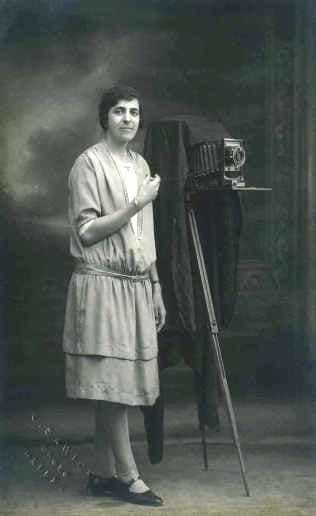
Karimeh Abbud
كريمة عبود
Photographer
The first woman photographer in Palestine, who stamped her prints 'Karimeh Abbud — Lady Photographer' and left a portrait record of Palestinian life two decades before the Nakba.
Karimeh Abbud was born in Bethlehem in 1893 into a Lutheran family originally from Khiyam in the Marja’youn district of southern Lebanon, which had settled in Palestine in the mid-nineteenth century. Her mother, Barbara Badr, was a schoolteacher; her father, Said Abbud, was a pastor of the Evangelical Lutheran Church in Bethlehem. She attended primary school in Bethlehem, finished her secondary education at Talitha Kumi in Beit Jala and the Collège des Frères in Jerusalem, and then studied Arabic literature at the American University of Beirut. She grew up speaking Arabic, German, and English.
She began photographing in 1913, after her father gave her a camera, and learned the craft from an Armenian photographer. Accompanying her father on his work travels gave her subjects in Bethlehem, Tiberias, Nazareth, Haifa, and Qisarya. Returning from Beirut in the early 1920s, she opened a studio in her own home in Bethlehem, photographing women, children, and weddings, and by the early 1930s she was working professionally — importing printing paper from Egypt, developing in her own darkroom, and becoming known for hand-colouring her prints. She eventually operated studios in Nazareth, Bethlehem, Haifa, and Jaffa, and stamped her work in Arabic and English: Karimeh Abbud musawwirat shams — Karimeh Abbud, Lady Photographer.
What that bilingual stamp made possible was a body of pictures no foreign or male photographer could have taken. Women from conservative families who would not sit for a stranger sat for her, first in Bethlehem and then travelling from Gaza, Jaffa, Haifa, and Jerusalem; her portraits show them in the embroidered dresses whose patterns identified their villages. Against the pilgrimage and biblical-scene photography that dominated the foreign studios of Ottoman and Mandate Palestine, Abbud’s work is domestic, commissioned, and local — Palestinians photographing themselves as they wished to be seen.
She died in Bethlehem on 27 April 1940 of tuberculosis and was buried in the cemetery of the Evangelical Lutheran Church there. Her name resurfaced only in the twenty-first century: the historian Issam Nassar discussed her in his 2005 study of early local photography in Palestine, and in 2006 a collector in Jerusalem announced the discovery of a cache of more than 400 prints bearing her signature. Copies of her portfolio have since been gathered by Ahmed Mrowat of the Nazareth Archives Project.
Sources
Further reading
An external biography or archive holding more on this life than the entry above.
Connected in the archive
14 connected records14 records elsewhere in the archive are linked to this one, each by a piece of evidence you can read below.
born in — 1 record
- Bethlehemبيت لحم
Evidence — From a recorded field in this archive: birthplace: "Bethlehem, Palestine" → Bethlehem (Bethlehem Governorate, West Bank)
named in this record — 2 records
One record names the other. A pointer for reading, not a claim that they belong to each other.
- Jerusalemالقدس
Evidence — Inferred from the text — read the evidence: She attended primary school in Bethlehem, finished her secondary education at Talitha Kumi in Beit Jala and the Collège des Frères in Jerusalem, and then studied Arabic literature at the American University of Beirut.
- Nazarethالناصرة
Evidence — Inferred from the text — read the evidence: She eventually operated studios in Nazareth, Bethlehem, Haifa, and Jaffa, and stamped her work in Arabic and English: Karimeh Abbud musawwirat shams — Karimeh Abbud, Lady Photographer.
names this person — 1 record
One record names the other. A pointer for reading, not a claim that they belong to each other.
- The Women of the Movement
Evidence — From a recorded field in this archive: Begin before the movement. She was photographing Palestinian families two decades before the Nakba, and stamping the prints “Lady Photographer” herself.
on a related subject — 10 records
Filed near each other — the same Mandate district, or the same uncommon subject tags.
- Emily Jacirإميلي جاسر
Evidence — From a recorded field in this archive: Shared tags: "Bethlehem", "archive".
- After the Last Sky: Palestinian Lives
Evidence — Inferred from the text — read the evidence: Shared tag: "photography".
- Annemarie Jacirآن ماري جاسر
Evidence — Inferred from the text — read the evidence: Shared tag: "Bethlehem".
- Elia Suleimanإيليا سليمان
Evidence — Inferred from the text — read the evidence: Shared tag: "Nazareth".
- Elias Sanbarإلياس صنبر
Evidence — Inferred from the text — read the evidence: Shared tag: "photography".
- Khalil Beidasخليل بيدس
Evidence — Inferred from the text — read the evidence: Shared tag: "Nazareth".
- and 4 more
Cite this page
Every claim above carries its sources — citation is the point.
- Chicago
“Karimeh Abbud.” Figures, FALASTEEN.AI. Accessed 22 August 2026. https://falasteen.ai/figures/karimeh-abbud.- MLA
“Karimeh Abbud.” Figures, FALASTEEN.AI, 2026, https://falasteen.ai/figures/karimeh-abbud. Accessed 22 August 2026.- BibTeX
@misc{falasteen-karimeh-abbud,
  title        = {Karimeh Abbud},
  howpublished = {\url{https://falasteen.ai/figures/karimeh-abbud}},
  organization = {FALASTEEN.AI — A Living Archive for Palestine},
  year         = {2026},
  note         = {Accessed 2026-08-22}
}