Bethlehem
بيت لحم
Bethlehem — Beit Lahm — carries a double weight: the birthplace of Jesus beneath the sixth-century Church of the Nativity, and a town pressed between settlements and the separation wall that now seals it off from Jerusalem, five miles away.
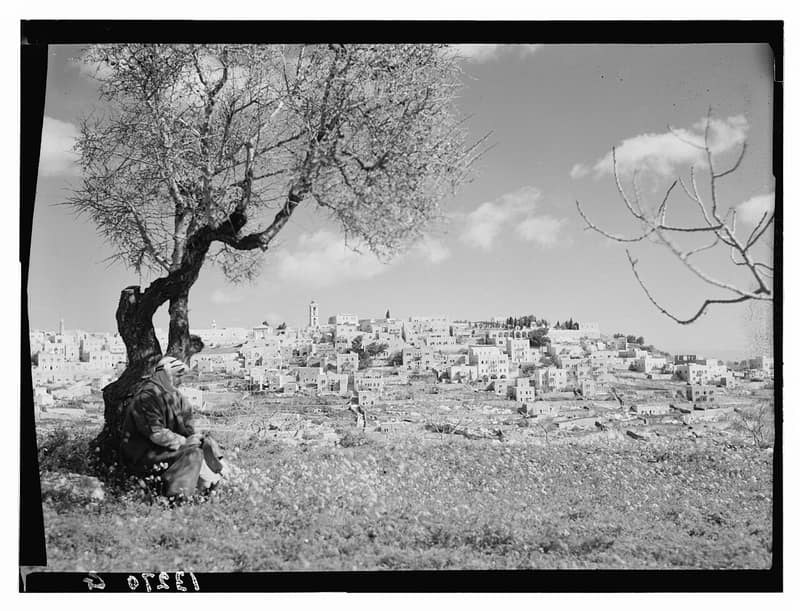
Bethlehem is older than its fame. Possibly glimpsed in the fourteenth-century BCE Amarna letters, it enters the Bible as the setting of the Book of Ruth and the home of David, anointed king in its fields. Christian tradition from at least the second century placed the birth of Jesus in a cave here; Helena, mother of Constantine, raised a church over the grotto in 339, and Justinian rebuilt it in the sixth century into the Church of the Nativity that stands today — the oldest church in continuous use in the Christian world, shared by Greek Orthodox, Armenian and Franciscan communities under the centuries-old Status Quo. In 2012 the church and its pilgrimage route down Star Street became Palestine’s first UNESCO World Heritage site.
The town lived by the pilgrimage and by the crafts that served it: olive-wood carving and mother-of-pearl inlay, sold in the workshops around Manger Square; embroidery; the convents, schools and hospitals of a town that forms one conurbation with Beit Jala and Beit Sahour. Bethlehem keeps three Christmases a year — Latin in December, Orthodox in January, Armenian in mid-January — and the tree is still lit each year in Manger Square.
Since 1967 that ancient openness has closed around it. Bethlehem passed from Jordanian rule to Israeli occupation, then to the Palestinian Authority in 1995. In 2002 the Nativity church itself became a refuge, besieged for thirty-nine days during Israel’s re-invasion of the West Bank cities. The separation barrier, begun the same year, runs through Bethlehem’s municipal land as a concrete wall eight to nine metres high, severing the town from Jerusalem — five miles away and unreachable for most of its people — while settlement expansion has closed in around its northern and eastern edges. Land loss and a strangled tourism economy have borne hardest on the old Christian families, whose share of the population has steadily dwindled. On the wall’s gray concrete, Banksy painted; in 2017 he opened the Walled Off Hotel facing it, billing it with having “the worst view in the world.”
In the Palestinian imagination Bethlehem holds both truths at once: the manger and the wall. In nearby Aida refugee camp, a giant key arches over the entrance — the key of return, raised in the town where the story began.
Sources
Cited works
3- whc.unesco.org(opens in a new tab)https://whc.unesco.org/en/list/1433/
- britannica.com — Bethlehem(opens in a new tab)https://www.britannica.com/place/Bethlehem
- btselem.org — separation barrier(opens in a new tab)https://www.btselem.org/separation_barrier
Cite this page
Every claim above carries its sources — citation is the point.
- Chicago
“Bethlehem.” Places, FALASTEEN.AI. Accessed 22 August 2026. https://falasteen.ai/places/bethlehem.- MLA
“Bethlehem.” Places, FALASTEEN.AI, 2026, https://falasteen.ai/places/bethlehem. Accessed 22 August 2026.- BibTeX
@misc{falasteen-bethlehem,
  title        = {Bethlehem},
  howpublished = {\url{https://falasteen.ai/places/bethlehem}},
  organization = {FALASTEEN.AI — A Living Archive for Palestine},
  year         = {2026},
  note         = {Accessed 2026-08-22}
}