The Embroidery Cooperatives
جمعيات التطريز
The societies — In'ash al-Usra in al-Bireh, In'aash al-Mukhayyam in Beirut — that turned tatreez from a village skill into paid work, and in doing so kept it being taught.
A craft survives because somebody is paid to keep doing it. After 1948 the economics of Palestinian embroidery collapsed: cloth and thread cost money that refugee families did not have, and in the interactive encyclopedia of the Institute for Palestine Studies the record is blunt — “some women were so cash-strapped that they sold their dresses to appreciative buyers.” Very few new dresses were made through the late 1940s and 1950s.
What restarted it was, first, remittances from Palestinians working in the Gulf, and then organisation. In 1965 Samiha Khalil and a group of women founded Jam’iyyat In’ash al-Usra, the Family Revival Society, in al-Bireh; Khalil ran it until her death in 1999. Among its earliest projects was a centre teaching girls sewing and traditional embroidery, and charity bazaars to sell what the centre made. In Beirut, Jam’iyyat In’aash al-Mukhayyam al-Filastini did comparable work in the camps. By the late 1960s and 1970s these community associations, together with the Palestinian national leadership, had made the preservation of embroidery a deliberate programme — against, in the encyclopedia’s framing, a double threat of disappearance and appropriation.
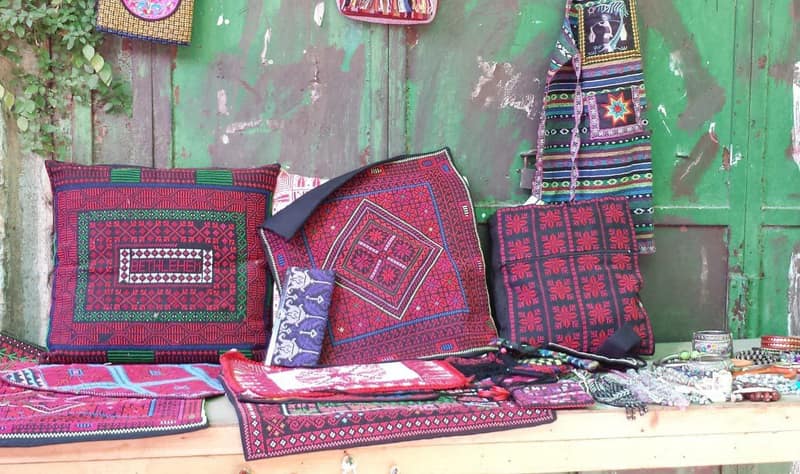
That is why the stitch is not a museum object. It went on being taught because it went on paying: cooperatives, camp workshops and family workrooms have produced cushion covers, bags, wall pieces and dresses continuously for sixty years, and they are on sale today in the markets of Hebron and Bethlehem and on the stalls of diaspora fundraisers. The photograph on this page is one such stall in the old city of Hebron in March 2025 — cushions, a shoulder bag, a folded runner, and along the border of the largest piece, cross-stitched in Latin capitals, the word BETHLEHEM.
When UNESCO inscribed Palestinian embroidery on the Representative List of the Intangible Cultural Heritage of Humanity in 2021, on the State of Palestine’s nomination, the file did not describe an endangered relic. It described a routine: the practice is transmitted “from mother to daughter and through formal training courses,” and women “gather in each other’s homes to practise embroidery and sewing, often with their daughters.” Both halves of that sentence — the kitchen and the training course — are what the societies built.
Sources
Connected in the archive
24 connected records24 records elsewhere in the archive are linked to this one, each by a piece of evidence you can read below.
set here — 3 records
- Hebronالخليل
Evidence — From a recorded field in this archive: places: "Hebron" → Hebron
- Ramallahرام الله
Evidence — From a recorded field in this archive: places: "Ramallah" → Ramallah
- al-Birehالبيرة
Evidence — Inferred from the text — read the evidence: places: "Al-Bireh" → al-Bireh
named in this record — 3 records
One record names the other. A pointer for reading, not a claim that they belong to each other.
- Samiha Khalilسميحة خليل
Evidence — Inferred from the text — read the evidence: In 1965 Samiha Khalil and a group of women founded Jam'iyyat In'ash al-Usra, the Family Revival Society, in al-Bireh; Khalil ran it until her death in 1999.
- Tatreez
Evidence — Inferred from the text — read the evidence: The societies — In'ash al-Usra in al-Bireh, In'aash al-Mukhayyam in Beirut — that turned tatreez from a village skill into paid work, and in doing so kept it being taught.
- Tatreez
Evidence — Inferred from the text — read the evidence: The societies — In'ash al-Usra in al-Bireh, In'aash al-Mukhayyam in Beirut — that turned tatreez from a village skill into paid work, and in doing so kept it being taught.
on a related subject — 18 records
Filed near each other — the same Mandate district, or the same uncommon subject tags.
- BADIL Resource Center for Palestinian Residency and Refugee Rights
Evidence — Inferred from the text — read the evidence: Shared tag: "refugees".
- Handala
Evidence — Inferred from the text — read the evidence: Shared tag: "refugees".
- Jerash Camp (Gaza Camp)مخيّم جرش
Evidence — Inferred from the text — read the evidence: Shared tag: "refugees".
- Keys of Return
Evidence — Inferred from the text — read the evidence: Shared tag: "refugees".
- Leila Khaledليلى خالد
Evidence — Inferred from the text — read the evidence: Shared tag: "refugees".
- Maftoul
Evidence — Inferred from the text — read the evidence: Shared tag: "cooperatives".
- and 12 more
Cite this page
Every claim above carries its sources — citation is the point.
- Chicago
“The Embroidery Cooperatives.” Culture, FALASTEEN.AI. Accessed 22 August 2026. https://falasteen.ai/culture/embroidery-cooperatives.- MLA
“The Embroidery Cooperatives.” Culture, FALASTEEN.AI, 2026, https://falasteen.ai/culture/embroidery-cooperatives. Accessed 22 August 2026.- BibTeX
@misc{falasteen-embroidery-cooperatives,
  title        = {The Embroidery Cooperatives},
  howpublished = {\url{https://falasteen.ai/culture/embroidery-cooperatives}},
  organization = {FALASTEEN.AI — A Living Archive for Palestine},
  year         = {2026},
  note         = {Accessed 2026-08-22}
}