Bethlehem Mother-of-Pearl
الصدف البيت لحمي
Nacre carved into crosses, rosaries, and models of the Church of the Nativity — a Bethlehem trade at least four centuries old, and for much of it a women's trade.
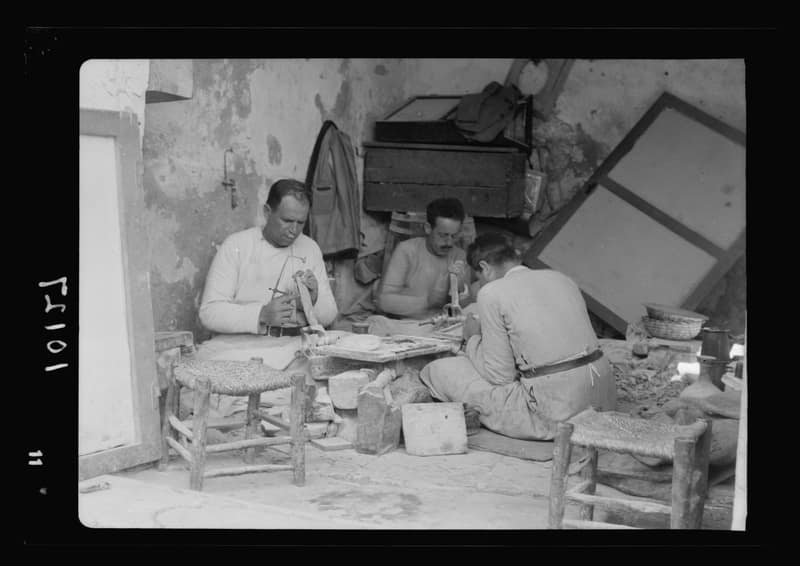
Mother-of-pearl carving is Bethlehem’s signature handicraft, said to have been brought to the town by Franciscan friars from Italy in the fifteenth century. Whatever its exact origin, it was established early: women were working in the industry by at least the 1600s, and the traveller Richard Pococke, visiting in 1727, described Bethlehem’s artisans making crosses, beads, and models of churches inlaid with nacre.
The trade grew on pilgrimage. A steady flow of Christian visitors to the Church of the Nativity created a market that could absorb small, portable, devotional objects year after year, and the craft became a reliable source of household income — particularly for women, who did much of the finishing and bead work. Bethlehem’s carvers exported as well: at the 1852 World’s Fair in New York, the brothers Giries and Ibrahim Mansur exhibited Palestinian mother-of-pearl to considerable notice, one of the earliest large presentations of Palestinian craft in the West.
The material itself has travelled further than the craftsmen. Historically the shell came from the Red Sea; by 2007 the principal sources were Australia, California, New Zealand, and Brazil. The workshops remain concentrated in a handful of Bethlehem families, and the trade rises and falls with pilgrimage — which is to say with closure, checkpoints, and the wall, since a craft that depends on visitors is a craft that can be shut down without anyone touching the workshop.
Sources
Connected in the archive
10 connected records10 records elsewhere in the archive are linked to this one, each by a piece of evidence you can read below.
named in this record — 1 record
One record names the other. A pointer for reading, not a claim that they belong to each other.
- Bethlehemبيت لحم
Evidence — Inferred from the text — read the evidence: The workshops remain concentrated in a handful of Bethlehem families, and the trade rises and falls with pilgrimage — which is to say with closure, checkpoints, and the wall, since a craft that depends on visitors is a craft that can be shut down without anyone touching the workshop.
names this record — 1 record
One record names the other. A pointer for reading, not a claim that they belong to each other.
- What a People Made
Evidence — From a recorded field in this archive: Nacre carved into crosses and models of the Nativity — four centuries of Bethlehem trade, and for much of it a women's trade.
on a related subject — 8 records
Filed near each other — the same Mandate district, or the same uncommon subject tags.
- Armenian Ceramics of Jerusalem
Evidence — Inferred from the text — read the evidence: Shared tag: "craft".
- Dheisheh Campمخيّم الدهيشة
Evidence — Inferred from the text — read the evidence: Shared tag: "bethlehem".
- Hebron Glass
Evidence — Inferred from the text — read the evidence: Shared tag: "craft".
- Mawsim al-Nabi Musa
Evidence — Inferred from the text — read the evidence: Shared tag: "pilgrimage".
- Nabulsi Soap
Evidence — Inferred from the text — read the evidence: Shared tag: "craft".
- Palestinian Pottery
Evidence — Inferred from the text — read the evidence: Shared tag: "craft".
- and 2 more
Cite this page
Every claim above carries its sources — citation is the point.
- Chicago
“Bethlehem Mother-of-Pearl.” Culture, FALASTEEN.AI. Accessed 22 August 2026. https://falasteen.ai/culture/bethlehem-mother-of-pearl.- MLA
“Bethlehem Mother-of-Pearl.” Culture, FALASTEEN.AI, 2026, https://falasteen.ai/culture/bethlehem-mother-of-pearl. Accessed 22 August 2026.- BibTeX
@misc{falasteen-bethlehem-mother-of-pearl,
  title        = {Bethlehem Mother-of-Pearl},
  howpublished = {\url{https://falasteen.ai/culture/bethlehem-mother-of-pearl}},
  organization = {FALASTEEN.AI — A Living Archive for Palestine},
  year         = {2026},
  note         = {Accessed 2026-08-22}
}