Hebron Glass
زجاج الخليل
The hand-blown glass of Hebron — blue, green, and amber vessels shaped for centuries in family factories beside the old city.
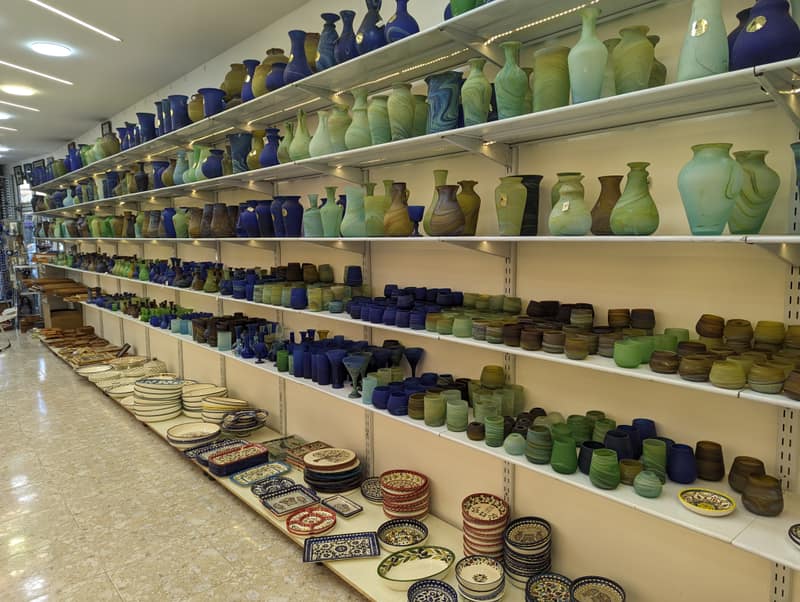
Glassmaking in Hebron — al-Khalil — is among the oldest continuous crafts of Palestine, with roots in the glassblowing tradition of the Roman and Phoenician eastern Mediterranean. By the medieval period Hebron’s furnaces were renowned across the region, and the city’s glassmakers absorbed techniques that traveled the trade routes between the Levantine coast and Venice, historic center of fine glass. Travelers’ accounts from Ottoman times describe Hebron’s glass quarter supplying beads, lamps, and vessels to markets from Egypt to the hajj caravans.
The craft remains deliberately simple. Recycled glass — bottles and broken vessels — is melted in clay furnaces fired for days, then gathered on iron blowpipes and shaped with little more than breath, gravity, and hand tools. The results are unmistakable: jugs, goblets, vases, and bowls in Hebron’s signature palette of cobalt blue, turquoise green, and honey amber, often streaked with the swirls of the mixed recycled glass. Each piece bears the slight irregularities of the hand that made it.
Today the tradition survives in a handful of family factories on the edge of the old city, above all those of the Al-Natsheh and Al-Qadi families, whose workshops still fire their furnaces and welcome visitors. The furnaces have endured closures, broken supply lines, and the constraints of occupation on movement and trade, yet Hebron glass remains one of Palestine’s most recognized material exports — a craft kept burning, like the glass itself, through continual reheating.
Sources
Connected in the archive
13 connected records13 records elsewhere in the archive are linked to this one, each by a piece of evidence you can read below.
named in this record — 1 record
One record names the other. A pointer for reading, not a claim that they belong to each other.
- Hebronالخليل
Evidence — Inferred from the text — read the evidence: Glassmaking in Hebron — al-Khalil — is among the oldest continuous crafts of Palestine, with roots in the glassblowing tradition of the Roman and Phoenician eastern Mediterranean.
names this record — 1 record
One record names the other. A pointer for reading, not a claim that they belong to each other.
- What a People Made
Evidence — From a recorded field in this archive: Blue, green and amber, blown by hand in family workshops beside the old city — one of the few Palestinian industries still working where it always did.
on a related subject — 11 records
Filed near each other — the same Mandate district, or the same uncommon subject tags.
- Palestinian Pottery
Evidence — From a recorded field in this archive: Shared tags: "hebron", "craft".
- Armenian Ceramics of Jerusalem
Evidence — Inferred from the text — read the evidence: Shared tag: "craft".
- Bethlehem Mother-of-Pearl
Evidence — Inferred from the text — read the evidence: Shared tag: "craft".
- Deqq
Evidence — Inferred from the text — read the evidence: Shared tag: "heritage".
- Nabulsi Soap
Evidence — Inferred from the text — read the evidence: Shared tag: "craft".
- Samiha Khalilسميحة خليل
Evidence — Inferred from the text — read the evidence: Shared tag: "heritage".
- and 5 more
Cite this page
Every claim above carries its sources — citation is the point.
- Chicago
“Hebron Glass.” Culture, FALASTEEN.AI. Accessed 22 August 2026. https://falasteen.ai/culture/hebron-glass.- MLA
“Hebron Glass.” Culture, FALASTEEN.AI, 2026, https://falasteen.ai/culture/hebron-glass. Accessed 22 August 2026.- BibTeX
@misc{falasteen-hebron-glass,
  title        = {Hebron Glass},
  howpublished = {\url{https://falasteen.ai/culture/hebron-glass}},
  organization = {FALASTEEN.AI — A Living Archive for Palestine},
  year         = {2026},
  note         = {Accessed 2026-08-22}
}