Palestinian Pottery
الفخار الفلسطيني
Red clay thrown on a hand wheel in Gaza and Hebron — cooking pots, water jars, and plant vessels made by families whose surname is simply 'the potter'.
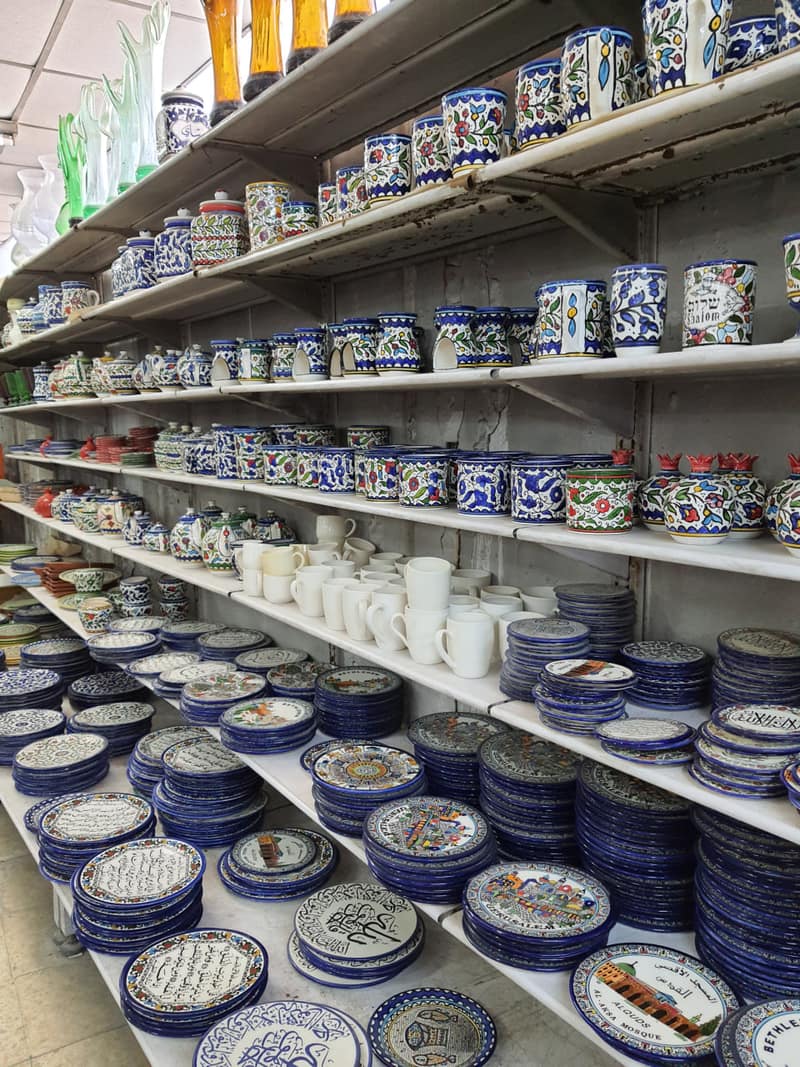
Gaza has the clay. Its terrain holds substantial deposits of terra rossa, the red, porous, iron-rich soil that takes and holds a shape, and the coastal strip has been producing pottery for a very long time: clay objects excavated at Tell el-Ajjul, just south of Gaza City, date to around 1500 BCE. The trade has left its name on the map — al-Fawakhir, the potters’ quarter of Gaza City, is still where Gazan clayware is sold, for cooking, for storage, for plants, and for the table.
The method has changed little. Raw clay is cleaned by passing water through it to carry off impurities, thrown on a manual wheel, left to dry for at least two days, then fired in kilns that reach around 800 degrees Celsius, and rested again before use. What comes out are working objects: vases, plant pots, jugs, plates, and the large jars used to keep water cool. In Gaza the Atallah family runs seven workshops; before 2000 they exported to the West Bank, Jordan, and the Gulf, and since then the export trade has slowed to a trickle under closure.
In Hebron the craft carries a family name outright. Fakhoury means potter, and the al-Fakhoury family of the old city has worked in ceramics across five generations, running the largest pottery business in the area still using traditional techniques from a shop open since 1964 — alongside the city’s better-known glassblowing. Between the two cities the same fact holds: these are not heritage revivals but continuous working trades, and what threatens them is not fashion but blockade, closure, and the loss of the markets they used to reach.
Sources
Connected in the archive
14 connected records14 records elsewhere in the archive are linked to this one, each by a piece of evidence you can read below.
named in this record — 2 records
One record names the other. A pointer for reading, not a claim that they belong to each other.
- Gaza Cityغزة
Evidence — Inferred from the text — read the evidence: Its terrain holds substantial deposits of terra rossa, the red, porous, iron-rich soil that takes and holds a shape, and the coastal strip has been producing pottery for a very long time: clay objects excavated at Tell el-Ajjul, just south of Gaza City, date to around 1500 BCE.
- Hebronالخليل
Evidence — Inferred from the text — read the evidence: In Hebron the craft carries a family name outright.
on a related subject — 12 records
Filed near each other — the same Mandate district, or the same uncommon subject tags.
- Hebron Glass
Evidence — From a recorded field in this archive: Shared tags: "hebron", "craft".
- 30 Seconds from Gaza: Diary of Genocide
Evidence — Inferred from the text — read the evidence: Shared tag: "gaza".
- A Long Walk from Gaza
Evidence — Inferred from the text — read the evidence: Shared tag: "gaza".
- Armenian Ceramics of Jerusalem
Evidence — Inferred from the text — read the evidence: Shared tag: "craft".
- Bethlehem Mother-of-Pearl
Evidence — Inferred from the text — read the evidence: Shared tag: "craft".
- Gaza in Crisis: Reflections on Israel's War Against the Palestinians
Evidence — Inferred from the text — read the evidence: Shared tag: "gaza".
- and 6 more
Cite this page
Every claim above carries its sources — citation is the point.
- Chicago
“Palestinian Pottery.” Culture, FALASTEEN.AI. Accessed 22 August 2026. https://falasteen.ai/culture/palestinian-pottery.- MLA
“Palestinian Pottery.” Culture, FALASTEEN.AI, 2026, https://falasteen.ai/culture/palestinian-pottery. Accessed 22 August 2026.- BibTeX
@misc{falasteen-palestinian-pottery,
  title        = {Palestinian Pottery},
  howpublished = {\url{https://falasteen.ai/culture/palestinian-pottery}},
  organization = {FALASTEEN.AI — A Living Archive for Palestine},
  year         = {2026},
  note         = {Accessed 2026-08-22}
}